Ethanol vs. Electricity: Biomass converted into electricity could be more efficient than ethanol (w/Video)
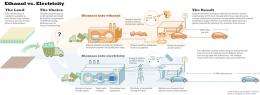
Ethanol vs. Electricity. Credit: McDade & Campbell/UC Merced
(PhysOrg.com) -- Concerns over petroleum gas prices and long-term effects of greenhouse gas emissions on the environment have prompted scientists to look for alternative renewable energy sources for transportation use. One of the questions at hand is determining what that preferred technology should be.
Scientists are examining biomass - plant matter that's grown and used to generate energy - as a potential power source. Two biomass technologies involve ethanol and electricity. Biomass converted into ethanol, a corn-based fuel, can power internal combustion vehicles. Biomass converted into electricity can fuel a vehicle powered by an electric battery.
A study by University of California, Merced, Assistant Professor Elliott Campbell and two other researchers in the May 8 issue of the journal Science suggests that biomass used to generate electricity could be the more efficient solution.
This video is not supported by your browser at this time.
Biofuels such as ethanol offer an alternative to petroleum for powering our cars, but growing energy crops to produce them can compete with food crops for farmland, and clearing forests to expand farmland will aggravate the climate change problem. How can we maximize our “miles per acre” from biomass?
In the study, Campbell, along with Christopher Field of the Carnegie Institution's Department of Global Ecology and David Lobell of Stanford University, the scientists found that biomass converted into electricity produced 81 percent more transportation miles and 108 percent more emissions offsets compared to ethanol.In other words, said Campbell, vehicles powered by biomass converted into electricity "got further down the road" compared to ethanol. As a result, Campbell continued, "we found that converting biomass to electricity rather than ethanol makes the most sense for two policy-relevant issues, transportation and climate."
The scientists based their study on two criteria: miles per area cropland and greenhouse gas offsets per area cropland. In both cases, scientists considered a range of feedstock crops (corn and switchgrass0 and vehicle types (small car, midsize car, small SUV and large SUV.
First, they looked at how many miles a range of vehicles powered by ethanol could travel versus a range of electric vehicles fueled by electricity. Second, they examined offsets to greenhouse gas emissions for ethanol and bioelectricity. Land use is an important factor to consider when evaluating each method. Globally, the amount of land available to grow biomass crops is limited. Using existing croplands for biofuels could cause increases in food prices and clearing new land, or deforestation, can have a negative impact on the environment.
The authors are careful to point out their study looked at two criteria, transportation and greenhouse gas offsets, but did not examine the performance of electricity and ethanol for other policy relevant criteria.
"We also need to compare these options for other issues such as water consumption, air pollution and economic costs," Campbell said.
Campbell joined UC Merced as an assistant professor in the School of Engineering in 2008. He earned bachelor's and master's degrees at Stanford University and his Ph.D. from the University of Iowa. Prior to joining UC Merced, Campbell received national attention for another study that concluded the United States Could meet up to 6 percent of its energy needs with biofuels produced on abandoned or degraded agricultural land.
More information: A copy of Campbell's abstract can be viewed online at http://sciencemag.org/
Source: University of California - Merced
-
Every black hole contains a new universe: A physicist presents a solution to present-day cosmic mysteries,
121 comments
-
Engineer thinks we could build a real starship enterprise in 20 years,
60 comments
-
Sugar makes you stupid: Study shows high-fructose diet sabotages learning, memory,
19 comments
-
Brain oscillations reveal that our senses do not experience the world continuously,
11 comments
-
New silicon memory chip developed,
11 comments
-
Can you help me decide what engineering field I should go into?
May 18, 2012
-
hovercraft question regarding propeller and motor
May 18, 2012
-
Light transmitting material with LEDs: Advice needed!
May 18, 2012
-
Multi plexing question
May 17, 2012
-
Force on gas strut
May 17, 2012
-
Water Pump Selection
May 14, 2012
- More from Physics Forums - General Engineering
More news stories
Google patent sends ring signals to Project Glass
(Phys.org) -- Google's September 2011 patent that was filed for a wearable display device was granted this week, which suggests that its envisioned heads-up display device can be controlled by infrared markers ...
App scans faces of bar-goers to guess age, gender
(AP) -- A watchful eye has arrived on San Francisco's bar scene, but not to keep you in check. It just wants to check you out.
19 minutes ago |
5 / 5 (1) |
0
Google gets China OK for Motorola deal
(AP) -- Authorities in China have approved Google Inc.'s bid to buy phone maker Motorola Mobility, clearing the way for the $12.5 billion deal to close early next week.
33 minutes ago |
not rated yet |
0
America expands once again -- digitally, this time
(AP) -- The metaphor is an easy one, overused and perhaps even a bit overwrought. We are forging forward into a digital frontier, leaving convention behind, traveling without guides into an uncharted virtual ...
19 minutes ago |
not rated yet |
0
Motorola Mobility smartphones face US import ban
A US commission sided with Microsoft by moving to ban the import of Android-powered Motorola smartphones based on patent infringement complaints by the software colossus.
13 hours ago |
3 / 5 (2) |
0
Malaysia scientist says found new Borneo frog
A Malaysian researcher known for finding new amphibian species said Friday his team had discovered at least one new species of frog in studies he said highlight Borneo's rich biodiversity.
Troubled freighter drifts toward Great Barrier Reef
A broken-down cargo ship was drifting towards the fringes of Australia's Great Barrier Reef Saturday, with fears of major damage if it were to run aground at the World Heritage-listed site.
ESC Heart Failure Guidelines feature new recommendations on devices, drugs and diagnosis
New recommendations on devices, drugs and diagnosis in heart failure were launched at the Heart Failure Congress 2012, 19-22 May, in Belgrade, Serbia, and published in the European Heart Journal. ...
Web-based video enhances patient compliance with cancer screening
Patients who watch an online instructional video are more likely to keep their appointments and arrive prepared for a scheduled colonoscopy than those who do not, according to a study by gastroenterologists at the University ...
Is it ripe? Carbon nanotube-based ethylene sensor establishes fruit ripeness
(Phys.org) -- The term ethylene (ethene) generally brings to mind polyethylene plastics, not fruit. However, ethylene is more than just a feedstock for chemical industry, it is also the smallest plant hormone, ...
SpaceX rocket launch aborted in last half-second (Update)
Engineers aborted the launch of a privately built spacecraft on a landmark mission to the International Space Station at the last second Saturday due to a rocket engine problem.
May 07, 2009
Rank: 1.8 / 5 (5)
1) what crop can we grow that will produce the largest mass of harvest with the least fertilizer, pesticide and water needed?
2) will the corn lobby and the politicians beholden to them work like crazy to supress any studies or movement in this direction?
(why yes, I am a pessimist, how did you know?)
May 07, 2009
Rank: 2.2 / 5 (5)
May 07, 2009
Rank: 4 / 5 (1)
1) don't make ethanol
2) use fossil based transportation fuels, not ethanol
3) burn non-edible plants to make electricity instead of using fossil fuels
4) replace vehicles with ones using electricity
Dozer: I think that answer to your 1) question will be algae. There has been news about algae energy use recently.
May 07, 2009
Rank: 4 / 5 (1)
May 08, 2009
Rank: not rated yet
Of course collection would likely use as much or more energy as could be collected, but meh. It's got to be collected anyways
May 08, 2009
Rank: 5 / 5 (1)
May 11, 2009
Rank: 1 / 5 (1)
May 12, 2009
Rank: 4 / 5 (1)
Means that, AT ANY GIVEN LOCATION, a 15% efficient solar-thermal plant can do the same job with 0.0165/15 = 0.0011 the area of the biomass plantation.
So which is better? 1 sq km of solar thermal which never needs re-planting and doesn't permanently damage anything, or 909.1 sq km of biomass plantation which depletes the soils, etc. etc. ? (HINT: the answer is solar thermal OR PV -> electrical)
Jun 07, 2009
Rank: not rated yet
While one can say that they would have to ignore the fact that after ethanol is made most of the biomass is still there in the leftover mash, corn stalks, cobs. So one can both have ethanol and burn wht's left for electricity.
Also left out is the mash is a better animal or even human feed than raw corn is.
Gasoline if taken by the same poor standard would be even less eff as one only gets about 1/4 of the output from the product.
And one can FT the biomass into gasoline, diesel which Shell, Syntroleum has already done but doesn't sell their GTL units so people could.
Taken together ethanol is no worse than other fuels and better than many.
A combo of NG, Ethanol, bio gasoline/diesel and EV's will be our future, especially EV's as they are 3x's as eff as any fueled car.
Which is why I built my EV. Sadly about the only way to get one. My 3wh service car style EV gets 600mph equivalent and my 2 seat EV sportswagon gets 250mpge.
The costs of oil are huge from pollution, CO2, subsidies, balance of payments, $500B/yr which go to our enemies like Iran, Russia, oil dictators and terrorist means ethanol and EV's, RE like wind, solar thermal, river/tidal power without dams, ect are very cheap comparatively.
WE need them all with eff, conservation and get rid of coal and imported oil. Oil hit $70 on 6-5-09 and going up with a bullet as the economy recovers will hit 150/bbl again by late next yr, 2010.
Jun 08, 2009
Rank: 1 / 5 (1)
New York to Miami in 2 hours - zoom zoom!