New LifePO4 battery made from non-toxic materials
May 05, 2009
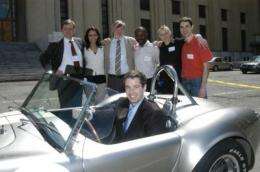
This is Dean MacNeil, a professor at the Université de Montréal’s Department of Chemistry and new NSERC-Phostech Lithium Industrial Research Chair in Energy Storage and Conversion, at wheel of battery-powered car with Süd-Chemie team. Credit: Université de Montréal

Thousands of small electric scooters, bicycles and wheelchairs throughout Europe and Asia are powered by LifePO4 -- a material used in advanced lithium-ion batteries developed by Université de Montréal researchers.

"It's a revolutionary battery because it is made from non-toxic materials abundant in the Earth's crust. Plus, it's not expensive,'" says Michel Gauthier, an invited professor at the Université de Montréal Department of Chemistry and co-founder of Phostech Lithium, the company that makes the battery material. "This battery could eventually make the electric car very profitable."

The theory will soon be tested, since the 100 percent electric Microcar that's set to debut in Europe this year will be and powered by the LifePO4 battery.

Phostech Lithium's production plant in St. Bruno, Quebec, produces the black LifePO4 powder, which is shipped across the world in tightly sealed barrels.

"The theoretical principle behind the battery was patented by a University of Texas professor in 1995. However, without the work of local chemists such as Nathalie Ravet, we couldn't have developed it," says Phostech Lithium engineer Denis Geoffroy.

Süd-Chemie, a leading specialty chemistry company based in Germany, first invested in Phostech Lithium in 2005. Now, just four years later, Süd-Chemie's total Canadian investments have reached $13 million and it stands as the 100% owner of Phostech Lithium. Phostech's St. Bruno plant began to produce LiFePO4 in 2006 with 20 employees and a 400 metric-ton capacity. Since then, Phostech has nearly doubled its staff.

"It is a battery that is much more stable and much safer," says Dean MacNeil, a professor at the Université de Montréal's Department of Chemistry and new NSERC-Phostech Lithium Industrial Research Chair in Energy Storage and Conversion. "In addition, it recharges much faster than previous batteries."

The NSERC Research Chair, funded in part by Phostech Lithium, will help investigate ways to improve the LifePO4 .

For Gauthier, Phostech Lithium is the product of academia and the business world coming together. "Even if we knew that lithium, iron and phosphate were theoretically promising materials, we had to make them efficient. We had to find the right voltage and maintain the right charging and discharging properties. This is where the university played a major role."

Source: University of Montreal (news : web)

Explore further: Solar and lithium ion car race winners announced

add to favorites email to friend print save as pdf

Related Stories

New battery technology powers for 12 years

Oct 04, 2005

University of Wisconsin-Madison scientists say they are developing super-charged tiny lithium batteries to help treat nervous system and other disorders.

Toward improving the safety of Lithium-ion batteries

Dec 17, 2007

After recalls and fires involving Lithium-ion batteries, battery manufacturers and scientists have launched an intensive effort to improve the safety of these rechargeable power packs found in dozens of consumer electronics ...

Recommended for you

Green conversion of heat to electricity

17 hours ago

Soon, it will be possible to produce electricity from heat over 30 degrees emitted from a waste incinerator, refinery, or data processor. The start-up Osmoblue has just confirmed the feasibility of this new ...

Space drives e-mobility

18 hours ago

An ESA business incubation start-up company is helping major car manufacturers to develop electric vehicle concepts and improve safety systems by turning ideas quickly into virtual prototypes.

User comments : 2

Adjust slider to filter visible comments by rank

Display comments: newest first

petrosdias
5 / 5 (3) May 05, 2009
How about some information about WHY it is safer, why it recharges quicker, and in general, why it's better.
jerryd
not rated yet Jun 07, 2009

Not sure why it's better but a MC just did 7.9sec 1/4 mile at 168mph with them and they fast charge between races. It combined with magnesium electrodes means inexpensive 300 mile range EV's in the near future, Yea!!

More news stories

Green conversion of heat to electricity

Soon, it will be possible to produce electricity from heat over 30 degrees emitted from a waste incinerator, refinery, or data processor. The start-up Osmoblue has just confirmed the feasibility of this new ...

Game system castAR debuts at Maker Faire

(Phys.org) —Two tech talents, formerly employees at video game publisher Valve, have been working on their own vision in the form of game-ready glasses. Their company, Technical Illusions, will seek to ...

Amazon plans greenhouse-style headquarters

US online giant Amazon has unveiled plans for a futuristic greenhouse style headquarters "where employees can work and socialize in a more natural, park-like setting."

If you can remember it, you can remember it wrong

(Medical Xpress)—Native peoples in regions where cameras are uncommon sometimes react with caution when their picture is taken. The fear that something must have been stolen from them to create the photo ...

Encouraging signs for bee biodiversity

Declines in the biodiversity of pollinating insects and wild plants have slowed in recent years, according to a new study. Researchers led by the University of Leeds and the Naturalis Biodiversity Centre in the Netherlands ...

B vitamins could delay dementia

(Medical Xpress)—Despite spending billions of dollars on research and development, drug companies have been unable to come up with effective treatments for dementia and Alzheimer's Disease (AD). Now, A. ...