Strange behavior: New study exposes living cells to synthetic protein
(Phys.org)—One approach to understanding components in living organisms is to attempt to create them artificially, using principles of chemistry, engineering and genetics. A suite of powerful techniques – collectively referred to as synthetic biology – have been used to produce self-replicating molecules, artificial pathways in living systems and organisms bearing synthetic genomes.
In a new twist, John Chaput, a researcher at Arizona State University's Biodesign Institute and colleagues at the Department of Pharmacology, Midwestern University, in Glendale, Ariz., have fabricated an artificial protein in the laboratory and examined the surprising ways living cells respond to it.
"If you take a protein that was created in a test tube and put it inside a cell, does it still function," Chaput asks. "Does the cell recognize it? Does the cell just chew it up and spit it out?" This unexplored area represents a new domain for synthetic biology and may ultimately lead to the development of novel therapeutic agents.
The research results, reported in the advanced online edition of the journal ACS Chemical Biology, describe a peculiar set of adaptations exhibited by Escherichia coli bacterial cells exposed to a synthetic protein, dubbed DX. Inside the cell, DX proteins bind with molecules of ATP, the energy source required by all biological entities.
"ATP is the energy currency of life," Chaput says. The phosphodiester bonds of ATP contain the energy necessary to drive reactions in living systems, giving up their stored energy when these bonds are chemically cleaved. The depletion of available intracellular ATP by DX binding disrupts normal metabolic activity in the cells, preventing them from dividing, (though they continue to grow).
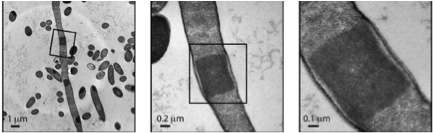
After exposure to DX, the normally spherical E. coli bacteria develop into elongated filaments. Within the filamentous bacteria, dense intracellular lipid structures act to partition the cell at regular intervals along its length (see figure 1). These unusual structures, which the authors call endoliposomes, are an unprecedented phenomenon in such cells.
"Somewhere along the line of this filamentation, other processes begin to happen that we haven't fully understood at the genetic level, but we can see the results phenotypically," Chaput says. "These dense lipid structures are forming at very regular regions along the filamented cell and it looks like it could be a defense mechanism, allowing the cell to compartmentalize itself." This peculiar adaptation has never been observed in bacterial cells and appears unique for a single-celled organism.
Producing a synthetic protein like DX, which can mimic the elaborate folding characteristics of naturally occurring proteins and bind with a key metabolite like ATP is no easy task. As Chaput explains, a clever strategy known as mRNA display was used to produce, fine-tune and amplify synthetic proteins capable of binding ATP with high affinity and specificity, much as a naturally occurring ATP-binding protein would.
First, large libraries of random sequence peptides are formed from the four nucleic acids making up DNA, with each strand measuring around 80 nucleotides in length. These sequences are then transcribed into RNA with the help of an enzyme – RNA polymerase. If a natural ribosome is then introduced, it attaches to the strand and reads the random sequence RNA as though it was a naturally-occurring RNA, generating a synthetic protein as it migrates along the strand. In this way, synthetic proteins based on random RNA sequences can be generated.
Exposing the batch of synthetic proteins to the target molecule and extracting those that bind can then select for ATP-binding proteins. But as Chaput explains, there's a problem: "The big question is how do you recover that genetic information? You can't reverse transcribe a protein back into DNA. You can't PCR amplify a protein. So we have to do all these molecular biology tricks."
The main trick involves an earlier step in the process. A molecular linker is chemically attached to the RNA templates, such that each RNA strand forms a bond with its newly translated protein. The mRNA-protein hybrids are exposed to selection targets (like ATP) over consecutive rounds of increasing stringency. After each round of selection, those library members that remain bound to the target are reverse-transcribed into cDNA (using their conveniently attached RNA messages), and then PCR amplified.
In the current study, E. coli cells exposed to DX transitioned into a filamentous form, which can occur naturally when such cells are subject to conditions of stress. The cells display low metabolic activity and limited cell division, presumably owing to their ATP-starved condition.
The study also examined the ability of E. coli to recover following DX exposure. The cells were found to enter a quiescent state known as viable but non-culturable (VBNC), meaning that they survived ATP sequestration and returned to their non-filamentous state after 48 hours, but lost their reproductive capacity. Further, this condition was difficult to reverse and seems to involve a fundamental reprogramming of the cell.
In an additional response to DX, the filamentous cells form previously undocumented structures, which the authors refer to as endoliposomes. These dense lipid concentrations, spanning the full width of the filamented E. coli, segment the cells into distinct compartments, giving the cells a stringbean-like appearance under the microscope.
The authors speculate that this adaptation may be an effort to maintain homeostasis in regions of the filamentous cell, which have essentially been walled off from the intrusion of ATP-depleting DX. They liken endoliposomes to the series of water-tight compartments found in submarines which are used to isolate damaged sections of the ship and speculate that DX-exposed cells are partitioning their genetic information into regions where it can be safely quarantined. Such self-compartmentalization is known to occur in some eukaryotic cells, but has not been previously observed in prokaryotes like E. coli.
The research indicates that there is still a great deal to learn about bacterial behavior and the repertoire of responses available when such cells encounter novel situations, such as an unfamiliar, synthetic protein. The study also notes that many infectious agents rely on a dormant state, (similar to the VBNC condition observed in the DX-exposed E. coli), to elude detection by antibiotics. A better understanding of the mechanisms driving this behavior could provide a new approach to targeting such pathogens.
The relative safety of E. coli as a model organism for study may provide a fruitful tool for more in-depth investigation of VBNC states in pathogenic organisms. Further, given ATP's central importance for living organisms, its suppression may provide another avenue for combating disease. One example would be an engineered bacteriophage capable of delivering DX genes to pathogenic organisms.
Journal information: ACS Chemical Biology
Provided by Arizona State University


