Quake risk at Japan atomic recycling plant: experts
Dec 19, 2012 by Kyoko Hasegawa
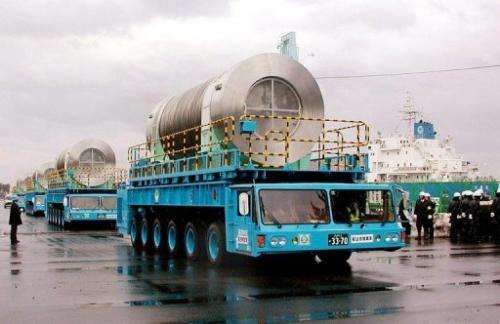
Canisters containing spent nuclear fuel are carried on trailers to the nuclear reprocessing plant at Rokkasho village in Aomori prefecture, 600km north of Tokyo, on December 19, 2000. Japan's only reprocessing plant for spent nuclear fuel could sit on an active seismic fault vulnerable to a massive earthquake, experts warned Wednesday.

Japan's only reprocessing plant for spent nuclear fuel could sit on an active seismic fault vulnerable to a massive earthquake, experts warned Wednesday.

If regulators agree they will have to order its closure and Japan would be without any recycling capacity of its own, a told AFP on condition of .

This would leave it dependent on other countries and with no way to deal with waste from the Fukushima plant crippled by last year's earthquake and tsunami.

Yasutaka Ikeda, assistant professor of at Tokyo University, said a nearly 100-kilometre (60-mile) fault runs under the Rokkasho reprocessing plant in northern Japan.

"Even though experts' opinions are divided on whether this fault is active or not, I think the possibility of it being an active fault is extremely high, given the evidence," Ikeda told AFP.

"This fault could cause an 8-magnitude earthquake, so any nuclear-related facilities in the region are in danger," he said, referring to the Shimokita Peninsula where the Rokkasho plant is located.

Mitsuhisa Watanabe, professor of geomorphology at Tokyo University, separately told Wednesday's Tokyo Shimbun that part of an active fault runs directly under the Rokkasho plant, warning it is likely to move when the bigger fault moves.
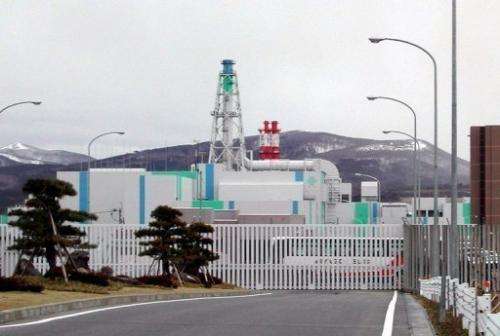
Japan's only plant to extract plutonium and uranium from spent nuclear fuel at Rokkasho village in Aomori prefecture, northern Japan, pictured on March 31, 2006. Japan's only reprocessing plant for spent nuclear fuel could sit on an active seismic fault vulnerable to a massive earthquake, experts warned Wednesday.

Active faults are those that, amongst other things, have moved within the past 120,000-130,000 years. Under government guidelines atomic installations cannot be sited on a fault if it is still classed as active.

The comment came days after government-appointed experts found that a in the same region may sit atop an active seismic fault.

A panel appointed by the Nuclear Authority (NRA) said Friday fractures in the earth beneath the Higashidori plant's compound on the peninsula may be active faults, meaning it would likely have to be scrapped.

An unfinished storage facility is also on the peninsula, in addition to the recycling plant and the Higashidori power plant. It is also home to another part-built atomic power plant

A NRA official told AFP Wednesday the nuclear watchdog "may have to consider whether to conduct additional research at Rokkasho, but for the time being we will watch that being carried out by the plant operator."

Operator Japan Nuclear Fuel said last month it would conduct more research on the fault, but a spokesman said the purpose is to back up its claim that the seismic fault is not active.

Resource-poor Japan has poured billions of dollars into a nuclear fuel recycling programme, in which uranium and plutonium are extracted from spent fuel for reuse in nuclear power plants.

All but two of Japan's nuclear reactors remain offline after being shuttered for regular safety checks after the meltdowns at Fukushima. They must get the go-ahead from the newly-formed NRA before they can be restarted.

The only working reactors are at Oi in the west, but experts including Watanabe are investigating whether the that runs underneath it is active.

Hundreds of thousands were made homeless by the Fukushima accident, and tracts of prime land were left unfarmable after radiation spread across a large area.

Anti-nuclear sentiment has run high in Japan, which used to rely on atomic power for around a third of its electricity needs. However, it did not translate into votes for anti-nuclear parties in the weekend election.

Explore further: Second Japan nuclear plant at fault risk

add to favorites email to friend print save as pdf

Related Stories

Second Japan nuclear plant at fault risk

Dec 14, 2012

A second nuclear plant in Japan sits atop a possibly active seismic fault, government-appointed experts said Friday, days after the first facility was said to be at risk.

Fault under Japan nuclear plant 'may be active'

Nov 11, 2012

Japan's only working nuclear power plant sits on what may be a seismic fault in the earth's crust, a geologist has warned, saying it is "very silly" to allow it to continue operating.

Japan says plant clean-up will take decades

Jul 09, 2011

Japan's prime minister said on Saturday the decommissioning of the crippled Fukushima nuclear plant would take decades, in the first government announcement of a long-term timeframe for the clean-up.

Japan vows to continue nuclear plant exports

Aug 05, 2011

Japan said Friday it will continue exporting atomic power plants, despite uncertainty over its own use of them as it continues to grapple with a crisis at the tsunami-hit Fukushima nuclear plant.

Japan reactor back to full power after shutdown

Jul 09, 2012

A nuclear reactor in western Japan began full operations on Monday, the first restart since the country shut down its atomic stations in the wake of last year's crisis at the Fukushima Daiichi plant.

Recommended for you

Energy-positive with natural ventilation

May 17, 2013

Buildings can be air-conditioned using entirely natural means, without mechanical ventilation systems. This is the claim made by 78-year-old Benjamin Bronsema, who will be awarded his PhD for his thesis on the subject at ...

CTRL+P: Printing Australia's largest solar cells

May 16, 2013

(Phys.org) —The printer has allowed researchers from the Victorian Organic Solar Cell Consortium (VICOSC) – a collaboration between CSIRO, The University of Melbourne, Monash University and industry partners ...

A storage power plant on the seabed

May 16, 2013

Norwegian research scientists will contribute to realising the concept of storing electricity at the bottom of the sea. The energy will be stored with the help of high water pressure.

User comments : 0

More news stories

Yahoo Japan suspects 22 million IDs stolen

Yahoo Japan Corp. has said it suspects up to 22 million user IDs may have been stolen during an unauthorised attempt to access the administrative system of its Yahoo! Japan portal.

US seizes Bitcoin operator accounts

US authorities seized the accounts of a Bitcoin digital currency exchange operator, claiming it was functioning as an "unlicensed money service business," court documents showed Friday.

Facebook, Twitter announce apps for Google's Glass

Google says it's still figuring out the best ways to use Glass, but the company announced Thursday that Facebook, Twitter and several other media firms have built their own applications for the futuristic-looking wearable ...

New colonoscope provides ground-breaking view of colon

A ground-breaking advance in colonoscopy technology signals the future of colorectal care, according to research presented today at Digestive Disease Week(DDW). Additional research focuses on optimizing the minimal withdrawal ...

Alaska volcano shoots ash 15,000 feet into the air

(AP)—One of Alaska's most restless volcanoes has shot an ash cloud 15,000 feet into the air in an ongoing eruption that has drawn attention from a nearby community but isn't expected to threaten air traffic.

Chinese, Indian airlines face EU pollution fines

Eight Chinese and two Indian airlines face fines of up to several million euros for not paying for their greenhouse gas emissions during flights within the bloc, the European Commission said on Friday.