The race is on in 2nd Atacama solar challenge
Nov 15, 2012
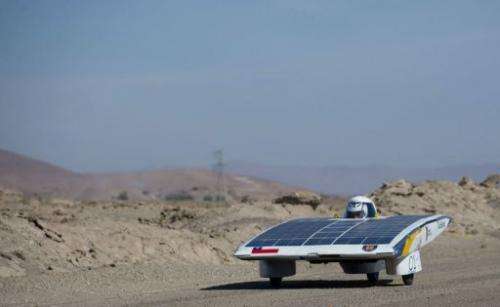
The driver of the Chilean team Das-Udec competes in the first stage of the Atacama Solar Challenge. Fifteen solar cars from Chile, Argentina, Venezuela and India set off Thursday on the 1,300-kilometer race through the uber-dry Atacama Desert.

Fifteen solar cars from Chile, Argentina, Venezuela and India set off Thursday on a 1,300-kilometer (800-mile) race through the uber-dry Atacama Desert in the second Atacama Solar Challenge.

The start line for the November 15-19 , first launched last year to encourage the development of low-cost environmentally-friendly vehicles, was in the Humberstone saltpeter, about 800 kilometers (500 miles) north of Chile's capital, Santiago.

The saltpeter, declared a , is a —with all its high-end facilities, including a pool, a hospital, a theater, a hotel and a tennis court, lying abandoned since salt mining was halted there more than a decade ago.

The fifteen competing vehicles—some powered exclusively by the sun's rays and some solar- and pedal-powered hybrids—were to race across 330 kilometers (205 miles) in the first leg.
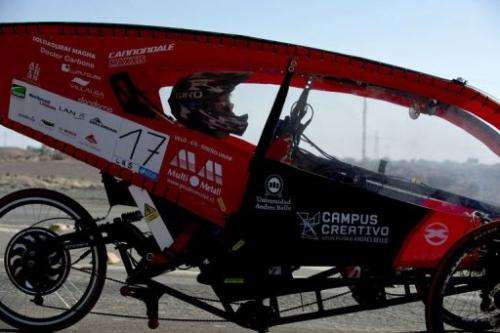
The driver of the Chilean team Unab competes in the first stage of the Atacama Solar Challenge. Fifteen solar cars from Chile, Argentina, Venezuela and India set off Thursday on the 1,300-kilometer race through the uber-dry Atacama Desert.

This year's favorite was the entry from the returning champion University of La Serena team, with its newly remodeled Intikallpa, named using the Quechua word for "solar energy."

"This year, we came with better engineering design, which makes the car more competitive," team member Leonardo Saguas told AFP, boasting his car can reach maximum speeds of 120 kilometers per hour.

His team was busily cleaning its car's solar panels, while their main rivals, from the University of Chile worked to protect their car's plates, to keep them cool and maximize performance.

Also participating were racers developed by universities in Argentina, Venezuela and India.
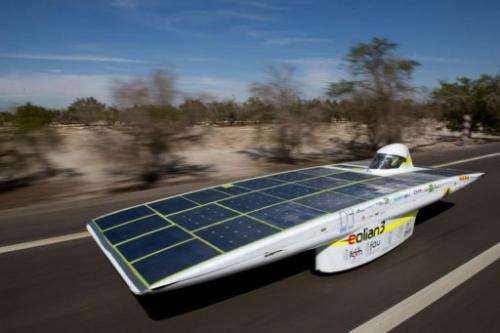
The Chilean team Eolian 3 competes during the first stage of the Atacama Solar Challenge. Fifteen solar cars from Chile, Argentina, Venezuela and India set off Thursday on the 1,300-kilometer race through the uber-dry Atacama Desert.

Most of the solar-powered vehicles consist of a flat rectangular vessel lined with to absorb solar energy, which is stored in batteries, and with a cubicle to house the driver.

"On this day, the strategy is not to make a mistake. We have a climb to get to Calama," the end of the first leg, said Saguas, "but on Friday the climb is even harder."

The vehicles will share the road with regular cars, trucks and buses as they speed to the finish line.

Last year's race, held in October 2011, saw 30 teams from seven countries in Latin America participating. The teams traveled on a 1,060-kilometer course during three days of competition.

Explore further: Green cars ready to race in 2nd Atacama solar challenge

add to favorites email to friend print save as pdf

Related Stories

Japanese solar car leads race Down Under

Oct 26, 2009

Japan's Tokai Challenger was on Monday leading a solar car race across the harsh Australian Outback, having covered about half of the 3,000 kilometre (1,860 mile) desert course, officials said.

Recommended for you

Solar plane aims for new world distance record

14 minutes ago

Solar Impulse, the first aircraft that can fly day and night fueled entirely by energy from the sun, embarked Wednesday on the second leg of its historic journey across the American continent.

EU leaders look to energy for growth boost

6 hours ago

EU leaders, desperate to give growth a boost, target energy policy Wednesday amid concerns a US-led revolution in shale oil and gas development will reshape the global economy and leave Europe far behind.

Tests lead to doubling of fuel cell life

7 hours ago

(Phys.org) —Researchers working to improve durability in fuel cell powered buses, including a team from Simon Fraser University, have discovered links between electrode degradation processes and bus membrane ...

Ground-breaking study benchmarks biofuel pricing

7 hours ago

(Phys.org) —Ground-breaking Australian research on the viability of aviation biofuels has today been released, at the culmination of almost three years of work by The University of Queensland, James Cook ...

User comments : 0

More news stories

Solar plane aims for new world distance record

Solar Impulse, the first aircraft that can fly day and night fueled entirely by energy from the sun, embarked Wednesday on the second leg of its historic journey across the American continent.

Facebook joins Web freedom group

Facebook on Wednesday became a full member of the Global Network Initiative, a non-governmental organization promoting Internet freedom and privacy rights.