Snow helps solar cells sometimes, research shows
Oct 28, 2012
solar cell

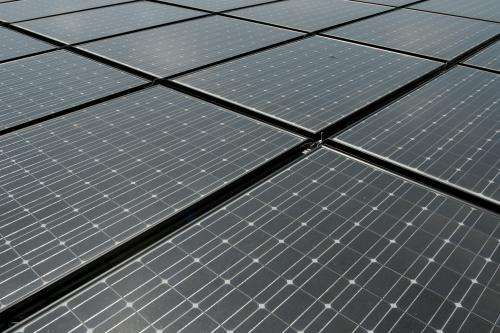
Snow and solar cells aren't mutually exclusive, according to a Michigan Technological University scientist. Photovoltaic panels can be well worth the investment even if you live in a winter wonderland.

True, a layer of can cause a solar-cell blackout for awhile. But not many locales enjoy heavy snow for more than a few months. And even in the bleak midwinter, panels don't usually stay snow-covered for long.

"Sometimes snow actually helps ," says Michigan Tech's Joshua Pearce. He's referring to the albedo effect, when sunlight reflects off snow. It can make a panel generate more electricity in the same way that it gives skiers sunburn on sunny winter days.

With researchers from St. Lawrence College and Queen's University, in Kingston, Ontario, and a team of 20 industry partners, Pearce studied the effect of snow on the Open Solar Outdoors Test Field. They created a computer model to predict how much power generation would decline in various amounts of snow cover and on different types of solar modules mounted at different angles, from flat to steeply pitched. Then they validated their model with data from many of Ontario's huge commercial solar farms.

"In most cases power losses are minimal, even in snowy Canada," Pearce said. However, the group has developed a model that can be used to design the most efficient , no matter how much snow is in the area.

Pearce and R. W. Andrews have authored paper based on a preliminary study, "Prediction of Energy Effects on Photovoltaic Systems Due to Snowfall Events," published in proceedings of the 2012 38th IEEE Photovoltaic Specialists Conference.

Explore further: More heat, more light: A step toward better solar energy systems

More information: full paper

Related Stories

End of Winter: How 2012 snow stacks up

Mar 14, 2012

The mild winter of 2012 has many people asking, "Where's the snow?" These two snow cover maps show the difference between snow extent on March 3, 2011, and March 5, 2012. The maps were compiled from data collected ...

Skiers look at their back yard, not slopes

Dec 11, 2007

A study suggested that U.S. skiers are less likely to head to the slopes if their backyards are snow-free, despite how much snow is reported at ski areas.

Skiers welcome snow to Swiss slopes

Dec 07, 2011

Swiss ski enthusiasts are breathing a sigh of relief after heavy snow finally hit the slopes, kicking off the winter season in earnest.

Recommended for you

Solar plane sets distance record on US tour

5 hours ago

The first manned aircraft that can fly day and night powered only by solar energy set a new distance record Thursday when it landed after the second leg of a cross-country US tour.

Solar plane aims for new world distance record

19 hours ago

Solar Impulse, the first aircraft that can fly day and night fueled entirely by energy from the sun, embarked Wednesday on the second leg of its historic journey across the American continent.

EU leaders look to energy for growth boost

May 22, 2013

EU leaders, desperate to give growth a boost, target energy policy Wednesday amid concerns a US-led revolution in shale oil and gas development will reshape the global economy and leave Europe far behind.

User comments : 1

Adjust slider to filter visible comments by rank

Display comments: newest first

antialias_physorg
not rated yet Oct 29, 2012
With thin film solar becoming dirt cheap we should think about covering arable land in winter with it.

Extra income for the farmers, protection ofthe soil from wind erosion and additional energy during the part of the year where it's needed most. It's win-win-win.

More news stories

Solar plane sets distance record on US tour

The first manned aircraft that can fly day and night powered only by solar energy set a new distance record Thursday when it landed after the second leg of a cross-country US tour.

Engineers pioneer flat spray-on optical lens

A University of British Columbia engineer and a team of U.S. researchers have made a breakthrough utilizing spray-on technology that could revolutionize the way optical lenses are made and used.

Researchers suggest boosting body's natural flu killers

A known difficulty in fighting influenza (flu) is the ability of the flu viruses to mutate and thus evade various medications that were previously found to be effective. Researchers at the Hebrew University of Jerusalem have ...

Russia evacuates drifting Arctic research station

Russia has ordered the urgent evacuation of the 16-strong crew of a drifting Arctic research station after ice floe that hosts the floating laboratory began to disintegrate, officials said Thursday.