Algae-fueled bioreactor shows promise as synthetic natural gas producer
Sep 13, 2012 by Emmanuel Barraud
Algae-fueled bioreactor shows promise as synthetic natural gas producer
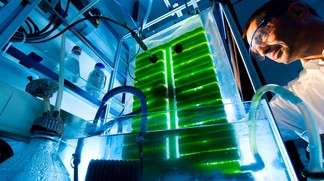
This demonstration photobioreactor is being shown in Bern. Credit: Thomas Ernsting

(Phys.org)—Technology developed at EPFL and the Paul Scherrer Institute to transform microorganisms into methane gas will be presented at the Swiss Energy and Climate Summit taking place this week in Bern. The technology could play a role in the future sustainable production of biosynthetic natural gas.

A greenish light emanates from a curious structure that has been installed in a pavilion on the Federal Square in Bern. As part of the Swiss Energy and taking place this week, the demonstration illustrates a particularly promising technology for synthetic natural gas production developed by Christian Ludwig and his team from the Paul Scherrer Institue and EPFL.

These new "powerplants" have many advantages. "Growing algae consumes CO2 from the atmosphere," Ludwig explains in his presentation, which is scheduled for this Friday in Bern. "As it transforms, it re-emits the CO2 but in a concentrated form that we might be able to sequester and store, for example, underground. This system also produces renewable biogas, thus avoiding the problem of competition with ."

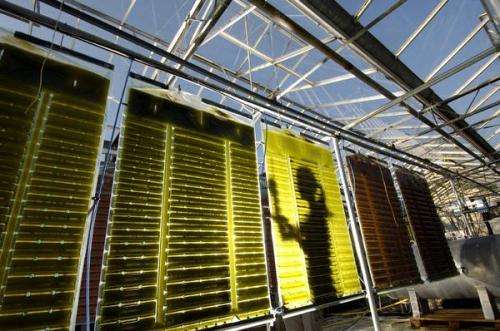
Algae have one notable advantage over other sources of biomass: they "grow" much more rapidly. In favorable conditions, they can generate 30-55 tons of dry matter per hectare per year – five to ten times more than sources such as corn, soy, or sugar cane. "And above all, they can be cultivated without soil, simply in bioreactors exposed to sunlight, thus avoiding the use of fertile that are needed for food production," Ludwig adds.
© Steger

In closed circuit

The process presented this week, which goes by the name SunCHem, transforms the algal biomass into methane via catalytic hydrothermal gasification. "This device doesn't require any solvents and can use non-potable water," adds Mariluz Bagnoud, a scientist from EFPL's Environmental Engineering Institute. "In addition, the nutritive elements the algae need, such as phosphorus, are recycled in the process and re-injected into the culture medium. It is an important breakthrough because these resources are limited, too."

Although the environmental impact is thus minimal, the yield is enormous: 60-70% of the potential energy of the biomass produced in these "photo-bioreactors" can be recuperated in the form of natural gas, with all the advantages that this represents in terms of transport and use – it can simply be injected into an existing gas distribution network. "We have examined the entire length of the chain, from the choice of algae type and how it's cultured to its transformation into natural gas, in order to identify the best solutions at every stage," explains Ludwig. "We're currently working on the regeneration of our ruthenium-based catalyzer."

Biosynthetic natural gas will play an important role in the energy supply in coming decades. Switzerland will depend on its power plants as it enters a transitional phase of abandoning nuclear power. "A sustainable and decentralized production of biogas that doesn't require the use of land necessary for food production has many advantages that we should now be exploiting," concludes Ludwig.

Explore further: Study IDs two compressed air energy storage methods, sites for the Northwest

Related Stories

Low-cost process produces natural gas from algae

May 06, 2009

(PhysOrg.com) -- A new method for converting algae into renewable natural gas for use in pipelines and power generation has been transferred from the Department of Energy's Pacific Northwest National Laboratory to the marketplace ...

'Green' energy from algae

Aug 06, 2009

In view of the shortage of petrochemical resources and climate change, development of CO2-neutral sustainable fuels is one of the most urgent challenges of our times. Energy plants like rape or oil palm a ...

Fuel from market waste

Feb 09, 2012

Mushy tomatoes, brown bananas and overripe cherries -- to date, waste from wholesale markets has ended up on the compost heap at best. In future it will be put to better use: Researchers have developed a new ...

Turning waste into inexpensive, green fuel

Sep 14, 2011

Researchers at the University of California, Riverside's Center for Environmental Research and Technology (CERT) at the Bourns College of Engineering have received two grants to further explore a process they developed that ...

Crude oil no longer needed for plastics

Mar 30, 2010

Each year the world produces about 130 million kilo of ethene, the most important raw material for plastics. This gigantic industry is currently dependent on crude oil. And that is running out. Dutch researcher Tymen Tiemersma ...

Recommended for you

Philippines approves three new wind farms

6 hours ago

The Philippines has approved three wind farm projects that will generate 208 megawatts, enough to power more than 40,000 middle-class homes, an energy official said on Monday.

Goldman Sachs to invest in Japan green energy

6 hours ago

US investment banking giant Goldman Sachs said Monday it will start investing in Japanese renewable energy projects, with a reported $2.9 billion outlay over the next five years.

Bacteria use hydrogen, carbon dioxide to produce electricity

15 hours ago

Researchers have engineered a strain of electricity-producing bacteria that can grow using hydrogen gas as its sole electron donor and carbon dioxide as its sole source of carbon. Researchers at the University of Massachusetts, ...

German energy shift faces headwinds

May 19, 2013

Tense engineers have their eyes peeled on complex colour-coded diagrams on a wall-sized screen that makes their control room look like the inside of a spaceship.

User comments : 0

More news stories

SARS-like virus claims new life in Saudi

A Saudi man who had contracted the coronavirus has died, raising the death toll in the kingdom from the SARS-like virus to 16, the health ministry announced on Monday on its Internet website.

Study suggests new source of kidneys for transplant

Nearly 20 percent of kidneys that are recovered from deceased donors in the U.S. are refused for transplant due to factors ranging from scarring in small blood vessels of the kidney's filtering units to the organ going too ...

Study shows how bilinguals switch between languages

(Medical Xpress)—Individuals who learn two languages at an early age seem to switch back and forth between separate "sound systems" for each language, according to new research conducted at the University of Arizona.