Sterling science: Strain in silver nanoparticles creates unusual 'twinning'
Aug 30, 2012 by Jared Sagoff
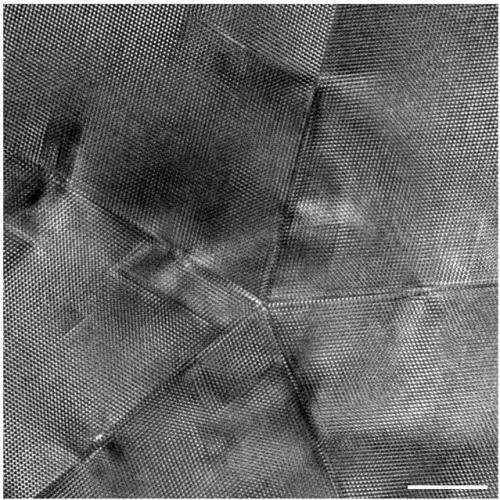
A high-resolution transmission electron microscopy image of the core of a single silver nanowire. The scale bar represents 5 nm in length. The image was taken on the Argonne Chromatic Aberration-corrected TEM (ACAT) machine. Image: Argonne National Laboratory

(Phys.org)—When twins are forced to share, it can put a significant strain on their relationship. While this observation is perhaps unsurprising in the behavior of children, it is less obvious when it comes to nanoparticles.

After spending close to a decade examining the structure of made of pure silver, scientists at the U.S. Department of Energy's (DOE) Argonne National Laboratory have discovered a set of unusual behaviors in with a strained, five-fold symmetry formed by "twinning" in the . The twinned crystals' unusual pentagonal symmetry and complicated structures distinguish them from the cubic crystalline lattices typical of many silver .

The "twinned" structures occur when adjacent domains within the nanoparticle arrange themselves by sharing the same planes, said Argonne nanoscientist Yugang Sun. Since the five-fold twinned structures do not perfectly fill the volume that the atoms would normally occupy in silver, there is a lot of strain in the or . Typically, nanoparticles made from have formed highly symmetric lattices in a configuration called "face-centered cubic"; but the strains in five-fold twinned nanowires distort the lattices into a body-centered tetragonal symmetry.

The difference between the atom arrangements in nanoparticles could determine both the strength of the material as well as its efficiency as a catalyst, Sun said. "This is a fundamental study that looks in depth into the nature of metals at the most basic level," he said. "However, it's essential that scientists understand such properties in order to exploit any advantages that these very small structures might provide us down the road."

Sun and his colleagues also discovered that the lattice stresses are absorbed unequally by different regions of the nanowires. The center, he said, exhibits signs of high strain, while the outer layer is not strained as much. This behavior suggests each nanowire is actually composed of two distinct regions – something that is very important to determine the stability of the highly strained nanowires.

The unusual structure of the silver nanowires also allows materials scientists to establish how strain distributes itself along one extended dimension. "This can answer a lot of questions that remain in materials science, particularly for this kind of common structure," Sun said. 

The paper was published online in the July 24 issue of Nature Communications.

Explore further: Researchers create highly conductive and elastic conductors using silver nanowires

More information: doi:10.1038/ncomms1963

Related Stories

Disappearing gold a boon for nanolattices

Jan 30, 2012

(PhysOrg.com) -- When gold vanishes from a very important location, it usually means trouble. At the nanoscale, however, it could provide more knowledge about certain types of materials. A recent discovery ...

DNA can act like Velcro for nanoparticles

Nov 18, 2010

DNA can do more than direct how bodies our made -- it can also direct the composition of many kinds of materials, according to a new study from the U.S. Department of Energy’s Argonne National Laboratory.

Building crystalline materials from nanoparticles and DNA

Oct 13, 2011

Nature is a master builder. Using a bottom-up approach, nature takes tiny atoms and, through chemical bonding, makes crystalline materials, like diamonds, silicon and even table salt. In all of them, the properties of the ...

Major advance in understanding how nanowires form

Mar 25, 2011

New insights into why and how nanowires take the form they do will have profound implications for the development of future electronic components. PhD student Peter Krogstrup from the Nano-Science Center at ...

Recommended for you

Stacking 2-D materials produces surprising results

May 16, 2013

(Phys.org) —Graphene has dazzled scientists, ever since its discovery more than a decade ago, with its unequalled electronic properties, its strength and its light weight. But one long-sought goal has proved ...

User comments : 1

Adjust slider to filter visible comments by rank

Display comments: newest first

retrosurf
not rated yet Aug 30, 2012
Lovely.
So in this instance, Linus Pauling was correct. The fivefold
symmetry was indeed due to twinning.

More news stories

How nanotechnology could keep your heart healthy

Since the heart is such a delicate and critical organ, clinicians usually opt not to intervene with the dead cells that remain after a heart attack or cardiac disease. "But we think that all heart attacks deserve some kind ...

Graphene joins the race to redefine the ampere

A new joint innovation by the National Physical Laboratory (NPL) and the University of Cambridge could pave the way for redefining the ampere in terms of fundamental constants of physics. The world's first ...

US seizes Bitcoin operator accounts

US authorities seized the accounts of a Bitcoin digital currency exchange operator, claiming it was functioning as an "unlicensed money service business," court documents showed Friday.

Chinese, Indian airlines face EU pollution fines

Eight Chinese and two Indian airlines face fines of up to several million euros for not paying for their greenhouse gas emissions during flights within the bloc, the European Commission said on Friday.

Alaska volcano shoots ash 15,000 feet into the air

(AP)—One of Alaska's most restless volcanoes has shot an ash cloud 15,000 feet into the air in an ongoing eruption that has drawn attention from a nearby community but isn't expected to threaten air traffic.