Sensor detects glucose in saliva and tears for diabetes testing
Aug 21, 2012 by Emil Venere
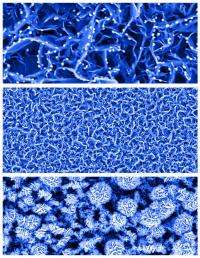
These color-enhanced scanning electron microscope images show nanosheets resembling tiny rose petals. The nanosheets are key components of a new type of biosensor that can detect minute concentrations of glucose in saliva, tears and urine. The technology might eventually help to eliminate or reduce the frequency of using pinpricks for diabetes testing. (Purdue University photo/Jeff Goecker)

(Phys.org) -- Researchers have created a new type of biosensor that can detect minute concentrations of glucose in saliva, tears and urine and might be manufactured at low cost because it does not require many processing steps to produce.

"It's an inherently non-invasive way to estimate glucose content in the body," said Jonathan Claussen, a former Purdue University doctoral student and now a research scientist at the U.S. Naval Research Laboratory. "Because it can detect glucose in the saliva and tears, it's a platform that might eventually help to eliminate or reduce the frequency of using pinpricks for diabetes testing. We are proving its functionality."

Claussen and Purdue doctoral student Anurag Kumar led the project, working with Timothy Fisher, a Purdue professor of mechanical engineering; D. Marshall Porterfield, a professor of agricultural and biological engineering; and other researchers at the university's Birck Nanotechnology Center.

Findings are detailed in a research paper being published this week in the journal .

"Most sensors typically measure glucose in blood," Claussen said. "Many in the literature aren't able to detect glucose in tears and the saliva. What's unique is that we can sense in all four different human serums: the saliva, blood, tears and urine. And that hasn't been shown before."

The paper, featured on the journal's cover, was written by Claussen, Kumar, Fisher, Porterfield and Purdue researchers David B. Jaroch, M. Haseeb Khawaja and Allison B. Hibbard.

The sensor has three main parts: layers of nanosheets resembling tiny rose petals made of a material called graphene, which is a single-atom-thick film of carbon; platinum nanoparticles; and the enzyme glucose oxidase.

Each petal contains a few layers of stacked graphene. The edges of the petals have dangling, incomplete , defects where platinum nanoparticles can attach. Electrodes are formed by combining the nanosheet petals and platinum nanoparticles. Then the glucose oxidase attaches to the platinum nanoparticles. The enzyme converts glucose to peroxide, which generates a signal on the electrode.

"Typically, when you want to make a nanostructured biosensor you have to use a lot of processing steps before you reach the final product," Kumar said. "That involves lithography, chemical processing, etching and other steps. The good thing about these petals is that they can be grown on just about any surface, and we don't need to use any of these steps, so it could be ideal for commercialization."

In addition to diabetes testing, the technology might be used for sensing a variety of chemical compounds to test for other medical conditions.

"Because we used the enzyme glucose oxidase in this work, it's geared for diabetes," Claussen said. "But we could just swap out that enzyme with, for example, glutemate oxidase, to measure the neurotransmitter glutamate to test for Parkinson's and Alzheimer's, or ethanol oxidase to monitor alcohol levels for a breathalyzer. It's very versatile, fast and portable."

The technology is able to detect glucose in concentrations as low as 0.3 micromolar, far more sensitive than other electrochemical biosensors based on or graphite, carbon nanotubes and metallic nanoparticles, Claussen said

"These are the first findings to report such a low sensing limit and, at the same time, such a wide sensing range," he said.

The sensor is able to distinguish between glucose and signals from other compounds that often cause interference in sensors: uric acid, ascorbic acid and acetaminophen, which are commonly found in the blood. Unlike glucose, those compounds are said to be electroactive, which means they generate an electrical signal without the presence of an enzyme.

Glucose by itself doesn't generate a signal but must first react with the enzyme glucose oxidase. Glucose oxidase is used in commercial diabetes test strips for conventional diabetes meters that measure with a finger pinprick.

Explore further: 3D printing tiny batteries

More information: Nanostructuring Platinum Nanoparticles on Multilayered Graphene Petal Nanosheets for Electrochemical Biosensing, Advanced Functional Materials.

ABSTRACT
Hybridization of nanoscale metals and carbon nanotubes into composite nanomaterials has produced some of the best-performing sensors to date. The challenge remains to develop scalable nanofabrication methods that are amenable to the development of sensors with broad sensing ranges. A scalable nanostructured biosensor based on multilayered graphene petal nanosheets (MGPNs), Pt nanoparticles, and a biorecognition element (glucose oxidase) is presented. The combination of zero-dimensional nano-particles on a two-dimensional support that is arrayed in the third dimension creates a sensor platform with exceptional characteristics. The versatility of the biosensor platform is demonstrated by altering biosensor performance (i.e., sensitivity, detection limit, and linear sensing range) through changing the size, density, and morphology of electrodeposited Pt nanoparticles on the MGPNs. This work enables a robust sensor design that demonstrates exceptional performance with enhanced glucose sensitivity (0.3 µM detection limit, 0.01–50 mM linear sensing range), a long stable shelf-life (> 1 month), and a high selectivity over electroactive, interfering species commonly found in human serum samples.

Related Stories

Nano-tetherball biosensor precisely detects glucose

Jan 22, 2009

(PhysOrg.com) -- Researchers have created a precise biosensor for detecting blood glucose and potentially many other biological molecules by using hollow structures called single-wall carbon nanotubes anchored ...

New biosensor benefits from melding of carbon nanotubes, DNA

Nov 15, 2011

Purdue University scientists have developed a method for stacking synthetic DNA and carbon nanotubes onto a biosensor electrode, a development that may lead to more accurate measurements for research related to diabetes and ...

Recommended for you

An environmentally friendly battery made from wood

2 hours ago

Taking inspiration from trees, scientists have developed a battery made from a sliver of wood coated with tin that shows promise for becoming a tiny, long-lasting, efficient and environmentally friendly energy ...

Sound waves precisely position nanowires

3 hours ago

(Phys.org) —The smaller components become, the more difficult it is to create patterns in an economical and reproducible way, according to an interdisciplinary team of Penn State researchers who, using ...

Hybrid nanostructures: Getting to the core

5 hours ago

Material scientists expect the new multifunctional properties of hybrid nanostructures will transform the development of high-performance devices, including batteries, high-sensitivity sensors and solar cells. ...

3D printing tiny batteries

22 hours ago

(Phys.org) —3D printing can now be used to print lithium-ion microbatteries the size of a grain of sand. The printed microbatteries could supply electricity to tiny devices in fields from medicine to communications, ...

World's most powerful microscope ready for research

Jun 18, 2013

(Phys.org) —The world's most powerful microscope, which resides in a specially constructed room at the University of Victoria, has now been fully assembled and tested, and has a lineup of scientists and businesses eager ...

User comments : 4

Adjust slider to filter visible comments by rank

Display comments: newest first

Parsec
not rated yet Aug 21, 2012
How much platinum is used? I suspect tiny amounts, but platinum is both expensive and rare in nature limiting the inherent supply.

I suspect that a batch of test strips would cost a lot, but perhaps the platinum could be recovered.
Sonhouse
not rated yet Aug 21, 2012
The article says it is sensitive down to 300 nanomolars, what is the sensitivity of standard blood glucose testing? How much better is this new test?
moj85
not rated yet Aug 22, 2012
The article says it is sensitive down to 300 nanomolars, what is the sensitivity of standard blood glucose testing? How much better is this new test?

I would say a factor of 1000 more sensitive. A simple google shows glucose meters are sensitive down to about 2 mmol/L which corresponds to about 50 mg/dL in whole blood sampling (Wikipedia for glucose meter). 300 nanomolar is equal to 0.3 micromolar, which is 0.0003 millimolar. But keep in mind, the reason this test is so sensitive is because glucose levels in the saliva/tears/etc is much less than in whole blood from say, a finger prick. The point of this article is not that the test is more sensitive, but that you don't need to stab your finger 4 times a day to get your glucose levels. I think.

Ducknet
not rated yet Aug 24, 2012
You may want to read about LifeSaver products that already do this and are in funding stage with patents to diagnose many conditions to include HIV and the cost retail would be around $13. There's a patent for this type of technology with glucose too but it may be a little different than what is written here too, but same thing, saliva and 2 second swab/2 minute results.

http://www.alifes...feSaver/

More news stories

Sound waves precisely position nanowires

(Phys.org) —The smaller components become, the more difficult it is to create patterns in an economical and reproducible way, according to an interdisciplinary team of Penn State researchers who, using ...

An environmentally friendly battery made from wood

Taking inspiration from trees, scientists have developed a battery made from a sliver of wood coated with tin that shows promise for becoming a tiny, long-lasting, efficient and environmentally friendly energy ...

Hybrid nanostructures: Getting to the core

Material scientists expect the new multifunctional properties of hybrid nanostructures will transform the development of high-performance devices, including batteries, high-sensitivity sensors and solar cells. ...

3D printing tiny batteries

(Phys.org) —3D printing can now be used to print lithium-ion microbatteries the size of a grain of sand. The printed microbatteries could supply electricity to tiny devices in fields from medicine to communications, ...

Tech companies eye security that goes beyond passwords

In late February, a thief or thieves cracked into Evernote's digital vault filled with log-ins, passwords and email addresses belonging to 50 million users. It was a shocking cyberattack considering the Redwood City, Calif., ...

Validating maps of the brain's resting state

Kick back and shut your eyes. Now stop thinking. You have just put your brain into what neuroscientists call its resting state. What the brain is doing when an individual is not focused on the outside world ...

Prehistoric rock art maps cosmological belief

It is likely some of the most widespread and oldest art in the United States. Pieces of rock art dot the Appalachian Mountains, and research by University of Tennessee, Knoxville, anthropology professor Jan ...