Bringing down the cost of fuel cells: New catalyst dramatically cheaper without sacrificing performance
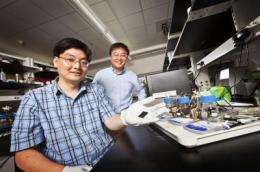
Engineers at the University of Wisconsin-Milwaukee (UWM) have identified a catalyst that provides the same level of efficiency in microbial fuel cells (MFCs) as the currently used platinum catalyst, but at 5% of the cost.
Since more than 60% of the investment in making microbial fuel cells is the cost of platinum, the discovery may lead to much more affordable energy conversion and storage devices.
The material – nitrogen-enriched iron-carbon nanorods – also has the potential to replace the platinum catalyst used in hydrogen-producing microbial electrolysis cells (MECs), which use organic matter to generate a possible alternative to fossil fuels.
"Fuel cells are capable of directly converting fuel into electricity," says UWM Professor Junhong Chen, who created the nanorods and is testing them with Assistant Professor Zhen (Jason) He. "With fuel cells, electrical power from renewable energy sources can be delivered where and when required, cleanly, efficiently and sustainably."
The scientists also found that the nanorod catalyst outperformed a graphene-based alternative being developed elsewhere. In fact, the pair tested the material against two other contenders to replace platinum and found the nanorods' performance consistently superior over a six-month period.
The nanorods have been proved stable and are scalable, says Chen, but more investigation is needed to determine how easily they can be mass-produced. More study is also required to determine the exact interaction responsible for the nanorods' performance.
The work was published in March in the journal Advanced Materials ("Nitrogen-Enriched Core-Shell Structured Fe/Fe3C-C Nanorods as Advanced Catalysts for Oxygen Reduction Reaction").
The right recipe
MFCs generate electricity while removing organic contaminants from wastewater. On the anode electrode of an MFC, colonies of bacteria feed on organic matter, releasing electrons that create a current as they break down the waste.
On the cathode side, the most important reaction in MFCs is the oxygen reduction reaction (ORR). Platinum speeds this slow reaction, increasing efficiency of the cell, but it is expensive.
Microbial electrolysis cells (MECs) are related to MFCs. However, instead of electricity, MECs produce hydrogen. In addition to harnessing microorganisms at the anode, MECS also use decomposition of organic matter and platinum in a catalytic process at their cathodes.
Chen and He's nanorods incorporate the best characteristics of other reactive materials, with nitrogen attached to the surface of the carbon rod and a core of iron carbide. Nitrogen's effectiveness at improving the carbon catalyst is already well known. Iron carbide, also known for its catalytic capabilities, interacts with the carbon on the rod surface, providing "communication" with the core. Also, the material's unique structure is optimal for electron transport, which is necessary for ORR.
When the nanorods were tested for potential use in MECs, the material did a better job than the graphene-based catalyst material, but it was still not as efficient as platinum.
"But it shows that there could be more diverse applications for this material, compared to graphene," says He. "And it gave us clues for why the nanorods performed differently in MECs."
Journal information: Advanced Materials
Provided by University of Wisconsin - Milwaukee


