Atomic structure of nanoparticles brought under control
Jun 14, 2012 by Richard Palmer
Image: Professor Richard E Palmer / University of Birmingham

Nanotechnologists are control freaks. They want to exploit the properties of materials at the ultimate level - the atoms.

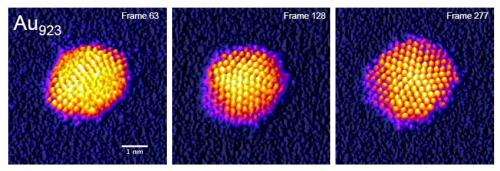
Imagine the frustration therefore when you build a near million dollar machine to create beams of nanoparticles, each containing a precisely selected number of atoms, 923 say (a "magic number"), and then you find that you've made at least three different atomic architectures at the same time, like three flavours of ice cream. You want to find some way to transform all the flavours into one.

Wang and Palmer at the University of Birmingham, UK, (Physical Review Letters 108 245502, 2012) have found a solution to the challenge.

They use the superfine beam in the aberration-corrected first to reveal the various 3-dimensional - the "isomers" of their gold nanoclusters - and then, by prolonged illumination with the , they drive the particles one by one towards their most stable, equilibrium structures.

The result is a personalised video for each particle, showing the atoms on the move towards their atomic destinations - stable configurations like the decahedron.

Apart from satisfying the desire for control, the results provide a new reference for computational models of nanostructure dynamics, down to the atom scale.

Explore further: Designing materials for the future

More information: DOI: 10.1103/PhysRevLett.108.245502

add to favorites email to friend print save as pdf

Related Stories

3D nanoparticle in atomic resolution

Feb 22, 2011

For the first time, scientists from Empa and ETH Zurich have, in collaboration with a Dutch team, managed to measure the atomic structure of individual nanoparticles. The technique, recently published in Nature, could ...

Designing materials for the future

Jun 12, 2012

As energy demands rise, materials scientists are increasingly interested in developing longer-lasting materials for use in the next generation of advanced nuclear and fusion reactors. However, before researchers ...

New record for world's smallest atomic valentine

Feb 14, 2012

(PhysOrg.com) -- Shattering their own world record from two years ago, scientists from the University of Birmingham in the UK have created the unofficial world’s smallest atomic valentine. Their tiny heart ...

New record for measurement of atomic lifetime

Sep 07, 2011

Researchers at the Niels Bohr Institute have measured the lifetime of an extremely stable energy level of magnesium atoms with great precision. Magnesium atoms are used in research with ultra-precise atomic ...

Recommended for you

Engineers' nanoantennas improve infrared sensing

May 20, 2013

(Phys.org) —A team of University of Pennsylvania engineers has used a pattern of nanoantennas to develop a new way of turning infrared light into mechanical action, opening the door to more sensitive infrared ...

Stacking 2-D materials produces surprising results

May 16, 2013

(Phys.org) —Graphene has dazzled scientists, ever since its discovery more than a decade ago, with its unequalled electronic properties, its strength and its light weight. But one long-sought goal has proved ...

User comments : 0

More news stories

How gold nanoparticles can help fight ovarian cancer

Positively charged gold nanoparticles are usually toxic to cells, but cancer cells somehow manage to avoid nanoparticle toxicity. Mayo Clinic researchers found out why, and determined how to make the nanoparticles effective ...

Radioactive nanoparticles target cancer cells

Cancers of all types become most deadly when they metastasize and spread tumors throughout the body. Once cancer has reached this stage, it becomes very difficult for doctors to locate and treat the numerous tumors that can ...

Power of US tornado dwarfs Hiroshima bomb

Wind, humidity and rainfall combined precisely to create Monday's massive killer tornado in Oklahoma. The awesome amount of energy released dwarfed the power of the atomic bomb that leveled Hiroshima.

Amazon plans greenhouse-style headquarters

US online giant Amazon has unveiled plans for a futuristic greenhouse style headquarters "where employees can work and socialize in a more natural, park-like setting."