New research can save tropical forests
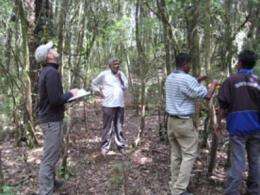
Scientists from the University of Gothenburg, Sweden, have investigated how much carbon the natural forests of Sri Lanka contain. The results are important for work to reduce deforestation of tropical countries, and for international negotiations in climate policy relating to a new climate agreement.
Global deforestation can be reduced by measuring the amount of carbon contained in natural forests. The measurements may make it possible for tropical countries to receive compensation from developed countries for the retention of forests.
Deforestation is responsible for approximately 12% of global greenhouse gas emissions. Most deforestation takes place in tropical forests, and it is important, therefore, to reduce the felling of such forests, in order to reduce total emissions of greenhouse gases.
Short-term profitability
One problem is that felling trees often gives a greater profit in the short term than allowing the forest to remain. However, it is possible to change the economic conditions such that countries can profit by allowing forests to stand.
Climate negotiations led by the UN in recent years have discussed a way of reducing global deforestation known as REDD+. This involves tropical countries being paid by developed countries if they retain or increase their tropical forests.
"But in order for REDD+ to work in practice, it's important to develop efficient systems for measuring the carbon in the forests, and such systems are deficient in Sri Lanka", says Eskil Mattsson, research student in physical geography at the Department of Earth Sciences, University of Gothenburg.
The carbon content of trees
One aspect of the work he has carried out in collaboration with Swedish and Sri Lankan colleagues involves measuring the carbon content of various types of natural forest in Sri Lanka. This meant carrying out measurements on approximately 20,000 trees. The results show that deforestation is responsible for nearly half of the greenhouse gas emissions that originate from human activity in Sri Lanka. There are, however, large differences between the amounts of carbon that different types of forest contain.
"The calculations are important in order to estimate the costs and benefits of reducing deforestation, since the levels of compensation will be based on the amount of carbon in the forest", says Eskil Mattsson.
Alternatives to felling
Eskil Mattson's studies have also shown that it is possible to use other ecosystems than natural forests to bind carbon and to provide food, timber and protection against climate change for the local population.
His work can be used, among other things, to reach a clearer understanding of how Sri Lanka and other tropical countries can retain natural forests in order to reduce the emission of greenhouse gases without a detrimental effect on the opportunities for the local population to support itself.
The results are also significant for international negotiations in climate policy, and for a new climate agreement in which issues relating to the measurement of carbon in forests and soil are high on the agenda.
The thesis "Forest and Land Use Mitigation and Adaptation in Sri Lanka – Aspects in the Light of International Climate Change Policies" will be defended at a disputation on 30 March 2012.
Provided by University of Gothenburg


