Nuclear watchdog urges French plants to boost safety
January 3, 2012

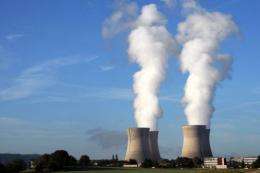
The four reactors of the Bugey nuclear plant in Saint-Vulbas, east of Lyon, central France

Enlarge

The four reactors of the Bugey nuclear plant in Saint-Vulbas, east of Lyon, central France, August 2011. A French nuclear watchdog on Tuesday called for the country's plants to beef up safety to cope with natural disasters under a programme likely to cost tens of billions of euros (dollars), but said none faced any immediate shutdown.

A French nuclear watchdog on Tuesday called for the country's plants to beef up safety to cope with natural disasters under a programme likely to cost tens of billions of euros (dollars), but said none faced any immediate shutdown.

It also called for a "rapid reaction force" to be operational by the end of 2014 that could intervene in a in less than 24 hours.

The recommendations, handed to Prime Minister Francois Fillon, were drafted by the Nuclear Authority (ASN) as part of a post-Fukushima inspection of France's .

"Following additional safety evaluations of priority nuclear installations, the ASN believes that the installations that have been assessed have a sufficient level of safety to warrant it not to request any immediate shutdown," it said.

"At the same time, the ASN believes that continuing operations require existing safety margins to be strengthened as swiftly as possible."

It gave operators until June 30 to spell out measures to strengthen safety in response to floods and earthquakes, providing for instance backup systems for power, coolant and plant operations.

The measures should aim at "preventing a serious accident or limiting its spread" and "limiting massive releases (of radioactivity) in an accident scenario," the ASN said.

In addition, operators should itemise their procedures for handling a crisis.
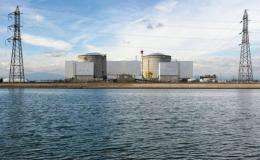
Fessenheim nuclear power plant, the oldest operational nuclear power plant in France
Enlarge

Fessenheim nuclear power plant, the oldest operational nuclear power plant in France, in Fessenheim, eastern France, March 2011. A French nuclear watchdog on Tuesday called for the country's plants to beef up safety to cope with natural disasters under a programme likely to cost tens of billions of euros (dollars), but said none faced any immediate shutdown.

The measures will require "tens of billions of euros (dollars) in investment," the ASN's president, Andre-Claude Lacoste, told a press conference.

"The work and financing are on a massive scale, requiring the hiring and training of hundreds of people," Lacoste said.

He noted that a single emergency diesel generator, designed to be protected against floods, costs "tens of millions" of euros. Another major expense would be building "bunkers" to serve as emergency backup for plant controllers.

"I don't see how this cannot have an impact on (electricity) prices," he warned.

Fillon's office said the government would ensure that the requests would be carried out "in their entirety (and) on time."

An anti-nuclear group, the Nuclear Observatory, dismissed the ASN report as a "predictable trick."

"The ASN is absolutely not independent and plays the role allotted to it by the government -- to have the public believe in the feasibility of nuclear safety," it said.

France is the most nuclear-dependent country in the world, deriving 75 percent of its electricity needs from 58 reactors, most of which were built in response to the oil shocks of the 1970s.

The programme gave birth to a massive state industry, with giants such as the nuclear plant builder Areva and operator Electricite de France (EdF) as well as the Atomic Energy Commission (CEA), which carries out civilian and military research.

But a decades-long "nuclear consensus" gathering all the major parties was badly shaken by the March 11 earthquake that ravaged the Fukushima Daiichi plant in northeastern Japan.

The issue is rising up the political agenda ahead of key elections this year.

In November, the opposition Socialist Party joined with the Greens to campaign for France to scale back its reliance on nuclear to 50 percent by 2025 by shutting 24 reactors and boosting production from wind, solar and other renewable sources.

French President Nicolas Sarkozy, like his predecessors, is a champion of nuclear. He lashed the Socialist-Greens proposal as "irresponsible" and potentially crippling.

France will vote in the first round of a presidential election in April and potentially a second round in May, followed by a two-round parliamentary election in June.

(c) 2012 AFP


Rank not rated yet
Relevant PhysicsForums posts

More news stories

Browser wars flare in mobile space

The browser wars are heating up again, but this time the fight is for dominance of the mobile Internet.

Technology / Software

created 13 hours ago | popularity 5 / 5 (2) | comments 3

Probability of contamination from severe nuclear reactor accidents is higher than expected: study

Catastrophic nuclear accidents such as the core meltdowns in Chernobyl and Fukushima are more likely to happen than previously assumed. Based on the operating hours of all civil nuclear reactors and the number ...

Technology / Energy & Green Tech

created May 22, 2012 | popularity 3.6 / 5 (25) | comments 56 | with audio podcast

HyperSolar shows dirty water no barrier to power world

(Phys.org) -- The Santa Barbara, California, company, HyperSolar, is set to transparently share the ups and downs of its research experiences toward the company’s ultimate vision, successfully producing ...

Technology / Energy & Green Tech

created May 24, 2012 | popularity 4.8 / 5 (16) | comments 17 | with audio podcast report

SpotterRF debuts Radar Backpack Kit (w/ Video)

(Phys.org) -- SpotterRF has announced a special radar backpack kit designed to enhance situational awareness for soldiers on the ground. The company says its special radar is designed for warfighters as part ...

Technology / Hi Tech & Innovation

created May 26, 2012 | popularity 5 / 5 (5) | comments 13 | with audio podcast report

Tesla to launch electric sedan in US on June 22

Tesla Motors said Tuesday it would begin deliveries of "the world's first premium electric sedan" on June 22, slightly ahead of schedule.

Technology / Energy & Green Tech

created May 22, 2012 | popularity 4.5 / 5 (12) | comments 18


Stunning image of smallest possible five-ringed structure

Scientists have created and imaged the smallest possible five-ringed structure – about 100,000 times thinner than a human hair – and you'll probably recognise its shape.

'Unzipped' carbon nanotubes could help energize fuel cells, batteries

Multi-walled carbon nanotubes riddled with defects and impurities on the outside could replace some of the expensive platinum catalysts used in fuel cells and metal-air batteries, according to scientists at ...

Change in developmental timing was crucial in the evolutionary shift from dinosaurs to birds: study

At first glance, it's hard to see how a common house sparrow and a Tyrannosaurus Rex might have anything in common. After all, one is a bird that weighs less than an ounce, and the other is a dinosaur that ...

Computer model used to pinpoint prime materials for efficient carbon capture

When power plants begin capturing their carbon emissions to reduce greenhouse gases – and to most in the electric power industry, it's a question of when, not if – it will be an expensive undertaking.

T cells 'hunt' parasites like animal predators seek prey, study shows

By pairing an intimate knowledge of immune-system function with a deep understanding of statistical physics, a cross-disciplinary team at the University of Pennsylvania has arrived at a surprising finding: T cells use a movement ...

Land and sea species differ in climate change response: study

(Phys.org) -- Marine and terrestrial species will likely differ in their responses to climate warming, new research by Simon Fraser University and Australia’s University of Tasmania has found.