Next-generation light bulb shines at CES
January 13, 2012 by Glenn Chapman
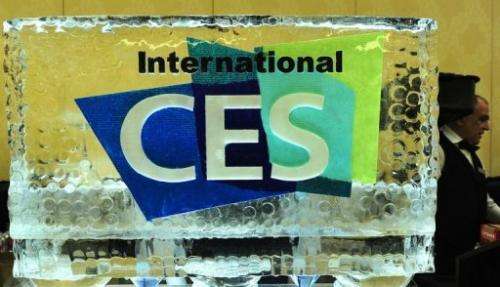
A block of ice with Consumer Electronics Show logo is seen ahead of the opening of the event on January 8, in Las Vegas, Nevada. A California startup out to change the world shined at the CES on Thursday with a light bulb, new-generation LED, blending beauty and efficiency with love for the Earth.
A California startup out to change the world shined at the Consumer Electronics Show on Thursday with a light bulb blending beauty and efficiency with love for the Earth.
Switch Lighting executives Tracy Bilbrough and Brett Sharenow glowed as they showed off new-generation LED (light-emitting diode) bulbs that they believe will transform the more than $30-billion global market.
"It is exciting to be the little David taking on the Goliath's of the world," Switch chief Bilbrough told AFP.
"You pick this because it doesn't have mercury; you can dim it; it loves cold weather; there is no ultra-violet so they don't draw any bugs outdoors, and it fits in any fixture an incandescent bulb goes in."
Switch bulbs being are being tested in two US hotels and will begin shipping later this month as a smart option to incandescent or CFL models.
Incandescent bulbs are power-sucking classics being phased out in countries around the world, replaced by energy-efficient CFL versions containing toxic mercury that make them hazardous to toss in the rubbish.
"LEDs are really the next thing in lighting," said Switch chief strategy officer Sharenow.
The Silicon Valley company's bulb is touted as Earth-friendly from "cradle to cradle" and lasts about seven times longer than CFLs while providing the kind of light people like from incandescent.
Switch bulbs have an artistic look akin to a snow glove perched on a silver pedestal. They can also survive a three-foot drop to a hardwood floor.
A ring of metal prongs, each with a computer chip on it to emit light, is immersed in liquid that fills each bulb. The liquid cools the chips while acting as a lens to magnify light.
"It is food-grade; actually used in making beer, pasta and women's cosmetics," Sharenow said of the liquid, the ingredients of which were secret.
"We actually get more light out of the LEDs with liquid in the glass dome than if there was air in there."
Switch bulbs use 80 percent less electricity than incandescent bulbs and last for about 25,000 hours no matter often you switch them on or off, he added.
The life spans of CFL bulbs shrinks as they are flicked on or off and they buzz or burn out if dimmed.
Switch bulbs, which are being launched in 65- and 75-watt models, are priced at $35 each but the price was expected to drop under $20 by the end of the year.
Even at a price of $35, businesses recover the cost in six months while homeowners hit that mark in two years, according to Sharenow.
LED bulb efficiency is on par with CFL, which cost about three dollars each versus 50 cents for incandescent. Bilbrough expected LED bulbs to quickly get more efficient that CFL.
Switch is first targeting businesses that see cost-savings in energy-efficient bulbs that last them more than a decade. Bilbrough estimated that Switch bulbs would last about 25 years or longer in home use.
"If you put that in your baby's room when they come home from the hospital, they will still be studying under it when they are in college," Bilbrough said with a nod toward one of the bulbs.
"These things will last longer than your phone, iPad, car or sofa."
When people are done with Switch bulbs, the company wants them back so they can recycle or reuse the parts giving them new lives in a practice referred to in the industry as "cradle to cradle."
"We want to reuse every part we can so nothing goes back to the biosphere of the Earth," Sharenow said.
Switch in coming months will release a 100-watt bulb and models tailored for Europe.
"Everyone is looking for ways to avoid building power plants," Bilbrough said, noting that about 20 percent of the world's electric power goes to lighting.
"The one thing with no negative environmental impact is to use less," he continued.
(c) 2012 AFP
-
From lemons to lemonade: Reaction uses carbon dioxide to make carbon-based semiconductor,
32 comments
-
Thioridazine kills cancer stem cells in human while avoiding toxic side-effects of conventional cancer treatments,
3 comments
-
SpaceX private rocket blasts off for space station (Update),
42 comments
-
Climate scientists say they have solved riddle of rising sea,
31 comments
-
SpaceX capsule has 'new car' smell, astronauts say (Update),
4 comments
-
Need a rigid insulation material???
21 hours ago
-
magnets or EMF in car bumpers to protect from fender bender
May 26, 2012
-
length of wire in a coil of known dimensions?
May 25, 2012
-
India Engineering Powerhouse
May 25, 2012
-
electromagnet core dereference between hard and soft iron
May 25, 2012
-
Measuring water pressure in an open tank
May 24, 2012
- More from Physics Forums - General Engineering
More news stories
Browser wars flare in mobile space
The browser wars are heating up again, but this time the fight is for dominance of the mobile Internet.
13 hours ago |
5 / 5 (2) |
3
Probability of contamination from severe nuclear reactor accidents is higher than expected: study
Catastrophic nuclear accidents such as the core meltdowns in Chernobyl and Fukushima are more likely to happen than previously assumed. Based on the operating hours of all civil nuclear reactors and the number ...
Technology / Energy & Green Tech
May 22, 2012 |
3.6 / 5 (25) |
56
|
HyperSolar shows dirty water no barrier to power world
(Phys.org) -- The Santa Barbara, California, company, HyperSolar, is set to transparently share the ups and downs of its research experiences toward the companys ultimate vision, successfully producing ...
SpotterRF debuts Radar Backpack Kit (w/ Video)
(Phys.org) -- SpotterRF has announced a special radar backpack kit designed to enhance situational awareness for soldiers on the ground. The company says its special radar is designed for warfighters as part ...
Tesla to launch electric sedan in US on June 22
Tesla Motors said Tuesday it would begin deliveries of "the world's first premium electric sedan" on June 22, slightly ahead of schedule.
Technology / Energy & Green Tech
May 22, 2012 |
4.5 / 5 (12) |
18
Stunning image of smallest possible five-ringed structure
Scientists have created and imaged the smallest possible five-ringed structure about 100,000 times thinner than a human hair and you'll probably recognise its shape.
'Unzipped' carbon nanotubes could help energize fuel cells, batteries
Multi-walled carbon nanotubes riddled with defects and impurities on the outside could replace some of the expensive platinum catalysts used in fuel cells and metal-air batteries, according to scientists at ...
Change in developmental timing was crucial in the evolutionary shift from dinosaurs to birds: study
At first glance, it's hard to see how a common house sparrow and a Tyrannosaurus Rex might have anything in common. After all, one is a bird that weighs less than an ounce, and the other is a dinosaur that ...
Computer model used to pinpoint prime materials for efficient carbon capture
When power plants begin capturing their carbon emissions to reduce greenhouse gases and to most in the electric power industry, it's a question of when, not if it will be an expensive undertaking.
T cells 'hunt' parasites like animal predators seek prey, study shows
By pairing an intimate knowledge of immune-system function with a deep understanding of statistical physics, a cross-disciplinary team at the University of Pennsylvania has arrived at a surprising finding: T cells use a movement ...
Land and sea species differ in climate change response: study
(Phys.org) -- Marine and terrestrial species will likely differ in their responses to climate warming, new research by Simon Fraser University and Australia’s University of Tasmania has found.
Jan 13, 2012
Rank: 3.8 / 5 (4)
look if your bulbs are burning out buy a higher VOLTAGE bulb you are probably getting a lot of spikes in current from you electricity provider.
Voltage is different than wattage... wattage is directly proportional to light output -- voltage allows your bulb to absorb those spikes in electricity without blowing... there are two voltage levels in bulbs -- look next time you are in the store or ask someone in that department -- normally the old guy in the corner will know what you are talking about.
Jan 13, 2012
Rank: 3.8 / 5 (4)
It won't stay secret too long giving out clues like that :P
Jan 13, 2012
Rank: 5 / 5 (3)
Jan 13, 2012
Rank: 3 / 5 (8)
Jan 13, 2012
Rank: 5 / 5 (3)
LED lights are already much cheaper than incandescent bults. See http://www.sfgate...9886.DTL
They cost more up front , but then you can just forget about them while they save you money on electricity. For me, not having to change bulbs is a huge advantage.
Jan 13, 2012
Rank: 2.8 / 5 (13)
"When I turn on the swtich, the light comes on too fast."
"They use too little electricity, it must be satanic."
"They are heavier than regular bulbs and it strains me to lift one."
"If you eat one you have to call a Hasmat Team when you poop."
"The electronic light makes me fart."
Jan 13, 2012
Rank: 1.5 / 5 (8)
Is your workplace evacuated every time one breaks?
MORON.
"Both were tossed out before a replacement was available and the result has been both dangerous and very embarrassing." - ArxMindless
Jan 13, 2012
Rank: 5 / 5 (4)
Jan 13, 2012
Rank: 2 / 5 (8)
http://www.aether...ison.gif
There are another quality factors in the game: the light of LED is not multispectral and diffusive and LED adapters are source of EM smog.
Jan 14, 2012
Rank: 4.7 / 5 (3)
For indoor lighting, I'd much prefer halogen lights. They give a natural, sunny day-like light that simply makes me feel good and happy.
Jan 14, 2012
Rank: 1.8 / 5 (4)
Halogens waste 90% of their energy to heat and are only modestly more efficient than regular incandescent bulbs.
Worthless garbage.
Jan 14, 2012
Rank: 5 / 5 (3)
Jan 14, 2012
Rank: 4.5 / 5 (2)
Jan 15, 2012
Rank: 3.5 / 5 (2)
Jan 15, 2012
Rank: 4.3 / 5 (3)
Incandescent:
Pros: cheap unit cost, excellent color rendition, reaches max light output quickly when turned on, can be used as a heat source, good ambient temperature tolerance
Cons: inefficient light source; requires heat tolerant fixture, short lifespan, poor vibration resistance, power cycling tolerance only fair. Highest life-cycle cost
CFL:
Pros: low operating costs, good color rendition possible, moderate unit cost, good vibration resistance
Cons: short lifespan, poor power cycling tolerance, slow turn-on, contains toxic material, fragile, loses considerable amount of efficiency with age, poor heat or cold tolerance.
LED
Pros: lowest life-cycle operating cost, long life, high power-cycling tolerance, instant-on, excellent cold tolerance
Cons: high unit cost, fair to poor color rendition, poor heat tolerance, highly directional.
The LED is a great choice for passageway and storeroom lighting, but needs more development to be used in "living space.
Jan 15, 2012
Rank: 2.7 / 5 (7)
You must not be talking to the 80% of them who believe in angels.
Would you mind telling us where those Iraqui WMD were again?
I have never encountered a Conservative who wasn't a chronic, congenital liar.
Jan 15, 2012
Rank: 1.7 / 5 (3)
My only reservation was the stark white color. I'm used to it now. It is possible to scrim the lights for color. Also, the quality of the dimming capabilities is dependent on the quality of the power supply; Surges can cause them to hiss a bit requiring me to fiddle with the dimmer to silence them. I suspect that surges may shorten the life-span as in incandescents, but I may be wrong. I have this one exterior light that used to burn out monthly, and has not since I installed an LED. YEAH!
P.S. Vendicar Decarian is an emotionally depraved bigot. Everybody knows what he does with that brown thumb of his.
Jan 15, 2012
Rank: 5 / 5 (2)
I ordered one a couple of weeks ago and I'm waiting for it to arrive. I am curious to see just how warm and luminous its light will truly be.
I am a little sceptical about the bombastic claims of immense longevity of LED bulbs. I have no doubt they last longer than the other types, but... entire 25 years? This was tested... when?
I think a lot of the calculations of exactly how much money LEDs can save you over time due to their longevity, are pure guesswork.
I also worry that if these calculations are based on high quality LEDs, who's to say that's what we're going to get in the shops? Does a 25 year life span of a bulb that consists of 120 diodes mean that in 25 years all the diodes will still be functional, or would maybe only half of them still be working?
Jan 15, 2012
Rank: 5 / 5 (2)
I think $35 per bulb is overpriced anyway, but new gadgets always are, so hopefully this price will drop over the next few years when these bulbs become more common in the Western markets.
This is why I intend to wait a little longer before equipping my whole house with LEDs. If I can order a LED bulb from China for $5 NOW, and they sell the exact same one, imported from China, for $35 in the US and Europe, we're just paying for the hype. Unless of course, the $5 bulb I ordered from China turns out to be made of paper. :))
We shall see.
Jan 15, 2012
Rank: 1 / 5 (2)
Jan 16, 2012
Rank: not rated yet
I'm not aware that any conservatives objects to new products like these. What's objectionable is being FORCED by government to buy a particular kind of bulb, rather than being free to choose what one believes is best for their needs.
Jan 16, 2012
Rank: 3 / 5 (2)
Well then.. Since American conservatives aren't being "forced" to purchase any light bulbs then they have nothing to complain about.
So on that basis, their childish whining is even more insipid.
Jan 24, 2012
Rank: not rated yet
Correct. Despite these people's delusions that "LEDs are really the next thing in lighting", actually the most promising energy-efficient and non-toxic technology at the moment is Electron-Stimulated Luminescence, currently developed by VU1 Corp., not least of all because of those bulbs' superior spectral output (i.e. natural-looking light color).