Iowa State engineer wants to 'sculpt' more powerful electric motors and generators
January 26, 2012

Iowa State engineer wants to 'sculpt' more powerful electric motors and generators

Enlarge

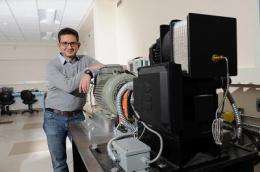
Iowa State University's Dionysios Aliprantis is working to improve the performance of electric motors. Credit: Photo by Bob Elbert/Iowa State University

Dionysios Aliprantis took up an imaginary hammer and chisel and pounded away at the air.

"Think of the ancient Greeks and their sculptures," said the Iowa State University assistant professor of electrical and .

Now apply the idea of a sculptor precisely chipping away at stone to the electric motors that run our machines and generate our electricity. Aliprantis is working to develop computer modeling technology that will show engineers how to chip away at the surfaces of electric motors to create new designs and shapes that can increase .

"The goal is to get more out of the same size motor," he said. "Or, that could mean getting the same power with a smaller motor."

Aliprantis is quick to say he's not looking for a huge improvement in a motor's performance.

"I'm looking for a little bit of increase, maybe 5 percent or 1 percent," he said. "But multiply that number by the number of , let's say, and you could get savings in the billions of dollars. The potential here could be huge."

Aliprantis' project is supported by a five-year, $400,000 grant from the National Science Foundation's Faculty Early Career Development Program. The grants support junior faculty identified as teacher-scholars through outstanding research, excellent education and the integration of education and research.

Assisting with the motor design project is Yanni Li, a doctoral student in electrical and computer engineering.

Aliprantis and Li want to take advantage of the fact that most electric motors and generators operate in just one direction – in most applications there's no real need for them to go into reverse. The motors, however, have long been designed to offer equal performance no matter which way they're rotating.

And so the engineers are exploring how electric motors can be improved by optimizing performance in a preferred direction of rotation. To do that, they've written a computer modeling program that incrementally changes the design of the motors – just like a sculptor chipping away – and calculates when the surface shape is just right.

The teeth that hold coils of wire within an electric motor, for example, have typically been built with a symmetrical shape that maintains performance in either direction. By making the teeth asymmetrical, the engineers hope the motor can pick up some power when rotating in the preferred direction.

"We are trying to develop a systematic way of getting to the right shape," Aliprantis said. "This idea is very simple, but motors are still being designed using techniques that are essentially one hundred years old."

Aliprantis is also busy with other projects to improve electric motors, advance alternative energy systems and improve engineering education:

  • Another project is aiming to improve the models used to predict the dynamic performance of electric motors as engineers experiment with different power electronics and control technologies. The idea is to develop more sophisticated control systems that capture more of a motor's performance characteristics. The project is supported by Iowa State's department of electrical and computer engineering and includes Yuanzhen Xu, a master's student in electrical and computer engineering.
  • Aliprantis is also collecting data on how much solar energy is available throughout a day. The idea is to improve power forecasts by developing better models of cloud cover. That would help utilities make better estimates of the power they can expect from solar panels on a given day. Chengrui Cai, a doctoral student in electrical and computer engineering, is assisting with the project.
  • Aliprantis is part of an Iowa State faculty team that's developing a new, multidisciplinary doctoral program in Wind Energy Science, Engineering and Policy. He's also using a National Science Foundation grant to work with Purdue University faculty to improve undergraduate education in power electronics and motor drives by modernizing student lab equipment and course content.
Because electric motors are all around us – in vehicles, wind turbines, power plants and all kinds of machinery – Aliprantis said finding new ways to improve their performance can make a real difference in the development of sustainable energy resources.

Provided by Iowa State University search and more info website

4.6 /5 (5 votes)  

Filter


Move the slider to adjust rank threshold, so that you can hide some of the comments.


Display comments: newest first

dschlink
Jan 26, 2012

Rank: 5 / 5 (1)
I'd assume that improved performance in one direction would mean reduced performance in the other. In most applications, that isn't a problem. Even in a car, one rarely uses reverse for more than a tiny fraction of the time.
gmurphy
Jan 26, 2012

Rank: not rated yet
The type of optimisation described here is perfect for evolutionary algorithms.
antialias_physorg
Jan 27, 2012

Rank: not rated yet
I'd assume that improved performance in one direction would mean reduced performance in the other.

If that 'reduced performanc' in the other direction means a reduced heat generation then that's OK by me.

Better geometry of coils or smaller supporting structures means less material. Less material means less inertial mass, which is a power saving during acceleration and braking. it would also mean less mass to lug around.

Better coupling of the electromagnetic fields would just up the efficincey.

I hope he finds something. But I bet it will be hard. Engineers have been trying to optimize electric motors for over a hundred years now. If he gets a 1% increase in efficiency then that would be beyond my wildest expectations.
Rank 4.6 /5 (5 votes)
Relevant PhysicsForums posts

More news stories

Browser wars flare in mobile space

The browser wars are heating up again, but this time the fight is for dominance of the mobile Internet.

Technology / Software

created 13 hours ago | popularity 5 / 5 (2) | comments 3

Probability of contamination from severe nuclear reactor accidents is higher than expected: study

Catastrophic nuclear accidents such as the core meltdowns in Chernobyl and Fukushima are more likely to happen than previously assumed. Based on the operating hours of all civil nuclear reactors and the number ...

Technology / Energy & Green Tech

created May 22, 2012 | popularity 3.6 / 5 (25) | comments 56 | with audio podcast

HyperSolar shows dirty water no barrier to power world

(Phys.org) -- The Santa Barbara, California, company, HyperSolar, is set to transparently share the ups and downs of its research experiences toward the company’s ultimate vision, successfully producing ...

Technology / Energy & Green Tech

created May 24, 2012 | popularity 4.8 / 5 (16) | comments 17 | with audio podcast report

SpotterRF debuts Radar Backpack Kit (w/ Video)

(Phys.org) -- SpotterRF has announced a special radar backpack kit designed to enhance situational awareness for soldiers on the ground. The company says its special radar is designed for warfighters as part ...

Technology / Hi Tech & Innovation

created May 26, 2012 | popularity 5 / 5 (5) | comments 13 | with audio podcast report

Tesla to launch electric sedan in US on June 22

Tesla Motors said Tuesday it would begin deliveries of "the world's first premium electric sedan" on June 22, slightly ahead of schedule.

Technology / Energy & Green Tech

created May 22, 2012 | popularity 4.5 / 5 (12) | comments 18


Stunning image of smallest possible five-ringed structure

Scientists have created and imaged the smallest possible five-ringed structure – about 100,000 times thinner than a human hair – and you'll probably recognise its shape.

'Unzipped' carbon nanotubes could help energize fuel cells, batteries

Multi-walled carbon nanotubes riddled with defects and impurities on the outside could replace some of the expensive platinum catalysts used in fuel cells and metal-air batteries, according to scientists at ...

Change in developmental timing was crucial in the evolutionary shift from dinosaurs to birds: study

At first glance, it's hard to see how a common house sparrow and a Tyrannosaurus Rex might have anything in common. After all, one is a bird that weighs less than an ounce, and the other is a dinosaur that ...

Computer model used to pinpoint prime materials for efficient carbon capture

When power plants begin capturing their carbon emissions to reduce greenhouse gases – and to most in the electric power industry, it's a question of when, not if – it will be an expensive undertaking.

T cells 'hunt' parasites like animal predators seek prey, study shows

By pairing an intimate knowledge of immune-system function with a deep understanding of statistical physics, a cross-disciplinary team at the University of Pennsylvania has arrived at a surprising finding: T cells use a movement ...

Land and sea species differ in climate change response: study

(Phys.org) -- Marine and terrestrial species will likely differ in their responses to climate warming, new research by Simon Fraser University and Australia’s University of Tasmania has found.