NASA eyes power in Tropical Storm Washi, warnings in the Philippines
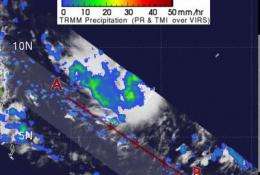
TRMM provided a "top down" rainfall analysis of Tropical Storm Washi on Dec. 15. Light to moderate rainfall (green and blue) was falling throughout the storm a rate between .78 to 1.57 inches/20 to 40 mm per hour). There was a small area of heavy (red) rainfall to the southwest of the center. Credit: Credit: SSAI/NASA, Hal Pierce
NASA's TRMM satellite measured heavy rainfall and powerful towering thunderstorms as Tropical Depression 27W intensified into Tropical Storm Washi today. Now, warnings are up in areas of the Philippines as Washi heads in that direction.
Now that Tropical Depression 27W strengthened into a tropical storm, it has been given two names: Washi and Sendong. Tropical cyclones within each ocean basin are named in six year lists, but some countries will also assign their own names to a storm, so following a storm can get a little confusing. Low pressure areas that form into a depression are given a number and Washi's was 27W, for the twenty-seventh tropical depression in the western North Pacific this season. Once it strengthens into a tropical storm it gets a name.
Tropical Storm Washi, or Sendong as it is known in the Philippines has residents there on guard as it continues to strengthen upon its approach.
The Philippine Atmospheric, Geophysical and Astronomical Services Administration (PAGASA) Weather Forecasting Section, Weather Division is responsible for forecasts of tropical cyclones affecting the Philippines. PAGASA noted in a bulletin today, December 15 at 5 p.m. local time (0900 UTC or 4 a.m. EST): "Tropical Storm 27W (called "Sendong" in the Philippines) is expected to make landfall over Surigao del Sur early tomorrow (Friday) afternoon and by Saturday afternoon, at 220 km East Northeast of Puerto Princesa City. By Sunday afternoon, it will be at 260 km West Northwest of Puerto Princesa City."
As a result of Washi's (Sendong) approach, PAGASA has posted warning signals. Signal One is in effect for Mindanao and Visayas. Mindanao is the second largest and easternmost island of the Philippines. It is one of the three island groups in the country, the others being Luzon and the Visayas.
Included in the warning in Mindanao is the province of Surigao Del Norte including Siargao Island, Surigao Del, Sur and Dinagat Province, Agusan Provinces and Misamis Oriental. Included in the warning in Visayas are the provinces of Eastern Samar and Western Samar, Leyte Provinces, Camotes Island, and Bohol. Heavy rains and gusty winds are expected. Rainfall may cause flooding and mudslides.
On Dec. 15 at 0900 UTC, Tropical Storm Washi had maximum sustained winds near 35 knots (40 mph/65 kmh). It was about 140 nautical miles (161 miles/259 km) west of Palau near 7.7 North and 131.5 East. It was moving quickly to the west at 20 knots (23 mph/37 kmh).
When the Tropical Rainfall Measuring Mission (TRMM) satellite passed over Washi early today, Dec. 15 at 0205 UTC (Dec. 14 at 9:05 a.m. EST) a "hot towering" thunderstorm was seen in the southwestern quadrant of the storm topping 10 miles (16 kilometers) high. Research done at NASA's Goddard Space Flight Center in Greenbelt, Md. has shown that tropical cyclones are likely to intensify within six hours of a "hot tower" being spotted in a tropical cyclone.
Multispectral satellite imagery showed the banding of thunderstorms wrapping into the center of circulation - another indication that the storm is strengthening. The storm is strengthening because the wind shear is light (only 10 knots/11 mph/18 kmh) and the sea surface temperatures are very warm at about 88 degrees Fahrenheit (31 Celsius) which is about 8F warmer than the minimum temperature needed to maintain a tropical cyclone.
The Joint Typhoon Warning Center expects Washi to make landfall on Friday, Dec. 16 and then re-emerge over water in the Sulu Sea. In the meantime, residents of Minandao and Visayas need to prepare for Washi's arrival.
Provided by
NASA's Goddard Space Flight Center
-
From lemons to lemonade: Reaction uses carbon dioxide to make carbon-based semiconductor,
32 comments
-
Thioridazine kills cancer stem cells in human while avoiding toxic side-effects of conventional cancer treatments,
3 comments
-
SpaceX private rocket blasts off for space station (Update),
42 comments
-
Climate scientists say they have solved riddle of rising sea,
31 comments
-
SpaceX capsule has 'new car' smell, astronauts say (Update),
4 comments
-
Hypothetical desert earth
20 hours ago
-
More human population = greater mass?
May 25, 2012
-
Conversion from aircraft bearing to normal degrees
May 23, 2012
-
Interpretation/Analysis of the Lab results(HEPA filter)
May 22, 2012
-
Has anyone here attended the The Urbino Summer School in Paleoclimatology?
May 22, 2012
-
Earthquakes: Mag 6 N. Italy and Mag 5.6 W. Bulgaria
May 21, 2012
- More from Physics Forums - Earth
More news stories
Land and sea species differ in climate change response: study
(Phys.org) -- Marine and terrestrial species will likely differ in their responses to climate warming, new research by Simon Fraser University and Australia’s University of Tasmania has found.
3 hours ago |
3.7 / 5 (3) |
3
|
Yale study concludes public apathy over climate change unrelated to science literacy
Are members of the public divided about climate change because they don't understand the science behind it? If Americans knew more basic science and were more proficient in technical reasoning, would public consensus match ...
5 hours ago |
4.8 / 5 (4) |
11
|
10 million years needed to recover from mass extinction
It took some 10 million years for Earth to recover from the greatest mass extinction of all time, latest research has revealed.
Space & Earth / Earth Sciences
5 hours ago |
5 / 5 (3) |
1
|
Sophisticated simulations predict future warming
The chances of our planet being hit by a global warming of 3 degrees Celsius by 2050 is as likely as it being hit by an increase of 1.4 degrees, new research shows. Presented in the journal Nature Geoscience, the British study ...
Space & Earth / Earth Sciences
May 22, 2012 |
4.4 / 5 (9) |
51
Aliens don't want to eat us, says former SETI director
Alien life probably isnt interested in having us for dinner, enslaving us or laying eggs in our bellies, according to a recent statement by former SETI director Jill Tarter.
Space & Earth / Space Exploration
May 25, 2012 |
4.4 / 5 (14) |
41
'Unzipped' carbon nanotubes could help energize fuel cells, batteries
Multi-walled carbon nanotubes riddled with defects and impurities on the outside could replace some of the expensive platinum catalysts used in fuel cells and metal-air batteries, according to scientists at ...
Change in developmental timing was crucial in the evolutionary shift from dinosaurs to birds: study
At first glance, it's hard to see how a common house sparrow and a Tyrannosaurus Rex might have anything in common. After all, one is a bird that weighs less than an ounce, and the other is a dinosaur that ...
Computer model used to pinpoint prime materials for efficient carbon capture
When power plants begin capturing their carbon emissions to reduce greenhouse gases and to most in the electric power industry, it's a question of when, not if it will be an expensive undertaking.
T cells 'hunt' parasites like animal predators seek prey, study shows
By pairing an intimate knowledge of immune-system function with a deep understanding of statistical physics, a cross-disciplinary team at the University of Pennsylvania has arrived at a surprising finding: T cells use a movement ...
Scientists develop ultra-sensitive test that detects diseases in their earliest stages
Scientists have developed an ultra-sensitive test that should enable them to detect signs of a disease in its earliest stages, in research published today in the journal Nature Materials.
Manufacturing genes to attack flu virus
An international research team has manufactured a new protein that can combat deadly flu epidemics.