Spectrum of green cars eye LA auto show crown
November 16, 2011

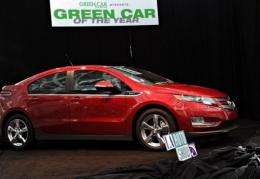
The Chevrolet Volt is shown after being named "Green Car of the Year" at the LA Auto Show in 2010

Enlarge

The Chevrolet Volt is shown after being named "Green Car of the Year" at the LA Auto Show in 2010. Five environmentally friendly cars are vying for the crown of Green Car of the Year at the LA Auto Show this week -- each using different fuel or fuel combinations.

Five environmentally friendly cars are vying for the crown of Green Car of the Year at the LA Auto Show this week -- each using different fuel or fuel combinations.

Demonstrating the growing range of options available for motorists wanting to cut their carbon footprint, the shortlist includes all-electric, gas-electric hybrid and natural gas-powered models.

The finalists for the accolade, the winner of which is to be announced on Thursday, are: the Natural Gas, the Volkswagen Passat TDI, the Mitsubishi i, the V and the Electric.

"There's all-electric, a diesel, a natural gas and there's a hybrid," said John O'Dell, senior editor at Edmunds.com -- a leading website for car buyers.

"That shows the industry is finally getting to the point where there's some consumer choice in green offerings. When you look at those vehicles, they run the gamut of fuel types, price range and vehicle types," he told the Los Angeles Times.

Last year the annual Los Angeles show's crown went to the 2011 , which beat back competition from Asian rivals including Nissan and Hyundai.

Of this year's finalists, the Mitsubishi and Ford contenders are all-electric; the Prius is a larger version of the popular gas-electric hybrid, the Volkswagen runs on diesel, and the Honda uses natural gas.

"We have some choices," said O'Dell, "and there will be far more choices a few years from now."

(c) 2011 AFP

Filter


Move the slider to adjust rank threshold, so that you can hide some of the comments.


Display comments: newest first

Nerdyguy
Nov 16, 2011

Rank: 1 / 5 (3)
I have yet to figure out how an all-electric car could be branded with the "green" label, when it relies on electricity that -- at least in the United States -- very likely comes from burning coal.
idaho
Nov 17, 2011

Rank: not rated yet
my electricity comes from hydro to power a green car. If you do not like your power choices do something about it.
antialias_physorg
Nov 17, 2011

Rank: not rated yet
I have yet to figure out how an all-electric car could be branded with the "green" label

it at least gives you the option to go green (while gasoline powered cars don't). That current electricity production comes from non-clean sources (coal, oil, gas, nuclear) doesn't mean it has to stay that way.

There are already energy companies out there that offer you deals where you can get your energy from clean sources. So if you're serious about going green then there's not much problem.
Nerdyguy
Nov 17, 2011

Rank: not rated yet
@idaho, @antialias: good points.

One question though Idaho: how would one realistically do something about changing a power source? Obviously, you live near a hyrdo plant. I'm near nuclear and coal. Other than producing one's power off-grid, most people, particularly in cities, aren't going to have much in the way of options.
antialias_physorg
Nov 17, 2011

Rank: not rated yet
Power companies (at least over here) do it this way: You get a contract that the number of Watts you use will be generated via renewables. This in turns means that (summed over all customers) the powerplant has to produce/buy X number of Watts off of relevant power sources.

The actual Watt you are getting out of your socket may come from any source since there aren't separate power lines for renewables or non-renewables.

It doesn't really matter whether my actual Watts are hydro and my neighbors' are coal or the other way around. Only that more Watts are generated via renewables and less via traditional methods.
Nerdyguy
Nov 17, 2011

Rank: not rated yet
Power companies (at least over here) do it this way: You get a contract that the number of Watts you use will be generated via renewables. This in turns means that (summed over all customers) the powerplant has to produce/buy X number of Watts off of relevant power sources.


I had no idea. Does it cost significantly more?

So, I was surprised to find this in my own state, seeing as how it's never mentioned:

On August 20, 2007, with the signing of Session Law 2007-397 (Senate Bill 3), North Carolina became the first state in the Southeast to adopt a Renewable Energy and Energy Efficiency Portfolio Standard (REPS). Under this new law, investor-owned utilities in North Carolina will be required to meet up to 12.5% of their energy needs through renewable energy resources or energy efficiency measures. Rural electric cooperatives and municipal electric suppliers are subject to a 10% REPS requirement.

But nothing about availability for an individual to have any options.
antialias_physorg
Nov 17, 2011

Rank: not rated yet
I had no idea. Does it cost significantly more?

What do you mean by significantly? In some regions you can find eco-power providers that will actually give you lower rates than the standard rates by the large power companies (up to 20%). On average, though, eco-rates are about 10% more expensive.
I don't find that too bad, since if you're eco-minded you most likely don't waste all that much energy and your bill is lower than the standard household, anyways.

You have to do some careful checking on your power company, though, before you sign. In Europe you can buy power plant 'types' separately from powerplants. This means that a wily provider can buy the 'type' (e.g. 'hydro') off of a hydro powerplant in Norway and then slap it onto a nuclear powerplant in France.
Suddenly the former hydro plant is a nuclear plant and the nuclear plant is a hydro power plant (and they can sell you the power from the nuclear plant as 'green' without ever buying any renewable power at all).
Nerdyguy
Nov 17, 2011

Rank: not rated yet
What do you mean by significantly? In some regions you can find eco-power providers that will actually give you lower rates than the standard rates by the large power companies (up to 20%). On average, though, eco-rates are about 10% more expensive.
I don't find that too bad, since if you're eco-minded you most likely don't waste all that much energy and your bill is lower than the standard household, anyways.

You have to do some careful checking on your power company, though, before you sign. In Europe you can buy power plant...


Very enlightening. This would seem to be a very practical and more easily-accepted means (vs. strict mandates) of encouraging more renewable energy. I've always believed that education plus decent options plus incentives (we have some of those re: green energy in the U.S., mostly tax rebates) = faster acceptance. People just feel better when they get to "make up their own minds" about an issue. Thanks for the heads-up.
Rank not rated yet
Relevant PhysicsForums posts

More news stories

Browser wars flare in mobile space

The browser wars are heating up again, but this time the fight is for dominance of the mobile Internet.

Technology / Software

created 12 hours ago | popularity 5 / 5 (2) | comments 3

Probability of contamination from severe nuclear reactor accidents is higher than expected: study

Catastrophic nuclear accidents such as the core meltdowns in Chernobyl and Fukushima are more likely to happen than previously assumed. Based on the operating hours of all civil nuclear reactors and the number ...

Technology / Energy & Green Tech

created May 22, 2012 | popularity 3.6 / 5 (22) | comments 56 | with audio podcast

HyperSolar shows dirty water no barrier to power world

(Phys.org) -- The Santa Barbara, California, company, HyperSolar, is set to transparently share the ups and downs of its research experiences toward the company’s ultimate vision, successfully producing ...

Technology / Energy & Green Tech

created May 24, 2012 | popularity 4.8 / 5 (16) | comments 17 | with audio podcast report

SpotterRF debuts Radar Backpack Kit (w/ Video)

(Phys.org) -- SpotterRF has announced a special radar backpack kit designed to enhance situational awareness for soldiers on the ground. The company says its special radar is designed for warfighters as part ...

Technology / Hi Tech & Innovation

created May 26, 2012 | popularity 5 / 5 (5) | comments 13 | with audio podcast report

Tesla to launch electric sedan in US on June 22

Tesla Motors said Tuesday it would begin deliveries of "the world's first premium electric sedan" on June 22, slightly ahead of schedule.

Technology / Energy & Green Tech

created May 22, 2012 | popularity 4.5 / 5 (12) | comments 18


Nvidia trumpets Tegra 3 phone design wins for 2012

(Phys.org) -- Nvidia’s competitive war paint has a name, Tegra 3. On the heels of Nvidia announcements about lowering costs of its Tegra 3 processors and Nvidia-enabled tablets running Android Ice Cream ...

'Unzipped' carbon nanotubes could help energize fuel cells, batteries

Multi-walled carbon nanotubes riddled with defects and impurities on the outside could replace some of the expensive platinum catalysts used in fuel cells and metal-air batteries, according to scientists at ...

T cells 'hunt' parasites like animal predators seek prey, study shows

By pairing an intimate knowledge of immune-system function with a deep understanding of statistical physics, a cross-disciplinary team at the University of Pennsylvania has arrived at a surprising finding: T cells use a movement ...

Computer model used to pinpoint prime materials for efficient carbon capture

When power plants begin capturing their carbon emissions to reduce greenhouse gases – and to most in the electric power industry, it's a question of when, not if – it will be an expensive undertaking.

Change in developmental timing was crucial in the evolutionary shift from dinosaurs to birds: study

At first glance, it's hard to see how a common house sparrow and a Tyrannosaurus Rex might have anything in common. After all, one is a bird that weighs less than an ounce, and the other is a dinosaur that ...

Land and sea species differ in climate change response: study

(Phys.org) -- Marine and terrestrial species will likely differ in their responses to climate warming, new research by Simon Fraser University and Australia’s University of Tasmania has found.