Plastic bottles solve Nigeria's housing problem
Nov 07, 2011 by Aminu Abubakar
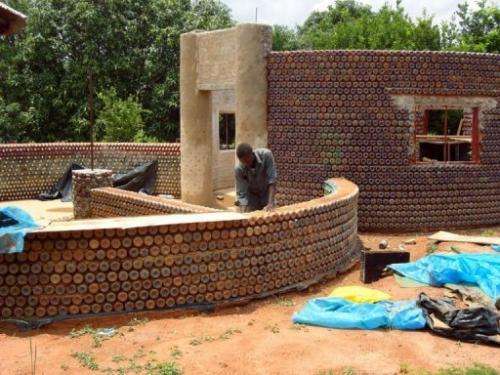
A man builds a wall with plastic bottles in the village of Sabon Yelwa. A group of activists have come up with a plan to build a house using bottles, providing what they say is an environmentally smart way to tackle the housing shortage problem in Nigeria.

The idea undoubtedly seemed strange at first: take the plastic water bottles that litter Nigeria's roads, canals and gutters and allow people to live inside them.

Not literally, but almost.

What a group of activists did was come up with a plan to build a house using those bottles, providing what they say is an environmentally smart strategy of chipping away at a housing shortage in Africa's most populous nation.

With the prototype near the northern Nigerian city of Kaduna now well underway, the group wants to extend its efforts and build more, aiming to unleash what they say is some long bottled-up potential.

Unconvinced? Supporters say those yet to see the structure on the outskirts of the village of Sabon Yelwa can throw stones if they want to. This house is being built to last.

"This is the first house in Africa built from bottles, which could go a long way in solving Nigeria's huge housing need and cleaning the badly polluted environment," project initiator Christopher Vassiliu said during a tour of the building.
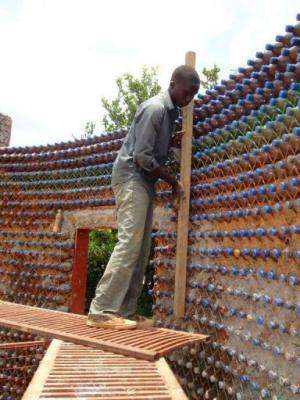
Nineteen-year old mason, Yahaya Musa, checks a wall of made of sand-filled plastic bottles in the village of Sabon Yelwa. Sitting on 58-square metres, the two-bedroom bungalow looks like an ordinary home.

It is in many ways a marvel to look at. The project was initiated by the Kaduna-based NGO Development Association for Renewable Energies (DARE), with help from foreign experts from Africa Community Trust, a London-based NGO.

Sitting on 58-square metres (624-square feet), the two-bedroom bungalow looks like an ordinary home, but it differs in many ways. When completed, the house whose construction started in June will be used to train masons in building such structures.

It is made from capped, sand-filled , each weighing three kilogrammes, or nearly two pounds.

The bottles are stacked into layers and bonded together by mud and cement, with an intricate network of strings holding each bottle by its neck, providing extra support to the structure.

Bottle caps of various colours protrude from the cement-plastered walls, giving them a unique look. Those behind the project claim the sand-filled bottles are stronger than ordinary cinder blocks.

"The structure has the added advantage of being fire proof, bullet proof and earthquake resistant, with the interior maintaining a constant temperature of 18 degrees C (64 degrees F) which is good for tropical climate," Yahaya Ahmad, the project coordinator said.
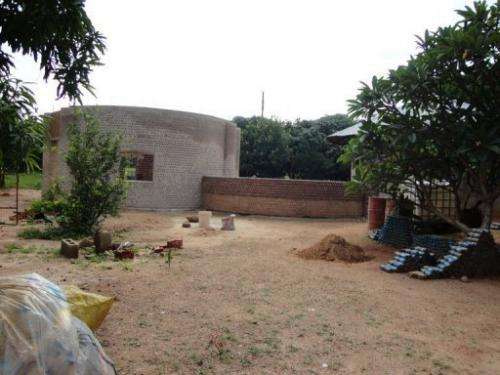
Outside view of a house under construction in the village of Sabon Yelwa. It is made from capped, sand-filled plastic bottles, each weighing three kilogrammes, or nearly two pounds.

With the right adjustments to the supporting pillars the building can be as high as three stories, but can go no higher due to the weight of the sand-filled bottles, Ahmad said.

Situated amidst an expansive irrigation farm, the building consists of a rotunda-shaped living room which connects to the interior via a short corridor.

Two rooms stand opposite with a bathroom and a toilet between them. A side door leads to an open courtyard and the kitchen.

The house is also designed to produce zero carbon emissions as it will be wholly powered by solar panels and methane gas from recycled human and animal waste.

"Nigeria has a serious waste and energy problem, and this project is one small step towards making positive changes," said Katrin Macmillan, a British environmental activist involved in the project.

"Plastic bottles take hundreds of years to bio-degrade in landfills."

Construction, which has reached 70 percent completion, is estimated to require 14,000 bottles. Huge piles of empty plastic bottles litter the site from donations from embassies, hotels and restaurants.

Environmental experts say Nigeria, a country of some 160 million, throws out about three million plastic bottles daily.

The country is also grappling with a deficit of 16 million housing units that requires a staggering 45 trillion naira ($300 billion) to meet, according to Nigeria's Federal Mortgage Bank.

Plastic houses are cheap to construct as it costs a quarter of the money required to build a conventional house, said Vassiliu, a Greek national who has been working in Nigeria as a water drilling engineer for 30 years.

The project is to cost two million naira ($12,700), Vassiliu said.

A second plastic bottle project is due to commence in January at a primary school in need of more classrooms in the town of Suleja near Nigeria's capital Abuja.

"The project would take 200,000 bottles out of landfills into education", said Macmillan.

Explore further: User awareness key to effective energy monitoring

add to favorites email to friend print save as pdf

Related Stories

Cement-like creation could help the environment

Apr 20, 2010

(PhysOrg.com) -- Civil and Environmental Engineering Assistant Professor Naji Khoury has created a permeable cement-like material that offers a host of environmental advantages over traditional paving.

Canada to ban BPA baby bottles

Apr 18, 2008

Canada became the first country to declare the widely used chemical bisphenol A unsuitable for use in baby bottles and set a ban mechanism in motion Friday.

Taiwan turns plastic junk to 'green' gold

Sep 13, 2010

The mountains of used plastic bottles at a recycling station in Taipei emit a faint smell of garbage dump, but soon they will be turned into wigs and clothes that people will wear.

Recommended for you

Radiation leak at Japan lab; small impact expected

4 hours ago

An atomic research lab in northern Japan has reported a radiation leak that may have affected about 50 people, though none were hospitalized and no impact was expected outside the facility, the lab's operator ...

The long road to the 2000-watt society

May 24, 2013

The vision of a society in which each inhabitant of the earth manages to consume only 2000 watts has already been around for 15 years. During this time, there has been a steady increase in environmental awareness ...

Germany must spread cost of energy shift fairly: IEA

May 24, 2013

The International Energy Agency said Friday that Germany must shield its consumers from paying too much of the cost of its ambitious switch from nuclear power and fossil fuels toward renewable energy.

Solar Kettle allows for boiling water off the grid

May 23, 2013

(Phys.org) —A company called Contemporary Energy has unveiled a new device it calls the Solar Kettle. It looks very much like a normal coffee thermos, but has flaps on one side that open to allow for collecting ...

User comments : 9

Adjust slider to filter visible comments by rank

Display comments: newest first

88HUX88
not rated yet Nov 07, 2011
they look like PET bottles, the most recyclable of all plastics, they shouldn't be in landfill. This is the wrong solution.
kaasinees
not rated yet Nov 07, 2011
I remember a house building project where they build a house out of old car tires and some other things what people consider junk.
At least it's now a house instead of a landfill.
Squirrel
not rated yet Nov 07, 2011
Beer bottles have been designed specifically so they can be reused as bricks in building.
http://inhabitat....ds-beer/
http://archinect....d-bottle

There is even a Wikipedia article on them
http://en.wikiped...tle_wall
TJ_alberta
not rated yet Nov 07, 2011
squirrel: thanks for telling us about the WOBO idea. As long as the builders don't have to empty the bottles themselves -- then the walls should go up straight.
jamey
not rated yet Nov 07, 2011
Ummm... Would be nice, though, if they didn't make the Martian Polar Express mistake while they were doing this. Three kilograms is about 6.6 pounds, not "nearly 2"
Sepp
not rated yet Nov 07, 2011
they look like PET bottles, the most recyclable of all plastics, they shouldn't be in landfill. This is the wrong solution.


What they are doing with these bottles IS recycling. If by recycling we mean that the bottles find another, useful purpose, after having served the primary purpose of carrying the water or soft drink they originally contained.
martinwolf
not rated yet Nov 07, 2011
good use of locally available building materials combined with creative utilization..nice..
melior
not rated yet Nov 07, 2011
Typo on the photo caption, should say "...or nearly 7 lbs."
Vendicar_Decarian
not rated yet Nov 08, 2011
The interior maintaining a constant temperature of 18 degrees C (64 degrees F).

This would appear to make energy wasting air conditioners mostly unnecessary.

More news stories

Yahoo, pay-TV operators among Hulu bidders

Online video site Hulu is again up for sale, with Yahoo and pay TV operators DirecTV and Time Warner Cable among the seven bidders, according to a person with direct knowledge of the matter.

Radiation leak at Japan lab; small impact expected

An atomic research lab in northern Japan has reported a radiation leak that may have affected about 50 people, though none were hospitalized and no impact was expected outside the facility, the lab's operator ...

Google eyes emerging markets networks

Google has become deeply involved in a series of projects to build and operate wireless networks in emerging markets including sub-Saharan Africa and Southeast Asia, a report said Friday.

Facial-recognition technology proves its mettle

(Phys.org) —In a study that evaluated some of the latest in automatic facial recognition technology, researchers at Michigan State University were able to quickly identify one of the Boston Marathon bombing ...

Galaxies fed by funnels of fuel

(Phys.org) —Computer simulations of galaxies growing over billions of years have revealed a likely scenario for how they feed: a cosmic version of swirly straws.