Developing economies see no escape from coal

November 25, 2011 by Sibongile Khumalo

Coal generates 90 percent of electricity in South Africa, 70 percent in China and 55 percent in India

Enlarge

File photo of a coal-powered power plant in China's Shanxi province. Coal currently generates 70 percent of power in China. The nation plans to reduce this 63 percent by 2015.

Concrete towers rise over the African bush, as the continent's largest coal-fired power station takes shape in a multi-billion-dollar testament to developing nations' love affair with coal.

South Africa, like China and India, has large domestic coal supplies that provide a cheap source of to meet an ever-growing demand.

But this has also placed the three nations among the world's leading producers of , which are a key driver of climate change.

The countries are among the world's top five producers of coal, which generates 90 percent of electricity in South Africa, 70 percent in China, and 55 percent in India.

The three nations are collectively pouring tens of billions of dollars into new coal plants, while also pushing ahead with plans for nuclear and renewable energy generation.

"These days coal has become something like a swear word. No one likes it, but the country needs electricity," said Cornelis van der Waal, a South African energy analyst at consultancy firm Frost and Sullivan.

"Everyone would love clean energy but coal is cheap and at this stage this is what the country can afford," he said.
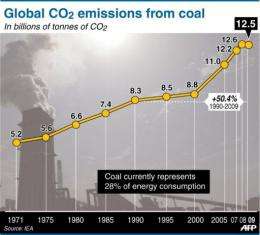
Global CO2 emissions from coal since 1971
Enlarge

Graphic showing world carbon dioxide emissions from coal since 1971.

South Africa plans to double its energy supply over the next 20 years, but despite ambitious proposals for renewable and nuclear power production coal will still make up 65 percent of the mix.

The 125-billion rand ($14.8 billion, 11 billion euro) Medupi station outside the northern town of Lephalale, expected to go online in two years, will be the fourth-largest plant in the world. The equally large Kusile station is already under construction.

Medupi is touted as Africa's first "supercritical" , using higher temperatures that produce more energy from less coal, while emitting less ash and . The plant will also have bag filters to trap more emissions.

China is pressing ahead with new carbon capture and that would trap carbon dioxide underground. South Africa and India say such technology remains a distant prospect for them.

One such scheme is being built in Inner Mongolia by state-owned China Shenhua Group, which plans to pump liquefied carbon dioxide underground in the desert, where it could be stored for 1,000 years.
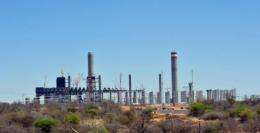
South Africa plans to double its energy supply over the next 20 years but coal will still make up 65 percent of the mix.
Enlarge

The 125-billion-rand ($14.8 billion, 11 billion euro) Medupi station in South Africa is expected to come online in two years. The plant will be the fourth-largest coal power station in the world.

China has not revealed the cost or extent of its power expansion but plans to bring coal down to 63 percent of its energy mix by 2015.

India, on the other hand, expects coal to grow to 65 percent of its supply by 2030. It has built 55 coal-fired plants since 2007, and plans another 100 over the next decade, the coal ministry says.

Environmental activists complain that nations are not doing enough to develop renewable energy sources, and are piling particular scorn on South Africa, as the host of UN climate talks that begin on Monday in Durban.

"Renewable energy beats coal in every context, and building colossal coal-fired power stations is absurd in the face of the catastrophic effects of climate change," said Melita Steele, a Greenpeace Africa climate campaigner.

"There are no environmentally acceptable ways of burning coal. Burning coal is one of the most destructive practices on the planet, and the true cost of coal is destruction at every step," said Steele.

But emerging nations argue that technologies for wind and solar power are only able to address a small part of their energy needs.

"Renewable energy projects are good for remote areas but for urban centres coal is the only source to generate power as it caters to our demand of continuous energy needs," said Umashankar S., programme manager for Industry and Environment at India's Centre for Science and Environment.

"In a developing economy, there is no getting away from ."

(c) 2011 AFP

Filter


Move the slider to adjust rank threshold, so that you can hide some of the comments.


Display comments: newest first

rawa1
Nov 25, 2011

Rank: 1 / 5 (12)
For Chinese it would be much more strategic to deal with cold fusion ASAP. It would cover the need of energy and they could store the coal for chemical industry. These needs the cold fusion cannot cover, not to say about devastation of life environment in China.
dogbert
Nov 25, 2011

Rank: 2.6 / 5 (12)
As usual, the article decries the use of plentiful, cheap and energy dense coal while touting the use of prohibitively expensive and woefully inadequate renewal energy sources.

The human cost of denying billions of people adequate energy is not even considered.

Coal will continue to be used in developing nations and in developed nations because it addresses energy needs as alternative sources cannot.
rawa1
Nov 25, 2011

Rank: 1.7 / 5 (11)
the article decries the use of plentiful, cheap and energy dense coal while touting the use of prohibitively expensive..
It's true, but the free market economy operates with current prices only. It cannot foresee the future, which is why it's oscillating in periodic crisis. In addition, the free market economy isn't able to take account into distributed, i.e. "hidden" cost of environmental problems, like the aerosols induced droughts. The hidden risk of fossil fuel economy is, it cannot be switched into another so easily, when the fossil fuel reserves will get depleted. After then the people will get refrain to the only solution, which they know: the global nuclear war, which will limit their consumption. I'm convinced, we have more farseeing ways how to go. The burning of Chinese coil bring the global ecological problems, not just the drought in China.
http://disc.sci.g...obal.jpg
rawa1
Nov 25, 2011

Rank: 1 / 5 (11)
We should realize, that the Chinese civilization is very opportunistic. The people who are stealing the intellectual property, eating the dogs and paying the killing of rhinos for their horns will indeed burn the coal, if they would consider it advantageous temporarily. If they can see some money, they will use it without any moral scruples.

http://www.telegr...age.html

http://www.treehu...age.html

On the other hand, the western democracy is ignoring the cold fusion for decades from the very same reason, so it's difficult to judge the Chinese just with respect to their coal burning.
ShotmanMaslo
Nov 25, 2011

Rank: 5 / 5 (7)
We should realize, that the Chinese civilization is very opportunistic. The people who are stealing the intellectual property, eating the dogs and paying the killing of rhinos for their horns will indeed burn the coal, if they would consider it advantageous temporarily.


Cannot blame them for it, cheap energy is essential for modern society, and Chinese do not use much if expressed per capita. Chinese are also leading the development in liquid fuel thorium reactors and renewables for the future.

On the other hand, the western democracy is ignoring the cold fusion for decades from the very same reason, so it's difficult to judge the Chinese just with respect to their coal burning.


Cold fusion is not real.
rawa1
Nov 25, 2011

Rank: 1 / 5 (9)
Cold fusion is not real.
Of course, the fossil fuel based countries like the Poland, Russia or China cannot be happy from cold fusion at all. These countries will lose their money invested into fossil fuel shares and technologies.

http://nextbigfut...all.html

http://pesn.com/2...icensee/
antialias_physorg
Nov 25, 2011

Rank: 5 / 5 (7)
These countries will lose their money invested into fossil fuel shares and technologies.
How much money have you invested into cold fusion?
Let me guess. None.

So stop criticizing others' investment.

As to the article. I think the developed countries are missing a really big opportunity here by not setting up alternative power plants in developing countries (low labor costs, cheap land, optimal weather conditions).
Taking a cut of the energy for production of portable energy sources (artificial ethanol, hydroge, whatever) could be well worth the investment.
Osiris1
Nov 25, 2011

Rank: 1 / 5 (1)
Oh just wait til the Chinese use nuclear boosters and rockets for its space program. Why the efficiency of nuclear rocket systems allow within the envelope of contemporary mechanical and rocketry engineering's structural capabilities a much greater volume and flexibility of cargoes for a much wider diversification of mission possibilities. You would not BE REQUIRED TO USE OVER NINETY PERCENT OF THE SHIP FOR FUEL STORAGE that is useless with five minutes of takeoff! So what if the world protests! How many divisions does the 'world' have to stop them? Mankind will progress. The only choice is what ethical flavor...short lived republican budget cutters or long lived Chinese explorers who WILL find a second home for humanity....and put their stamp on it. They HAVE the coal so it is up to them to use those chemicals where it is cheapest to use them. So the world gets warmer. That only means that the presently unproductive Gobi desert can then be farmed.
Pirouette
Nov 25, 2011

Rank: 2.2 / 5 (10)
There's also the political reasons for China to use their coal. . . .the comfort of a heated home for their own people. The more comfort their people experience in Red China, the less worry for the government that there will be an uprising against their leaders by the discontented. That's not to say that a counter revolution can't occur anyway due to anger from the oppressed people. But it's less likely if the government provides the people with the things they need most. . .like a warm house. And cheap coal means low heating bills and electricity. Some things are deemed more important. . .like keeping your arse warm in the dead of winter. :)
StarGazer2011
Nov 28, 2011

Rank: 3 / 5 (4)
"Renewable energy beats coal in every context," ... except cost, scalability and reliability :)
ShotmanMaslo
Nov 28, 2011

Rank: not rated yet
Osiris - nuclear rockets are unsuitable for liftoff, but they will be great for deep space propulsion. The cancellation of project Orion was one of the greatest mistakes and "what ifs" of western science and technology, along with cancellation of the Saturn program and Oak Ridge molten salt fueled reactor program in the 70s.
antialias_physorg
Nov 28, 2011

Rank: not rated yet
except cost, scalability and reliability :)

Reliability? Maybe.

Cost? If you add up all the ancillary cost (pollution, health costs) then alternative power sources are WAY cheaper. But since we pay those with our taxes (or simply let following generations or other countries pay the consequences) we don't see that.

Scaleability? What is more scaleable than windparks and solar thermal or PV fields?

And if you spread you production capacity over a large anough area (the US or Europe) then the reliability is there. Tests with interconnected alternative energy power plants in germany have shown that you can get 100% BASE load all year round if you use a sensible mix.
Rank 5 /5 (4 votes)
Relevant PhysicsForums posts

More news stories

Browser wars flare in mobile space

The browser wars are heating up again, but this time the fight is for dominance of the mobile Internet.

Technology / Software

created 9 hours ago | popularity 5 / 5 (1) | comments 3

Probability of contamination from severe nuclear reactor accidents is higher than expected: study

Catastrophic nuclear accidents such as the core meltdowns in Chernobyl and Fukushima are more likely to happen than previously assumed. Based on the operating hours of all civil nuclear reactors and the number ...

Technology / Energy & Green Tech

created May 22, 2012 | popularity 3.6 / 5 (22) | comments 56 | with audio podcast

SpotterRF debuts Radar Backpack Kit (w/ Video)

(Phys.org) -- SpotterRF has announced a special radar backpack kit designed to enhance situational awareness for soldiers on the ground. The company says its special radar is designed for warfighters as part ...

Technology / Hi Tech & Innovation

created May 26, 2012 | popularity 5 / 5 (5) | comments 13 | with audio podcast report

HyperSolar shows dirty water no barrier to power world

(Phys.org) -- The Santa Barbara, California, company, HyperSolar, is set to transparently share the ups and downs of its research experiences toward the company’s ultimate vision, successfully producing ...

Technology / Energy & Green Tech

created May 24, 2012 | popularity 4.8 / 5 (16) | comments 17 | with audio podcast report

Tesla to launch electric sedan in US on June 22

Tesla Motors said Tuesday it would begin deliveries of "the world's first premium electric sedan" on June 22, slightly ahead of schedule.

Technology / Energy & Green Tech

created May 22, 2012 | popularity 4.5 / 5 (12) | comments 18


Land and sea species differ in climate change response: study

(Phys.org) -- Marine and terrestrial species will likely differ in their responses to climate warming, new research by Simon Fraser University and Australia’s University of Tasmania has found.

Almost half of new vets seek disability

(AP) -- America's newest veterans are filing for disability benefits at a historic rate, claiming to be the most medically and mentally troubled generation of former troops the nation has ever seen.

'Unzipped' carbon nanotubes could help energize fuel cells, batteries

Multi-walled carbon nanotubes riddled with defects and impurities on the outside could replace some of the expensive platinum catalysts used in fuel cells and metal-air batteries, according to scientists at ...

T cells 'hunt' parasites like animal predators seek prey, study shows

By pairing an intimate knowledge of immune-system function with a deep understanding of statistical physics, a cross-disciplinary team at the University of Pennsylvania has arrived at a surprising finding: T cells use a movement ...

Computer model used to pinpoint prime materials for efficient carbon capture

When power plants begin capturing their carbon emissions to reduce greenhouse gases – and to most in the electric power industry, it's a question of when, not if – it will be an expensive undertaking.

Change in developmental timing was crucial in the evolutionary shift from dinosaurs to birds: study

At first glance, it's hard to see how a common house sparrow and a Tyrannosaurus Rex might have anything in common. After all, one is a bird that weighs less than an ounce, and the other is a dinosaur that ...