Clean soot particle filters
October 5, 2011

Clean soot particle filters

Enlarge

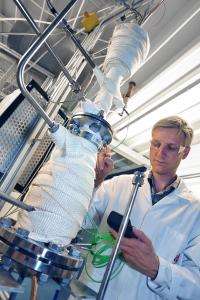
A researcher checks whether the soot particle filter is freed from soot even at exhaust temperatures of 140 degrees Celsius. (© Fraunhofer ISE)

The soot particle filters found on diesel vehicles are designed to ensure that no harmful particles make their way through the exhaust pipe. Often, though, the exhaust from newer-model engines is not hot enough to free the filters from soot particles on a regular basis. A new method removes impurities even at low exhaust temperatures.

Long gone are the days when spewed black clouds of exhaust into the air: Nowadays, there are filters in place that capture the largest of these soot particles. After a time, if too much soot accumulates in the filter, the soot is burned off and the filter is regenerated. The problem: only burn above temperatures of 500 to 600 degrees Celsius. Yet the temperature of truck exhaust is increasingly dropping as part of the effort to minimize of nitric oxides harmful to the environment.

There exist two approaches to removing soot from the filter: the first involves an oxidation that converts nitrogen monoxide in the exhaust into . If nitrogen dioxide is passed through the filter, the soot burns at lower temperatures. In some engine operating states – such as when the engine is still cold – this regeneration method does not suffice: In these cases, liquid fuel is added, that combusts with residual oxygen in the exhaust to heat the exhaust and filter. This cleansing method only works at exhaust temperatures in excess of 230 degrees Celsius, however. At lower temperatures, the fuel-exhaust mixture fails to ignite, damaging the catalytic converter. The problem: Exhaust from newer-model truck engines is only 160 to 180 degrees Celsius.

Researchers at the Fraunhofer Institute for Solar Energy Systems ISE in Freiburg, Germany, have come up with a method that reliably regenerates filters even at exhaust temperatures as low as 140 degrees. “We add a synthesis gas consisting of carbon monoxide and hydrogen to the exhaust,“ explains Dr. Thomas Aicher, group manager at ISE. “We introduce this gas mixture at the oxidation catalytic converter – lowering the ignition temperature to 140 degrees Celsius and freeing the filter from even at these low exhaust temperatures.“

But where does this synthesis gas come from? “We have two ways to generate this gas: One is to heat diesel fuel in the absence of air. This produces hydrogen and carbon. Then, the carbon is burned with the exhaust, creating carbon monoxide. Experts refer to this process as pyrolysis. The other way is to oxidize diesel with a very small amount of air so that the diesel combusts only partially. This is known as partial oxidation,“ explains Robert Szolak, a scientist at ISE. Researchers have already built and successfully tested prototypes for both approaches. The experts have now partnered with an industrial partner to investigate partial in greater detail.

Provided by Fraunhofer-Gesellschaft search and more info website

Filter


Move the slider to adjust rank threshold, so that you can hide some of the comments.


Display comments: newest first

unknownorgin
Oct 13, 2011

Rank: not rated yet
It is very clear that the filter system for diesel trucks is not a practical system and was required on trucks just to get somthing on the exhust pipe even if it did not work. The idea to fix this failure requires another chamber and the burning of more fuel. This foolishness costs everyone more money because of higher shipping costs to pay for these crackpot inventions.
Rank not rated yet
Relevant PhysicsForums posts

More news stories

Browser wars flare in mobile space

The browser wars are heating up again, but this time the fight is for dominance of the mobile Internet.

Technology / Software

created 9 hours ago | popularity 5 / 5 (1) | comments 3

Probability of contamination from severe nuclear reactor accidents is higher than expected: study

Catastrophic nuclear accidents such as the core meltdowns in Chernobyl and Fukushima are more likely to happen than previously assumed. Based on the operating hours of all civil nuclear reactors and the number ...

Technology / Energy & Green Tech

created May 22, 2012 | popularity 3.6 / 5 (22) | comments 56 | with audio podcast

SpotterRF debuts Radar Backpack Kit (w/ Video)

(Phys.org) -- SpotterRF has announced a special radar backpack kit designed to enhance situational awareness for soldiers on the ground. The company says its special radar is designed for warfighters as part ...

Technology / Hi Tech & Innovation

created May 26, 2012 | popularity 5 / 5 (5) | comments 13 | with audio podcast report

HyperSolar shows dirty water no barrier to power world

(Phys.org) -- The Santa Barbara, California, company, HyperSolar, is set to transparently share the ups and downs of its research experiences toward the company’s ultimate vision, successfully producing ...

Technology / Energy & Green Tech

created May 24, 2012 | popularity 4.8 / 5 (16) | comments 17 | with audio podcast report

Tesla to launch electric sedan in US on June 22

Tesla Motors said Tuesday it would begin deliveries of "the world's first premium electric sedan" on June 22, slightly ahead of schedule.

Technology / Energy & Green Tech

created May 22, 2012 | popularity 4.5 / 5 (12) | comments 18


'Unzipped' carbon nanotubes could help energize fuel cells, batteries

Multi-walled carbon nanotubes riddled with defects and impurities on the outside could replace some of the expensive platinum catalysts used in fuel cells and metal-air batteries, according to scientists at ...

T cells 'hunt' parasites like animal predators seek prey, study shows

By pairing an intimate knowledge of immune-system function with a deep understanding of statistical physics, a cross-disciplinary team at the University of Pennsylvania has arrived at a surprising finding: T cells use a movement ...

Computer model used to pinpoint prime materials for efficient carbon capture

When power plants begin capturing their carbon emissions to reduce greenhouse gases – and to most in the electric power industry, it's a question of when, not if – it will be an expensive undertaking.

Change in developmental timing was crucial in the evolutionary shift from dinosaurs to birds: study

At first glance, it's hard to see how a common house sparrow and a Tyrannosaurus Rex might have anything in common. After all, one is a bird that weighs less than an ounce, and the other is a dinosaur that ...

Yale study concludes public apathy over climate change unrelated to science literacy

Are members of the public divided about climate change because they don't understand the science behind it? If Americans knew more basic science and were more proficient in technical reasoning, would public consensus match ...

Same gene that stunts infants' growth also makes them grow too big: research

UCLA geneticists have identified the mutation responsible for IMAGe* syndrome, a rare disorder that stunts infants' growth. The twist? The mutation occurs on the same gene that causes Beckwith-Wiedemann syndrome, which makes ...