Solar-powered air-conditioning system for vehicles
October 11, 2011 By Wilfred Lai

Solar-powered air-conditioning system for vehicles

Enlarge

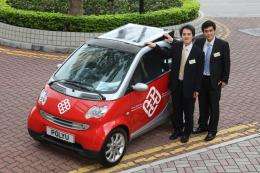
Solar private car. Credit: Partnership Development Office

Great news for drivers! They can now continue to keep the air-conditioning system on during the hot sunny days even when they stop the vehicle and switch off the engine. In collaboration with Green Power Industrial Ltd, PolyU's Department of Electrical Engineering has developed an innovative air-conditioning system for vehicles that can turn scorching summer heat into cool air without a single drop of gasoline.

Motorists are so used to turn on the engine for air-conditioning. Our solar-powered air-conditioning system for vehicles (SAV) will break this convention. Featuring photovoltaic technology and intelligent power control, SAV switches on-board air-conditioner to when petrol engine shuts off, and the switch-over is automatic and seamless.

Principal investigator of this project Prof Eric Cheng explained, "Drivers of minibuses or taxis can now switch off the engine but continue to stay cool while waiting for passengers at the station. In fact, our system helps extend the operation of air-conditioner for two more hours." Prof Cheng further stressed that this device can also give good power output even during cloudy or .

Similar to a big , this system has on the rooftop of the vehicle to collect power for storage in a battery to support a stand-alone electric air-conditioning unit when the is not running. The solar panel is made from bendy materials which can fit perfectly on any vehicle rooftop, giving it a sleek appearance. It also serves as a good thermal insulation for the interior and other valuable equipments inside the vehicle.

Idling not only pollutes the air, but is also bad for the engine as it may contaminate and accelerate the deterioration of components due to higher operational temperature and unnecessary prolonged operation. According to recent statistics, leaving a vehicle on idle for as short as 10 minutes a day will consume an average of 100 litres of petrol in one year. In other words, adopting our SAV can help save drivers' petrol and fuel cost.

PolyU's President Prof Timothy W. Tong hailed the device as a practical solution that could benefit thousands of professional drivers and pedestrians in the city. The installation of our SAV on a Swire Coca-Cola Hong Kong truck was first announced in October last year. A series of testing on the road have proven the system robust and effective. To make another milestone on the road to green transport, the system is now being widely deployed in public transport such as minibuses and taxis, as well as some commercial vehicles including an operation truck of the Airport Authority Hong Kong.

"We look forward to having more fruitful collaboration with Green Power Industrial Ltd and other industrial partners to build a low-carbon city. Together, we can jointly make a contribution for sustainable development of our community," said Prof Tong.

As part of an on-going mission in advancing technology that safeguards natural resources and our ecosystem, SAV is the latest from a stream of PolyU's green innovations with an aim to reduce harmful emissions and eliminate the effects of climate change. This system has also brought home two international awards from the 39th International Exhibition of Inventions of Geneva in April this year. This accolade will certainly serve as recognition of the hard work, the know-how and the dedication that PolyU researchers have put in creating meaningful innovations that move us towards a sustainable society.

Provided by The Hong Kong Polytechnic University

Filter


Move the slider to adjust rank threshold, so that you can hide some of the comments.


Display comments: newest first

dschlink
Oct 11, 2011

Rank: 5 / 5 (1)
This would be especially useful for diesel vehicles. My van's manual explicitly states that repeated idling for more than 5 minutes at a time can damage the engine. I've seen the results, ain't pretty.
CapitalismPrevails
Oct 11, 2011

Rank: not rated yet
I wonder how much charge this would provide for driving instead of a/c.
jerryd
Oct 11, 2011

Rank: 5 / 5 (1)
Won't work as not enough PV to power any known AC. Best to just use it to power a fan to keep temps at outside air temp.
tarheelchief
Oct 11, 2011

Rank: 5 / 5 (1)
This has been done on yachts for decades.If you could harness for recharging the batteries for power,and use it on freight trains as well you could make a fortune.
Howhot
Oct 11, 2011

Rank: 3 / 5 (1)
It's a great idea for EVs and if the AC isn't used, have the solar cells re-directed to charging that battery pack(s). Dump any excess back to the grid if you have enough spare battery capacity when you get home. For all of the million of commuters that drive to work, park the car for 8-9 hours we could solve the energy crisis.
Vendicar_Decarian
Oct 12, 2011

Rank: 5 / 5 (1)
"For all of the million of commuters that drive to work, park the car for 8-9 hours we could solve the energy crisis." - Howhot

Not even close.

Lets run some numbers. 400 million cars in the U.S. 1 square meter of roof area available, 8 hours of sunlight, 10 percent conversion efficiency.

1.5 kilowatts per square meter at 10 percent efficiency = 150 watts collected * 8 hours * 0.4 for the collection angle = 0.5 kilowatt hours of energy per car or roughly 200 million kilowatt hours of energy in total.

Average U.S. electric consumption is 24 kilowatt hours per day per household, so the amount of energy generated would be enough to power 8 million homes.
Bob_Kob
Oct 12, 2011

Rank: 5 / 5 (1)
Because every car is somewhere in direct sunlight 8 hours a day (i.e. not in undercover garage or parking lot).
a_n_k_u_r
Oct 12, 2011

Rank: 5 / 5 (1)
Harnessing energy from sun on vehicles make a LOT of sense:
1. Converting part of energy into electricity any way reduces heat.
2. The cost of electrical energy -- coming from gas/petrol -- is relatively higher than cost of electricity at home.
88HUX88
Oct 12, 2011

Rank: not rated yet
First, for hot climates a safari roof is passive and cheaper and would reduce the load on any air conditioner. The world seems to have forgotten about safari roofs. Second, is this a fix for bad habits? Running a bus engine to cool one person; is there no alternative? What about providing shaded parking or somewhere cool for them to wait?
Howhot
Oct 12, 2011

Rank: not rated yet
Vendicar, it also depends on the battery capacity carried with the vehicle too. I agree, i was stretching it a tad when I said "solve the energy crisis", but I could help play a part and if it help reduced you cost of ownership of an EV, or plugin hybrid, wouldn't everyone want to do it?

It seems very do-able technology-wise, just need solar panels shaped like body parts.
Rank 5 /5 (4 votes)
Relevant PhysicsForums posts

More news stories

Browser wars flare in mobile space

The browser wars are heating up again, but this time the fight is for dominance of the mobile Internet.

Technology / Software

created 9 hours ago | popularity 5 / 5 (1) | comments 3

Probability of contamination from severe nuclear reactor accidents is higher than expected: study

Catastrophic nuclear accidents such as the core meltdowns in Chernobyl and Fukushima are more likely to happen than previously assumed. Based on the operating hours of all civil nuclear reactors and the number ...

Technology / Energy & Green Tech

created May 22, 2012 | popularity 3.6 / 5 (22) | comments 56 | with audio podcast

SpotterRF debuts Radar Backpack Kit (w/ Video)

(Phys.org) -- SpotterRF has announced a special radar backpack kit designed to enhance situational awareness for soldiers on the ground. The company says its special radar is designed for warfighters as part ...

Technology / Hi Tech & Innovation

created May 26, 2012 | popularity 5 / 5 (5) | comments 13 | with audio podcast report

HyperSolar shows dirty water no barrier to power world

(Phys.org) -- The Santa Barbara, California, company, HyperSolar, is set to transparently share the ups and downs of its research experiences toward the company’s ultimate vision, successfully producing ...

Technology / Energy & Green Tech

created May 24, 2012 | popularity 4.8 / 5 (16) | comments 17 | with audio podcast report

Tesla to launch electric sedan in US on June 22

Tesla Motors said Tuesday it would begin deliveries of "the world's first premium electric sedan" on June 22, slightly ahead of schedule.

Technology / Energy & Green Tech

created May 22, 2012 | popularity 4.5 / 5 (12) | comments 18


'Unzipped' carbon nanotubes could help energize fuel cells, batteries

Multi-walled carbon nanotubes riddled with defects and impurities on the outside could replace some of the expensive platinum catalysts used in fuel cells and metal-air batteries, according to scientists at ...

T cells 'hunt' parasites like animal predators seek prey, study shows

By pairing an intimate knowledge of immune-system function with a deep understanding of statistical physics, a cross-disciplinary team at the University of Pennsylvania has arrived at a surprising finding: T cells use a movement ...

Computer model used to pinpoint prime materials for efficient carbon capture

When power plants begin capturing their carbon emissions to reduce greenhouse gases – and to most in the electric power industry, it's a question of when, not if – it will be an expensive undertaking.

Change in developmental timing was crucial in the evolutionary shift from dinosaurs to birds: study

At first glance, it's hard to see how a common house sparrow and a Tyrannosaurus Rex might have anything in common. After all, one is a bird that weighs less than an ounce, and the other is a dinosaur that ...

Yale study concludes public apathy over climate change unrelated to science literacy

Are members of the public divided about climate change because they don't understand the science behind it? If Americans knew more basic science and were more proficient in technical reasoning, would public consensus match ...

Same gene that stunts infants' growth also makes them grow too big: research

UCLA geneticists have identified the mutation responsible for IMAGe* syndrome, a rare disorder that stunts infants' growth. The twist? The mutation occurs on the same gene that causes Beckwith-Wiedemann syndrome, which makes ...