Physicists turn liquid into solid using an electric field
October 11, 2011

Physicists turn liquid into solid using an electric field

Enlarge

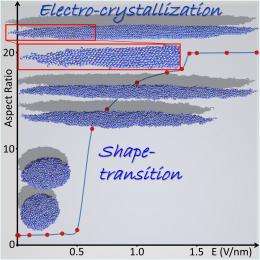
Electrocrystallization. Shape transitions and predicted electrocrystallization of a 10 nanometer formamide nano-droplet, obtained through molecular dynamics simulations. The vertical axis shows the aspect ratio between the long and short axes of the droplet.

(PhysOrg.com) -- Physicists have predicted that under the influence of sufficiently high electric fields, liquid droplets of certain materials will undergo solidification, forming crystallites at temperature and pressure conditions that correspond to liquid droplets at field-free conditions. This electric-field-induced phase transformation is termed electrocrystallization.

The study, performed by scientists at the Georgia Institute of Technology, appears online and is scheduled as a feature and cover article in the 42nd issue of Volume 115 of the .

“We show that with a strong , you can induce a phase transition without altering the thermodynamic parameters,” said Uzi Landman, Regents’ and Institute Professor in the School of Physics, F.E. Callaway Chair and director of the Center for Computational Materials Science (CCMS) at Georgia Tech.

In these simulations, Landman and Senior Research Scientists David Luedtke and Jianping Gao at the CCMS set out first to explore a phenomenon described by Sir Geoffrey Ingram Taylor in 1964 in the course of his study of the effect of lightning on raindrops, expressed as changes in the shape of drops when passing through an electric field.  While liquid drops under field-free conditions are spherical, they alter their shape in response to an applied electric field to become needle-like liquid drops. Instead of the water droplets used in the almost decade-old laboratory experiments of Taylor, the Georgia Tech researchers focused their theoretical study on a 10 nanometer (nm) diameter liquid droplet of formamide, which is a material made of small polar molecules each characterized by a dipole moment that is more than twice as large as that of a water molecule.  

With the use of molecular dynamics simulations developed at the CCMS, which allow scientists to track the evolution of materials systems with ultra-high resolution in space and time, the physicists explored the response of the formamide nano-droplet to an applied electric field of variable strength. Influenced by a field of less than 0.5V/nm, the spherical droplet elongated only slightly. However, when the strength of the field was raised to a critical value close to 0.5 V/nm, the simulated droplet was found to undergo a shape transition resulting in a needle-like liquid droplet with its long axis – oriented along the direction of the applied field – measuring about 12 times larger than the perpendicular (cross-sectional) small axis of the needle-like droplet. The value of the critical field found in the simulations agrees well with the prediction obtained almost half a decade ago by Taylor from general macroscopic considerations.

Past the shape transition further increase of the applied electric field yielded a slow, gradual increase of the aspect ratio between the long and short axes of the needle-like droplet, with the formamide molecules exhibiting liquid diffusional motions. 

“Here came the Eureka moment,” said Landman. “When the field strength in the simulations was ramped up even further, reaching a value close to 1.5V/nm, the liquid needle underwent a solidification phase transition, exhibited by freezing of the diffusional motion, and culminating in the formation of a formamide single crystal characterized by a structure that differs from that of the x-ray crystallographic one determined years ago under zero-field conditions. Now, who ordered that?” he added. 

Further analysis has shown that the crystallization transition involved arrangement of the molecules into a particular spatial ordered lattice, which optimizes the interactions between the positive and negative ends of the dipoles of neighboring molecules, resulting in minimization of the free energy of the resulting rigid crystalline needle.  When the electric field applied to the droplet was subsequently decreased, the crystalline needle remelted and at zero-field the liquid droplet reverted to a spherical shape. The field reversal process was found to exhibit a hysteresis.

Analysis of the microscopic structural changes that underlie the response of the droplet to the applied field revealed that accompanying the shape transition at 0.5 V/nm is a sharp increase in the degree of reorientation of the molecular electric dipoles, which after the transition lie preferentially along the direction of the applied electric field and coincide with the long axis of the needle-­­like liquid droplet. The directional dipole reorientation, which is essentially complete subsequent to the higher field electrocrystallization transition, breaks the symmetry and transforms the droplet into a field-induced ferroelectric state where it possesses a large net electric dipole, in contrast to its unpolarized state at zero–field conditions. 

Along with the large-scale atomistic computer simulations, researchers formulated and evaluated an analytical free-energy model, which describes the balance between the polarization, interfacial tension and dielectric saturation contributions. This model was shown to yield results in agreement with the computer simulation experiments, thus providing a theoretical framework for understanding the response of dielectric droplets to applied fields.

“This investigation unveiled fascinating properties of a large group of materials under the influence of applied fields,” Landman said. “Here the field-induced shape and crystallization transitions occurred because formamide, like water and many other materials, is characterized by a relatively large electric dipole moment. The study demonstrated the ability to employ external fields to direct and control the shape, the aggregation phase (that is, solid or liquid) and the properties of certain materials.” 

Along with the fundamental interest in understanding the microscopic origins of materials behavior, this may lead to development of applications of field-induced materials control in diverse areas, ranging from targeted drug delivery, nanoencapsulation, printing of nanostructures and surface patterning, to aerosol science, electrospray propulsion and environmental science.

Provided by Georgia Institute of Technology search and more info website

4.4 /5 (12 votes)  

Filter


Move the slider to adjust rank threshold, so that you can hide some of the comments.


Display comments: newest first

Isaacsname
Oct 11, 2011

Rank: not rated yet
This has to be the coolest thing I've read this morning. Sounds like a new generation of bulletproof materials are on the way.
SCVGoodToGo
Oct 11, 2011

Rank: 5 / 5 (1)
or Terminators
antialias_physorg
Oct 11, 2011

Rank: not rated yet
or Terminators


Likely more fast-acting shapeshift materials. I would like to see this tested on wing surfaces in order to adapt to micro turbulences instead of the static wing surfaces we use now. Could give us the elegant and swift adaptation to air currents that feathers give to birds.

I wonder if this can also be used in reverse on a highly polar, oriented solid to liquefy it.
Nanobanano
Oct 11, 2011

Rank: 1 / 5 (1)
Cybernetics.

Artificial muscle for the maimed and disabled.
Isaacsname
Oct 11, 2011

Rank: not rated yet
This is basically using Lorentz force to squeeze the fluid enough to force it to settle into a lattice ? Sounds like this also has potential for new types of fluidic lenses.
Eoprime
Oct 11, 2011

Rank: not rated yet
What field strenght would be required to solify normal water?
Would it look like normale ice?
Any guesses?
Judgeking
Oct 11, 2011

Rank: not rated yet
Build me my Batman cape now please.
hush1
Oct 11, 2011

Rank: 5 / 5 (1)
lol
Raining cats and dogs?
No.
Raining pins and needles.
Jeddy_Mctedder
Oct 11, 2011

Rank: not rated yet
where is the video of this, please god , i want to see this on a video!!!. video is worth a billion words.
Thex1138
Oct 12, 2011

Rank: not rated yet
Mimetic-Poly-Alloy.
Sean_W
Oct 12, 2011

Rank: not rated yet
Do the crystals "melt" when the field is removed (faster than ice or similar crystals would at the same temperature)?
superhuman
Oct 12, 2011

Rank: not rated yet
This is just a simulation operating under unrealistic parameters, don't read too much into it.

0.5 V/nm is 5 million volts per centimeter, exceeding breakdown voltage of almost anything. In reality the droplet would ionize, leading to short circuit and evaporation, long before the field reached such strength.
Rank 4.4 /5 (12 votes)
Relevant PhysicsForums posts
  • Laser noise spectrum
    created2 hours ago
  • Transparency of molten substances?
    createdMay 25, 2012
  • saturated paramagnetic and ferromagnetic
    createdMay 24, 2012
  • How to calculate the bandstructure of Twisted Bilayer Graphene
    createdMay 23, 2012
  • vast computational richness from swapping one proton
    createdMay 22, 2012
  • Oscillator strength of mixed LH- and HH-excitons
    createdMay 22, 2012
  • More from Physics Forums - Atomic, Solid State, Comp. Physics

More news stories

Is a classical electrodynamics law incompatible with special relativity?

(Phys.org) -- The laws of classical electromagnetism that were developed in the 19th century are the same laws that scientists use today. They include Maxwell’s four equations along with the Lorentz la ...

Physics / General Physics

created May 24, 2012 | popularity 4.7 / 5 (17) | comments 43 | with audio podcast feature

Landmark calculation clears the way to answering how matter is formed

(Phys.org) -- An international collaboration of scientists, including Thomas Blum, associate professor of physics, is reporting in landmark detail the decay process of a subatomic particle called a kaon – ...

Physics / General Physics

created May 25, 2012 | popularity 4.3 / 5 (22) | comments 51 | with audio podcast

Lying in wait for WIMPs: Researchers seek to dramatically increase sensitivity of Large Underground Xenon detector

Although it's invisible, dark matter accounts for at least 80 percent of the matter in the universe. No one knows what it is, but most scientists would bet on weakly interacting massive particles, or WIMPs.

Physics / General Physics

created May 23, 2012 | popularity 4 / 5 (7) | comments 16 | with audio podcast

Hawaii lab turns laser-powered bubbles into microrobots

(Phys.org) -- A team of scientists from the University of Hawaii are working on microrobots created from bubbles of air in a saline solution. The bubbles take on their title of “robots” as a laser ...

Physics / General Physics

created May 23, 2012 | popularity 5 / 5 (4) | comments 2 | with audio podcast weblog

Sound increases the efficiency of boiling

Scientists at the Georgia Institute of Technology achieved a 17-percent increase in boiling efficiency by using an acoustic field to enhance heat transfer. The acoustic field does this by efficiently removing vapor bubbles ...

Physics / Soft Matter

created May 24, 2012 | popularity 5 / 5 (2) | comments 2


Land and sea species differ in climate change response: study

(Phys.org) -- Marine and terrestrial species will likely differ in their responses to climate warming, new research by Simon Fraser University and Australia’s University of Tasmania has found.

Almost half of new vets seek disability

(AP) -- America's newest veterans are filing for disability benefits at a historic rate, claiming to be the most medically and mentally troubled generation of former troops the nation has ever seen.

'Unzipped' carbon nanotubes could help energize fuel cells, batteries

Multi-walled carbon nanotubes riddled with defects and impurities on the outside could replace some of the expensive platinum catalysts used in fuel cells and metal-air batteries, according to scientists at ...

T cells 'hunt' parasites like animal predators seek prey, study shows

By pairing an intimate knowledge of immune-system function with a deep understanding of statistical physics, a cross-disciplinary team at the University of Pennsylvania has arrived at a surprising finding: T cells use a movement ...

Computer model used to pinpoint prime materials for efficient carbon capture

When power plants begin capturing their carbon emissions to reduce greenhouse gases – and to most in the electric power industry, it's a question of when, not if – it will be an expensive undertaking.

Change in developmental timing was crucial in the evolutionary shift from dinosaurs to birds: study

At first glance, it's hard to see how a common house sparrow and a Tyrannosaurus Rex might have anything in common. After all, one is a bird that weighs less than an ounce, and the other is a dinosaur that ...