France launches vast solar panel array
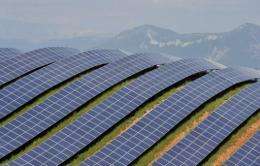
Solar panels are seen in in Les Mees, southern France. France has launched its largest-ever solar energy farm, with an array of panels spread over about 200 hectares (500 acres) in the mountainous southern Alpes-de-Haute-Provence region.
France on Thursday launched its largest-ever solar energy farm, with an array of panels spread over about 200 hectares (500 acres) in the mountainous southern Alpes-de-Haute-Provence region.
With a production capacity of 90 megawatts, the vast photovoltaic park features nearly 113,000 solar panels and was built at a cost of 110 million euros ($137 million).
It has roughly the same surface area as the nearby principality of Monaco, an independent state.
"It is the largest solar site currently in service in France," Stephane Behr, the head of the project at French energy firm Eco Delta, said at the array's inauguration ceremony.
The launch comes as Europe increasingly seeks alternative energy sources amid rising global carbon emissions from fossil fuels and concerns over atomic energy in the wake of Japan's nuclear disaster.
(c) 2011 AFP
-
From lemons to lemonade: Reaction uses carbon dioxide to make carbon-based semiconductor,
32 comments
-
Thioridazine kills cancer stem cells in human while avoiding toxic side-effects of conventional cancer treatments,
3 comments
-
SpaceX private rocket blasts off for space station (Update),
42 comments
-
Climate scientists say they have solved riddle of rising sea,
31 comments
-
SpaceX capsule has 'new car' smell, astronauts say (Update),
3 comments
-
Need a rigid insulation material???
16 hours ago
-
magnets or EMF in car bumpers to protect from fender bender
May 26, 2012
-
length of wire in a coil of known dimensions?
May 25, 2012
-
India Engineering Powerhouse
May 25, 2012
-
electromagnet core dereference between hard and soft iron
May 25, 2012
-
Measuring water pressure in an open tank
May 24, 2012
- More from Physics Forums - General Engineering
More news stories
Browser wars flare in mobile space
The browser wars are heating up again, but this time the fight is for dominance of the mobile Internet.
8 hours ago |
5 / 5 (1) |
3
Probability of contamination from severe nuclear reactor accidents is higher than expected: study
Catastrophic nuclear accidents such as the core meltdowns in Chernobyl and Fukushima are more likely to happen than previously assumed. Based on the operating hours of all civil nuclear reactors and the number ...
Technology / Energy & Green Tech
May 22, 2012 |
3.6 / 5 (22) |
56
|
SpotterRF debuts Radar Backpack Kit (w/ Video)
(Phys.org) -- SpotterRF has announced a special radar backpack kit designed to enhance situational awareness for soldiers on the ground. The company says its special radar is designed for warfighters as part ...
HyperSolar shows dirty water no barrier to power world
(Phys.org) -- The Santa Barbara, California, company, HyperSolar, is set to transparently share the ups and downs of its research experiences toward the companys ultimate vision, successfully producing ...
Tesla to launch electric sedan in US on June 22
Tesla Motors said Tuesday it would begin deliveries of "the world's first premium electric sedan" on June 22, slightly ahead of schedule.
Technology / Energy & Green Tech
May 22, 2012 |
4.5 / 5 (12) |
18
Computer model used to pinpoint prime materials for efficient carbon capture
When power plants begin capturing their carbon emissions to reduce greenhouse gases and to most in the electric power industry, it's a question of when, not if it will be an expensive undertaking.
'Unzipped' carbon nanotubes could help energize fuel cells, batteries
Multi-walled carbon nanotubes riddled with defects and impurities on the outside could replace some of the expensive platinum catalysts used in fuel cells and metal-air batteries, according to scientists at ...
T cells 'hunt' parasites like animal predators seek prey, study shows
By pairing an intimate knowledge of immune-system function with a deep understanding of statistical physics, a cross-disciplinary team at the University of Pennsylvania has arrived at a surprising finding: T cells use a movement ...
Yale study concludes public apathy over climate change unrelated to science literacy
Are members of the public divided about climate change because they don't understand the science behind it? If Americans knew more basic science and were more proficient in technical reasoning, would public consensus match ...
Same gene that stunts infants' growth also makes them grow too big: research
UCLA geneticists have identified the mutation responsible for IMAGe* syndrome, a rare disorder that stunts infants' growth. The twist? The mutation occurs on the same gene that causes Beckwith-Wiedemann syndrome, which makes ...
Change in developmental timing was crucial in the evolutionary shift from dinosaurs to birds: study
At first glance, it's hard to see how a common house sparrow and a Tyrannosaurus Rex might have anything in common. After all, one is a bird that weighs less than an ounce, and the other is a dinosaur that ...
Oct 13, 2011
Rank: 4.6 / 5 (9)
If these prices are correct, somebody in the U.S. is ripping everyone.
That $137 million installed is about half the purchase price of the panels alone in the U.S., even without the heliostats and power cables, and of course doesn't even remotely cover install cost.
This same project in the U.S. would cost like at least 5 times, maybe even 10 times more money total.
Does our country suck that bad at everything lately?
Oct 13, 2011
Rank: 4 / 5 (4)
Oct 13, 2011
Rank: 5 / 5 (2)
http://www.guardi...c-france
Oct 13, 2011
Rank: 5 / 5 (1)
Twice as expensive as the article lets you believe.
And, the 26 million kWh yearly production gives you an average rate of 3 MW instead of 18.2 MW.
This is the problem with renewables. Their nameplate figures are wildly misleading because the output fluctuates all the time very strongly.
Yet you have to build your infrastructure according to the peak output, which means that you can't build more peak wattage than you can use. In this case it means that France will never be able to cover more than about 16% of their consumption with solar power in the optimal case.
Unless of course they ditch the "virtual battery" scheme and invest in some actual batteries.
Oct 13, 2011
Rank: 5 / 5 (1)
I live in Texas - we call things that size "neighborhoods".
I'm with Nanobanano regarding thinking these things are way overpriced in the USA. I know it may be a supply/demand thing (which government interference always messes up), but I've got to wonder what the actual cost of production for these things is - not the wholesale or retail, but the real production costs. Just really curious...
Oct 13, 2011
Rank: not rated yet
From link in guardian.co.uk:
36 acres = 18.2 MW and $82,000,000.
Then 90 MW would equal 178 acres and $405,500,000, not $137,000,000.
If the 405 million is correct instead of the 137 million, then at $4055 per KW, this is in line with US installed prices of about 1 dollar per watt for the panel and $3 to $4 per watt for installation, wiring electronics etc.
Oct 13, 2011
Rank: 3 / 5 (4)
Kudo's to the engineers.
Oct 14, 2011
Rank: 3.5 / 5 (2)
Oct 14, 2011
Rank: not rated yet
Oct 14, 2011
Rank: 5 / 5 (1)
Have you got cells on your roof? People in my family have them. They have had them for 10 years and never cleaned them.
The cells only now starting to degrade (down about 5-10% from original optimal output) - but that is most likley due to degradation caused by UV.
Now if you want to have really optimal efficiency then you can pattern the covering glass with a nanolayer that will give you the lotus effect. The occasional rainfall will be ample to keep everything spotless (and the mountains of France aren't exactly sandstorm country)
New solar cells work well in ambient light. Cost per Watt used to be in favor of solar-thermal - that has changed recently with the drop in cost of PV. Solar-theraml doesn't use water but molten salt or oils with higher boiling points (better generator efficiency)
Oct 19, 2011
Rank: not rated yet
"With a production capacity of 90 megawatts, the vast photovoltaic park features nearly 113,000 solar panels and was built at a cost of 110 million euros ($137 million)."
In fact, all the plant on site represents a capacity of 90MWp, and our project represents 30.9 MWp for 113 000 solar panels and was built at a cost of 110 million euros ($137 million).