Did intense magnetic fields form shortly after the Big Bang?
September 13, 2011

Did intense magnetic fields form shortly after the Big Bang?

Enlarge

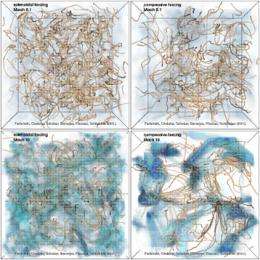
Turbulent structures of the magnetic field in four digital models representing significantly different physical conditions. For example, the interior of the Sun (top left) is not highly compressible and is characterized by subsonic flows, whereas the typical plasma of the primordial universe (bottom right) was very probably dominated by powerful compressive forces and highly supersonic turbulence. Credit: Federrath, Chabrier, Schober, Banerjee, Klessen, and Schleicher

Intense magnetic fields were probably generated in the universe shortly after the Big Bang, according to an international team led by Christoph Federrath and Gilles Chabrier of the CRAL (Centre de Recherche Astrophysique de Lyon, France). The project offers the first explanation for the presence of intergalactic and interstellar magnetized gas. Published in the September 9, 2011 issue of Physical Review Letters, the researchers' findings shed light on the properties of the earliest stars and galaxies in the universe.

Why is the gas found between galaxies or between the stars of the same galaxy magnetized? An international team of astrophysicists has put forward the first potential explanation for this phenomenon: an initially weak magnetic field could have been amplified by turbulent motions, like those that take place within the Earth and the Sun, and which must have existed in the . "According to our simulations, this turbulence produced an exponential growth of the magnetic field," explain research leaders Christoph Federrath and Gilles Chabrier. "Our calculations show that this phenomenon is possible even under extreme physical conditions, such as those encountered shortly after the Big Bang, when the first stars formed."

Their 3D digital simulations reveal how can be drawn out, twisted and folded by turbulent "flows." Just as electricity generates a magnetic field through the movement of charged particles, the charges themselves are subjected to a force as they move through a magnetic field. According to the , "The interaction between a magnetic field and turbulent energy -- a kind of kinetic energy generated by turbulence -- can amplify an initially weak field, converting it into a strong field." The researchers hope that their work will shed light on the properties of the very first to form in the universe.

More information: Mach Number Dependence of Turbulent Magnetic Field Amplification: Solenoidal versus Compressive Flows. C. Federrath, et al. Physical Review Letters. 9 September 2011.

Provided by CNRS search and more info website

Filter


Move the slider to adjust rank threshold, so that you can hide some of the comments.


Display comments: newest first

rawa1
Sep 16, 2011

Rank: not rated yet
When the ripples are expanding along water surface, their spreading becomes chaotic at the certain distance too due their dispersion at the tiny density fluctuations of underwater.

http://image.shut...3478.jpg

I presume, the appearance of all distant objects gets distorted due the cumulative effects of dispersion of light at the density fluctuations of vacuum (which are known as a CMBR noise) and it has nothing to do with the actual behavior of Universe at the beginning. It's the way, in which hidden extra-dimensions of space-time manifest. Every remote observer would see our galaxy distorted as well.
rawa1
Sep 16, 2011

Rank: not rated yet
The same effect can be observed even at the short distance scale. Every dipole powered with alternate current radiates the regular spherical waves of electromagnetic radiation into outside.

http://www.aether...pole.gif

But at the sufficient distance every spherical wave changes into stream of photons due the dispersion of light waves at the virtual particles of vacuum, i.e. the Maxwell solution converges into QED solution.

http://www.aether...tons.gif
Rank 5 /5 (3 votes)
Relevant PhysicsForums posts
  • Why does light move?
    created26 minutes ago
  • How to calculate the repulsion force between a permanent and an electromagnet?
    created1 hour ago
  • Why does light allow us to see things?
    created1 hour ago
  • Room temperature superconductivity
    created1 hour ago
  • Water flow question
    created5 hours ago
  • 16 year old solves 300 year old problem set by Isaac Newton
    created6 hours ago
  • More from Physics Forums - General Physics

More news stories

Is a classical electrodynamics law incompatible with special relativity?

(Phys.org) -- The laws of classical electromagnetism that were developed in the 19th century are the same laws that scientists use today. They include Maxwell’s four equations along with the Lorentz la ...

Physics / General Physics

created May 24, 2012 | popularity 4.7 / 5 (17) | comments 43 | with audio podcast feature

Landmark calculation clears the way to answering how matter is formed

(Phys.org) -- An international collaboration of scientists, including Thomas Blum, associate professor of physics, is reporting in landmark detail the decay process of a subatomic particle called a kaon – ...

Physics / General Physics

created May 25, 2012 | popularity 4.3 / 5 (22) | comments 51 | with audio podcast

Lying in wait for WIMPs: Researchers seek to dramatically increase sensitivity of Large Underground Xenon detector

Although it's invisible, dark matter accounts for at least 80 percent of the matter in the universe. No one knows what it is, but most scientists would bet on weakly interacting massive particles, or WIMPs.

Physics / General Physics

created May 23, 2012 | popularity 4 / 5 (7) | comments 16 | with audio podcast

Hawaii lab turns laser-powered bubbles into microrobots

(Phys.org) -- A team of scientists from the University of Hawaii are working on microrobots created from bubbles of air in a saline solution. The bubbles take on their title of “robots” as a laser ...

Physics / General Physics

created May 23, 2012 | popularity 5 / 5 (4) | comments 2 | with audio podcast weblog

Sound increases the efficiency of boiling

Scientists at the Georgia Institute of Technology achieved a 17-percent increase in boiling efficiency by using an acoustic field to enhance heat transfer. The acoustic field does this by efficiently removing vapor bubbles ...

Physics / Soft Matter

created May 24, 2012 | popularity 5 / 5 (2) | comments 2


Land and sea species differ in climate change response: study

(Phys.org) -- Marine and terrestrial species will likely differ in their responses to climate warming, new research by Simon Fraser University and Australia’s University of Tasmania has found.

'Unzipped' carbon nanotubes could help energize fuel cells, batteries

Multi-walled carbon nanotubes riddled with defects and impurities on the outside could replace some of the expensive platinum catalysts used in fuel cells and metal-air batteries, according to scientists at ...

T cells 'hunt' parasites like animal predators seek prey, study shows

By pairing an intimate knowledge of immune-system function with a deep understanding of statistical physics, a cross-disciplinary team at the University of Pennsylvania has arrived at a surprising finding: T cells use a movement ...

Computer model used to pinpoint prime materials for efficient carbon capture

When power plants begin capturing their carbon emissions to reduce greenhouse gases – and to most in the electric power industry, it's a question of when, not if – it will be an expensive undertaking.

Change in developmental timing was crucial in the evolutionary shift from dinosaurs to birds: study

At first glance, it's hard to see how a common house sparrow and a Tyrannosaurus Rex might have anything in common. After all, one is a bird that weighs less than an ounce, and the other is a dinosaur that ...

Almost half of new vets seek disability

(AP) -- America's newest veterans are filing for disability benefits at a historic rate, claiming to be the most medically and mentally troubled generation of former troops the nation has ever seen.