A high-tech propulsion system for the next 100 years
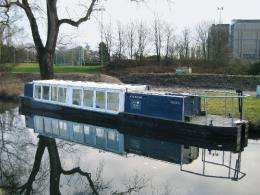
The converted hydrogen-fuelled barge «Ross Barlow» with the Empa-developed hydride storage tank.
Environmentally friendly fuels are not just of interest for use in cars. The University of Birmingham has been operating a canal boat with a fuel cell drive for three years now. In the world of shipbuilding, however, different rules apply than those in the automobile or aircraft manufacturing industries. Weight is of practically no significance, but the propulsion plant must have an operating lifetime as long as that of the boat itself. The hydride storage system the hydrogen tank which must meet this challenging requirement was designed by Empa.
One of the most efficient means of transporting freight is by ship. However, many of the ships sailing today are powered by ageing diesel motors fitted with neither exhaust cleaning equipment nor or modern control systems. Three years ago the University of Birmingham initiated an ambitious trial, converting an old canal barge to use hydrogen fuel. The old diesel motor, drive system and fuel tank were removed and replaced with a high efficiency electric motor, a battery pack for short-term energy supply and a fuel cell with a hydrogen storage system to charge the batteries. In September 2007 the converted boat, the "Ross Barlow", was launched on its maiden voyage on Britain's 3500 km long canal system. Last year the barge made its longest voyage to date, of four days duration and 105 km length, negotiating no less than 58 locks. A good opportunity to look back and take stock.
Mass-produced drive system meets tailor-made storage technology
The first task to be done in converting the 18 m long steel-hulled barge was to calculate the power requirements. Based on experience with other battery driven canal boats it was decided to use a 10 kW permanent magnet motor. To provide energy for longer trips a commercial fuel cell delivering 1 kW of power was chosen. This system was originally designed as an uninterruptible power supply (UPS) for use in the telephone industry. The capacity of the fuel cell was, however insufficient to power the boat directly, so the Ross Barlow was also fitted with a 47 kWh buffer battery. Lead acid batteries were used for this purpose since they are low maintenance, low-priced and easy to charge. The weight of the battery pack is of no consequence when used in an inland waterways vessel.
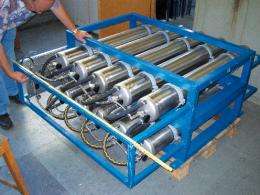
The Hydride Storage Module on board the Ross Barlow.
The hydrogen supply for the fuel cell was provided by hydride storage system developed by Empa and partly financed by the Swiss Federal Office of Energy (SFOE). This device can store hydrogen with an energy content of 50 kWh, which is equivalent to 20 pressurized gas cylinders each of 10 Liter capacity. The storage material consists of an alloy of titanium, zirconium, manganese, vanadium and iron in powder form which is packed into sealed steel tubes. The powder absorbs hydrogen, thus acting as a storage medium, only releasing it when heated. Since when "filling up" with hydrogen the metal powder generates heat which must be removed, each storage module is located in a water tank which can be warmed or cooled as necessary, In addition the ship is fitted with a solar panel which can supply up to 320 W of electric power.
Charging and discharging cycles for the next 100 years!
The journey through canals and locks makes widely varying demands on the barges electrical supply. To save wear and tear on the fuel cell, the motor draws its current from the lead acid batteries during routine sailing. A typical journey takes 4 to 6 hours during which time the canal boat uses 12 to 18 kWh of power. In continuous operation the fuel cell delivers 24 kWh of energy per day. This also powers the electronic monitoring system, leaving about 19 kWh with which to charge the buffer battery pack enough energy for a daily journey lasting six hours.
The reliability and operational lifetime of the metal hydride storage system was tested in the laboratory during its development. In practical terms this means that when used to power the "Ross Barlow", if the ship is assumed to travel 650 km per year through the British canal system, it would need refueling once a month with hydrogen. In this case the hydrogen storage system would have an operating lifetime in excess of 100 years, and would therefore comfortably outlast the useful lifetime of the barge itself.
The results of the test voyage
During the 105 km, four-day summer test journey a total of 106 kWh of electric energy was consumed on the "Ross Barlow", including lighting and recharging the crews mobile telephones and laptop computers.
The batteries supplied 71 per cent of this energy, the hydrogen fuel cell 25 per cent and the solar panel 4 per cent. There was unanimous praise from the crew for the practically silent way the boat sailed. Also notable was that when waiting in a lock the Ross Barlow was not engulfed by its own diesel fumes. The boat which accompanied it (which was about the same size) used some 50 L of diesel, resulting in a CO2 emission of approximately 133 kg. The Ross Barlow on the other hand produced no CO2 during its voyage, assuming that the hydrogen it used was derived from renewable sources and delivered free of emissions to the refueling point on the bank of the canal.
Provided by Empa
-
From lemons to lemonade: Reaction uses carbon dioxide to make carbon-based semiconductor,
32 comments
-
Thioridazine kills cancer stem cells in human while avoiding toxic side-effects of conventional cancer treatments,
3 comments
-
SpaceX private rocket blasts off for space station (Update),
42 comments
-
Climate scientists say they have solved riddle of rising sea,
31 comments
-
SpaceX capsule has 'new car' smell, astronauts say (Update),
2 comments
-
Need a rigid insulation material???
13 hours ago
-
magnets or EMF in car bumpers to protect from fender bender
May 26, 2012
-
length of wire in a coil of known dimensions?
May 25, 2012
-
India Engineering Powerhouse
May 25, 2012
-
electromagnet core dereference between hard and soft iron
May 25, 2012
-
Measuring water pressure in an open tank
May 24, 2012
- More from Physics Forums - General Engineering
More news stories
Browser wars flare in mobile space
The browser wars are heating up again, but this time the fight is for dominance of the mobile Internet.
6 hours ago |
5 / 5 (1) |
2
Probability of contamination from severe nuclear reactor accidents is higher than expected: study
Catastrophic nuclear accidents such as the core meltdowns in Chernobyl and Fukushima are more likely to happen than previously assumed. Based on the operating hours of all civil nuclear reactors and the number ...
Technology / Energy & Green Tech
May 22, 2012 |
3.6 / 5 (22) |
56
|
SpotterRF debuts Radar Backpack Kit (w/ Video)
(Phys.org) -- SpotterRF has announced a special radar backpack kit designed to enhance situational awareness for soldiers on the ground. The company says its special radar is designed for warfighters as part ...
HyperSolar shows dirty water no barrier to power world
(Phys.org) -- The Santa Barbara, California, company, HyperSolar, is set to transparently share the ups and downs of its research experiences toward the companys ultimate vision, successfully producing ...
Tesla to launch electric sedan in US on June 22
Tesla Motors said Tuesday it would begin deliveries of "the world's first premium electric sedan" on June 22, slightly ahead of schedule.
Technology / Energy & Green Tech
May 22, 2012 |
4.5 / 5 (11) |
18
Nvidia trumpets Tegra 3 phone design wins for 2012
(Phys.org) -- Nvidias competitive war paint has a name, Tegra 3. On the heels of Nvidia announcements about lowering costs of its Tegra 3 processors and Nvidia-enabled tablets running Android Ice Cream ...
Scientist: Evolution debate will soon be history
(AP) -- Richard Leakey predicts skepticism over evolution will soon be history. Not that the avowed atheist has any doubts himself.
Dell tablet leak: 10.1-inch display, two-battery choice
(Phys.org) -- Headline after headline talks about vendors tablets in the wings as likely number-one contenders for the iPad. Such claims have justifiably been taken with a grain of salt, considering ...
Keep food safety in mind this memorial day weekend
(HealthDay) -- Picnics, parades and cookouts are as much a part of Memorial Day weekend as tributes to the United States' war veterans.
Social welfare cuts ultimately come with heavy price, researchers say
(Phys.org) -- Slashing government funding for Medicaid, food stamps and other programs that serve the poor while politically popular with some lawmakers and many conservatives may do more harm ...
Is a classical electrodynamics law incompatible with special relativity?
(Phys.org) -- The laws of classical electromagnetism that were developed in the 19th century are the same laws that scientists use today. They include Maxwell’s four equations along with the Lorentz la ...

Aug 29, 2011
Rank: 5 / 5 (2)
Aug 29, 2011
Rank: not rated yet
Except that the energy density of the best batteries is vastly less than that of fuel cells. Certainly, battery power vehicles have their place, but for long distances they aren't suitable (even with significant future advances in battery technology).
Aug 29, 2011
Rank: 1 / 5 (1)
Aug 30, 2011
Rank: not rated yet
Aug 30, 2011
Rank: not rated yet
A lot of the barges on our canals that are used as movable living accomodation are usually fitted with solar panels on the flat roof and a small wind generator as well. It's actually unusual to see one not fitted with them these days.
Aug 30, 2011
Rank: not rated yet
Quote from the article:
"The batteries supplied 71 per cent of this energy, the hydrogen fuel cell 25 per cent and the solar panel 4 per cent."
Solar cells are OK, but there is a maximum of energy you can get per square meter (which is about 800W at northern latitudes at midday when there is no cloud cover - less during other hours/conditions)
The barge is 18 meter slong and maybe 3 meters wide (I could only find the length on the internet but the 3m are a generous estimate from the picture supplied) - so we get 54 square meters if we cover everything with solar panels. This nets us a maximum of 43kW at midday. If you include PV efficiency (up to 40%) you get about 17kW.
A barge that size is going nowhere with that kind of power alone (heck, your CAR is probably going nowhere on that kind of power).
And remember: For most of the day you get much less than those 17kW out of your solar cells.
Aug 30, 2011
Rank: 3 / 5 (2)
The boat already drew 71% of its energy from the batteries. All you need is 1/3 more batteries and it'll go the entire distance. Would be much cheaper and much more energy efficient - and you don't constantly waste 200W on "electric monitoring systems" because all the batteries need is a specific gravity meter; a small weighted glass bulb with a scale.
It's a bit sad when the hydrogen fuel cell is really so unwieldy as a technology that a simple lead acid battery can be a better choise.
Aug 30, 2011
Rank: 5 / 5 (1)
17 kW is plenty. Take notice that they installed a 10 kW motor in the barge, and used about 3 kW continuously.
17 kW is enough to take an ordinary compact car to 65 mph.
Still. 650 kilometers a year is not much. What sort of practical application does this thing have, other than driving up and down the river twice a year?
Aug 30, 2011
Rank: not rated yet
That's plenty of distance on the UK canals. Don't forget that these barges were originally used as a means of moving freight from city to city prior to the development of the ICE. The canal network developed in much the same way that a modern road system does and UK towns/cities aren't that far apart.
There's no reason why we couldn't go back to using them again if this system of motive power proves successful....apart from the 4mph speed limit!
Aug 30, 2011
Rank: not rated yet
17kW PEAK power. Under average conditions and using normal/commercial grade solar cells it would be much less.
(My calculations were based on experimental solar cells. Commercial solar cells are in the 20% efficiency range.)
The Japanese tried to fit a cargo ship with solar cells not too long ago (M/V Auriga Leader). But that only supplies enough to run lighting and other infrastructure but does not contribute to the driving the thing. Arguably it still lessens the fuel needed so that's still a step in the right direction.
Whether the hydrogen system is a good idea is dependent on the use. If you need a lot of recharge cycles from the equivalent number of batteries then it's cheaper.
Aug 30, 2011
Rank: 5 / 5 (2)
I know the history of the canals. However, 650 kilometers a year is not much.
Suppose two cities are 150 kilometers apart. That means you'll make two trips back and fort every year, on a barge that carries only a couple tons of goods. That would not have been adequate even in 18th century standards.
At that rate of travel, London would have been to Birmingham like New York was to London on a sailing ship. If it takes you six months to get your next shipment, what's the point? Get a mule to pull the barge instead.
Aug 30, 2011
Rank: not rated yet
If instead the barge does 100 km every week or so on a regular route between cities, it will cover 5200 km a year and subsequently the fuel cells and batteries will have to be replaced in 12 years time, which makes it rather expensive to operate.
So it still makes more sense to run the thing with a mule on the end of a long rope, like they actually did back in the days. Saves you a ton of cargo capacity from the batteries as well.
Aug 30, 2011
Rank: not rated yet
See http://www.planetsolar.org
Aug 30, 2011
Rank: not rated yet
Which produces CO2, though.
Since they did the 105km in 4 days that would be more like 9500km per year (so we're closer to a 6-7 year replacement time for the batteries. Without knowing exactly what type of fuel cell they were using its impossible to estimate what the lifespan of that would be. they only say that the storage containers would outlast the lifetime of the boat)
Aug 30, 2011
Rank: not rated yet
Aug 30, 2011
Rank: not rated yet
I still find it hard to take anything seriously when people talk about "sailing" a motor boat.
Sailing is sailing motoring is motoring - once we get that worked out, perhaps, we can discuss how efficient it is.
Sailing boats generally are close to silent when they are sailing and noisy when they are motoring.
Sep 03, 2011
Rank: not rated yet
Sep 04, 2011
Rank: not rated yet
Yes but if your engine dies you can eat it.
Sep 06, 2011
Rank: not rated yet
They have been and will be used for housing in many island nations like the Philippines the Caribbean and Indonesia.
The serious problem of human waste can be and should be conquered with new technology which is constantly evolving as nations become wealthier and demands for aqua culture increase.
The mobility issues depend on the canal structures or river dredging issues which plague any settlement,but which can afford many opportunities for seasonal work.If you can take your housing north,east,west, or south according to seasons or typhoons,hurricanes or tsunamis it is a significant advantage.