Sun-free photovoltaics
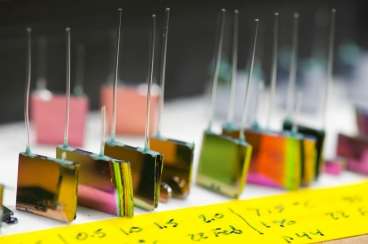
A new photovoltaic energy-conversion system developed at MIT can be powered solely by heat, generating electricity with no sunlight at all. While the principle involved is not new, a novel way of engineering the surface of a material to convert heat into precisely tuned wavelengths of light — selected to match the wavelengths that photovoltaic cells can best convert to electricity — makes the new system much more efficient than previous versions.
The key to this fine-tuned light emission, described in the journal Physical Review A, lies in a material with billions of nanoscale pits etched on its surface. When the material absorbs heat — whether from the sun, a hydrocarbon fuel, a decaying radioisotope or any other source — the pitted surface radiates energy primarily at these carefully chosen wavelengths.
Based on that technology, MIT researchers have made a button-sized power generator fueled by butane that can run three times longer than a lithium-ion battery of the same weight; the device can then be recharged instantly, just by snapping in a tiny cartridge of fresh fuel. Another device, powered by a radioisotope that steadily produces heat from radioactive decay, could generate electricity for 30 years without refueling or servicing — an ideal source of electricity for spacecraft headed on long missions away from the sun.
According to the U.S. Energy Information Administration, 92 percent of all the energy we use involves converting heat into mechanical energy, and then often into electricity — such as using fuel to boil water to turn a turbine, which is attached to a generator. But today's mechanical systems have relatively low efficiency, and can't be scaled down to the small sizes needed for devices such as sensors, smartphones or medical monitors.
"Being able to convert heat from various sources into electricity without moving parts would bring huge benefits," says Ivan Celanovic ScD '06, research engineer in MIT's Institute for Soldier Nanotechnologies (ISN), "especially if we could do it efficiently, relatively inexpensively and on a small scale."
It has long been known that photovoltaic (PV) cells needn't always run on sunlight. Half a century ago, researchers developed thermophotovoltaics (TPV), which couple a PV cell with any source of heat: A burning hydrocarbon, for example, heats up a material called the thermal emitter, which radiates heat and light onto the PV diode, generating electricity. The thermal emitter's radiation includes far more infrared wavelengths than occur in the solar spectrum, and "low band-gap" PV materials invented less than a decade ago can absorb more of that infrared radiation than standard silicon PVs can. But much of the heat is still wasted, so efficiencies remain relatively low.
An ideal match
The solution, Celanovic says, is to design a thermal emitter that radiates only the wavelengths that the PV diode can absorb and convert into electricity, while suppressing other wavelengths. "But how do we find a material that has this magical property of emitting only at the wavelengths that we want?" asks Marin Soljačić, professor of physics and ISN researcher. The answer: Make a photonic crystal by taking a sample of material and create some nanoscale features on its surface — say, a regularly repeating pattern of holes or ridges — so light propagates through the sample in a dramatically different way.
"By choosing how we design the nanostructure, we can create materials that have novel optical properties," Soljačić says. "This gives us the ability to control and manipulate the behavior of light."
The team — which also includes Peter Bermel, research scientist in the Research Laboratory for Electronics (RLE); Peter Fisher, professor of physics; and Michael Ghebrebrhan, a postdoc in RLE — used a slab of tungsten, engineering billions of tiny pits on its surface. When the slab heats up, it generates bright light with an altered emission spectrum because each pit acts as a resonator, capable of giving off radiation at only certain wavelengths.
This powerful approach — co-developed by John D. Joannopoulos, the Francis Wright Davis Professor of Physics and ISN director, and others — has been widely used to improve lasers, light-emitting diodes and even optical fibers. The MIT team, supported in part by a seed grant from the MIT Energy Initiative, is now working with collaborators at MIT and elsewhere to use it to create several novel electricity-generating devices.
Mike Waits, an electronics engineer at the Army Research Laboratory in Adelphi, Md., who was not involved in this work, says this approach to producing miniature power supplies could lead to lighter portable electronics, which is "critical for the soldier to lighten his load. It not only reduces his burden, but also reduces the logistics chain" to deliver those devices to the field. "There are a lot of lives at stake," he says, "so if you can make the power sources more efficient, it could be a great benefit."
The button-like device that uses hydrocarbon fuels such as butane or propane as its heat source — known as a micro-TPV power generator — has at its heart a "micro-reactor" designed by Klavs Jensen, the Warren K. Lewis Professor of Chemical Engineering, and fabricated in the Microsystems Technology Laboratories. While the device achieves a fuel-to-electricity conversion efficiency three times greater than that of a lithium-ion battery of the same size and weight, Celanovic is confident that with further work his team can triple the current energy density. "At that point, our TPV generator could power your smartphone for a whole week without being recharged," he says.
Celanovic and Soljačić stress that building practical systems requires integrating many technologies and fields of expertise. "It's a really multidisciplinary effort," Celanovic says. "And it's a neat example of how fundamental research in materials can result in new performance that enables a whole spectrum of applications for efficient energy conversion."
David L. Chandler contributed to this story.
Provided by Massachusetts Institute of Technology
This story is republished courtesy of MIT News (web.mit.edu/newsoffice/), a popular site that covers news about MIT research, innovation and teaching.


