Energy-harvesting shock absorber that increases fuel efficiency wins R&D 100 award
July 14, 2011 by Lisa Zyga weblog

shock absorber

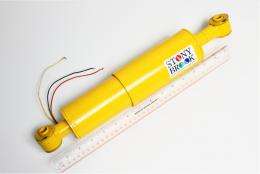
The shock absorber harvests energy from vibrations experienced by a vehicle's suspension system into electricity that can charge the battery and power vehicle electronics. Image credit: Lei Zuo

An energy-harvesting shock absorber that can be installed in a vehicle’s suspension system to absorb the energy from bumps in the road, convert the energy into electricity, and improve fuel efficiency by 1-8% has recently won the R&D 100 award. Nicknamed the “Oscar of Invention,” the annual award is given out by R&D Magazine to recognize the top 100 innovative technologies introduced during the previous year. Previous winners have included the ATM (1973), liquid crystal display (1980), Nicoderm anti-smoking patch (1992), lab on a chip (1996), and HDTV (1998).

The new shock absorbers were designed by Professor Lei Zuo and graduate students Xiudong Tang and Zachary Brindak at the State University of New York (SUNY) at Stony Brook, with funding from the New York State Energy Research and Development Authority (NYSERDA). The development joins regenerative braking and other techniques that address the vast amount of energy wasted by vehicles. Although transportation accounts for 70% of oil consumption in the US, only 10-16% of the fuel energy is used to drive the car - to overcome road resistance and air drag. The rest is lost due to braking, vibrational energy dissipation, exhaust heat, and other inefficiencies.

Zuo’s team developed and patented two different types of shock absorbers: linear and rotational. The new linear shock absorber consists of a small magnetic tube with high flux intensity that slides inside a larger, hollow coil tube. The rotational version employs a compact motion magnification mechanism.

Due to bumps and vibrations from normal driving, the sliding tubes or rotating generator can produce an electric voltage. When installed in a medium-sized passenger car traveling at 60 mph, the shock absorber can generate 100-400 watts of energy under normal driving conditions, and up to 1600 watts on particularly rough roads. Trucks, rail cars, and off-road vehicles get a return of 1-10 kilowatts, depending on road quality.

The harvested energy is then used to charge the battery and power the vehicle’s electronics, which is typically 250-350 watts with optional electronic systems turned off. This energy reduces the load on the vehicle’s alternator, which usually has a capacity about 500-600 watts. In this way, the harvested energy could increase fuel efficiency by 1-4% in conventional cars and by 8% in hybrid vehicles. As a side benefit, the shock absorber also creates a smoother ride due to the ability to adjust the suspension damping and implement self-powered vibration control.

The electricity-generating shock absorber can be retrofitted into today’s vehicles by replacing conventional shock absorbers - in which the vibration energy is wasted as heat - without modification of the vehicle suspension structure. The researchers estimate that the installation cost can be recouped in 3-4 years for typical passenger vehicles, and 1-2 years for trucks.

“If just 5% of the 256 million registered vehicles in this country adopt this technology, we will create a market of over six billion dollars,” said Zuo in a press release. “The total energy we can recover per year from the suspensions is more than the amount produced by the Niagara Falls Power Plant.”

Zuo added that the shock absorber is not yet commercially available, but the patent is ready for licensing. The researchers recently received a grant from the SUNY Technology Accelerator Fund to speed up commercialization.

More information: Prof. Zuo's handout and R&D 100 awards
via: Asian American e-Zine

© 2010 PhysOrg.com

4.9 /5 (17 votes)  

Filter


Move the slider to adjust rank threshold, so that you can hide some of the comments.


Display comments: newest first

Scottingham
Jul 14, 2011

Rank: 5 / 5 (3)
"I swear officer, I was only riding on the rumble strips to give my car some more juice"
Pyle
Jul 14, 2011

Rank: 2.2 / 5 (5)
I love it, but something about it screams windmills on cars to me. Anybody have any figures on how much heat is generated by a vehicle's suspension?

Seems to me that getting rid of the heat created with better suspension is more efficient than converting the vibrations into electricity. Ultimately you're burning gas/using electricity to get over the bumps so reducing the waste amount is better than converting the wasted effort to electricity.

What am I missing?
TheSpiceIsLife
Jul 14, 2011

Rank: 3.3 / 5 (3)
"The researchers estimate that the installation cost can be recouped in 3-4 years for typical passenger vehicles"

And most shock absorbers need replacing at around that time...
Alburton
Jul 14, 2011

Rank: 5 / 5 (4)
The thing is,Pyle,that suspensions are based on an ideally elastic spring AND a viscous medium (air or liquid) which creates (vertical)speed proportional friction and dissipates the energy in a dynamically specific way.Was the heat not generated,the car would bump up and down endlessly.
Which means that the quantity of heat is not related to the quality of a suspension.
What is proposed here is to use a magnetic field to speed down the vertical oscilations,and as the forces implied are again proportional to speed,that part of the calculations must have been pretty direct.
b0bb0
Jul 14, 2011

Rank: 4.6 / 5 (10)
"...the shock absorber can generate 100-400 watts of energy under normal driving conditions..."

The unit of energy is the 'joule' not the 'watt.' The watt is used to measure power.

Power is not energy.

b0bb0
Alburton
Jul 14, 2011

Rank: not rated yet
At SpiceIsLife.
Which leads us to the conclusion that effectively free suspensions are a pretty neat thing to have...
Isaacsname
Jul 14, 2011

Rank: 2 / 5 (1)
Why aren't piezoelectric tires popular ?
jselin
Jul 14, 2011

Rank: 4 / 5 (1)
I was about to tell you because its too much strain as piezoelectric materials are ceramic but I checked google and suprisingly there are piezoelectric polymers. Sounds like an interesting research path... too bad I'm a ceramics guy.
xznofile
Jul 14, 2011

Rank: not rated yet
switch the wires for a powered pogo stick
Pyle
Jul 14, 2011

Rank: not rated yet
Don't switch the wires and get something useful out of my kids.

No, I don't really mean that. Sort of...
Isaacsname
Jul 14, 2011

Rank: not rated yet
I was about to tell you because its too much strain as piezoelectric materials are ceramic but I checked google and suprisingly there are piezoelectric polymers. Sounds like an interesting research path... too bad I'm a ceramics guy.


There's people working on it.

http://spie.org/x...D=x48202

I'm positive I've stumbled on a patent or two.
I could see embedded PZT or something to that extent.
Wish I had gone to school to study engineering or something, I have all sorts off hare-brained ideas.
tk1
Jul 14, 2011

Rank: 5 / 5 (1)
"The researchers estimate that the installation cost can be recouped in 3-4 years for typical passenger vehicles"

And most shock absorbers need replacing at around that time...


Really?

Please let me know what vehicle you are driving so I never make the mistake of buying one!

In 31 years of driving and 29 years of owning a car I can only remember changing shocks once, that being a 82 AMC Spirit, ( the first shock came off sweet, the second was a nightmare and ofcourse we were working outside and it began raining)!

I drove a 93 Ford ranger for 10 plus years and put 300,000 plus miles on the mirror and other parts of the body. Two rear ends, three transmissions, three engines, tripple A priceless. But I never needed to change the shocks even up to the day that I took the truck off the road. (Was still running great but the cost of making it pass inspection would be worth more than the vehicle). Not saying shocks don't need changing, but every 3-4 years?
unknownorgin
Jul 14, 2011

Rank: 5 / 5 (3)
Every vehicle owner would benifit from these shock absorbing generators and also the information shows how poorly maintained roads waste fuel and cost motorist more money.
Jaeherys
Jul 14, 2011

Rank: 5 / 5 (1)
"...the shock absorber can generate 100-400 watts of energy under normal driving conditions..."

The unit of energy is the 'joule' not the 'watt.' The watt is used to measure power.

Power is not energy.

b0bb0


When you say, "the car generates 100-400 joules of energy per second", it doesn't sound so wrong does it?
fmfbrestel
Jul 14, 2011

Rank: not rated yet
Didn't Bose build an electric shock absorber a while back? I remember seeing a video of a car jumping a curb with them installed. I think they also claimed that it could mostly power itself through methods similar to what is described here.

How is this significantly different than Bose's ten year old tech?
fmfbrestel
Jul 14, 2011

Rank: 3 / 5 (2)
While it looks like a drop in replacement, you probably need a new alternator along with them.

Some nascar sponsor should licence this and install them in their race cars. You need gear head buy-in.
CapitalismPrevails
Jul 15, 2011

Rank: not rated yet
Aren't there engineers working on electromagnetic shock absorbers?
plasticpower
Jul 15, 2011

Rank: 5 / 5 (1)
"If just 5% of the 256 million registered vehicles in this country adopt this technology, we will create a market of over six billion dollars"

This would mean that a set of shock absorbers costs ~$47,000
Which makes this statement false:

"The researchers estimate that the installation cost can be recouped in 3-4 years for typical passenger vehicles, and 1-2 years for trucks."
antialias_physorg
Jul 15, 2011

Rank: 5 / 5 (1)
And most shock absorbers need replacing at around that time...

Woha. You must have some mean roads where you live.
Why aren't piezoelectric tires popular ?

Cost? Plus there's the problem of connecting a rotating producer with the rest of the car. Induction based connections have heavy losses and other type have wear and tear problms.
Anyways - the article you cited says it does 4.5 Watts - which is next to nothing compared to what the shock absorbers can do. Amortization times would be too high to be economical - especially since you replace tires more frequently than shock absorbers.

This would mean that a set of shock absorbers costs ~$47,000

Hmmm. By my calculation that would be 470$ for the set of absorbers. Sounds reasonable.

Eikka
Jul 15, 2011

Rank: 5 / 5 (2)

Hmmm. By my calculation that would be 470$ for the set of absorbers. Sounds reasonable.


Depending on whether you use the long billion, or the short billion.

Originally, US used the short scale and UK used the long scale, but then UK switched over to the short scale in 1974. The rest of Europe didn't follow along.

That means people who don't speak english natively have to translate between billions. One scale goes "thousand, million, milliard, billion, billiard...", and the other has "billion, trillion, quadrillion...".
antialias_physorg
Jul 15, 2011

Rank: not rated yet
Yes I know (I'm not a native english speaker - I'm german).

Seeing as this invention comes from the University of New York (and is reported on an english speaking site) I assumed they'd use the American numbering system.
Pyle
Jul 15, 2011

Rank: not rated yet
Depending on whether you use the long billion, or the short billion.

I must live in a tiny little bubble. I knew there was a problem with using billion instead of 10^9, but I have NEVER heard the terms milliard or billiard before. (Except of course unless you are talking about a felt table, some balls, and a cue stick.) Thanks Eikka!
wiyosaya
Jul 15, 2011

Rank: not rated yet
While it looks like a drop in replacement, you probably need a new alternator along with them.

IMHO, something to ensure the output is DC and the voltage is within acceptable limits is the likely "electronics package" for these.

Some nascar sponsor should licence this and install them in their race cars. You need gear head buy-in.

Agreed, especially here in the US.
marcin_szczurowski
Jul 17, 2011

Rank: not rated yet
A great idea. Why not generate power from brakes? There were such concepts but they died some time ago. I wonder why...
antialias_physorg
Jul 17, 2011

Rank: 5 / 5 (1)
braking occurs only very infrequently. So while the energy gained per braking action is high the average power gained over the entire ride is very low. So the extra weight of the generator isn't worth it (you expend more energy lugging it around than you get out of the reclaimed braking energy).

Some electric cars do use systems to reclaim braking energy. This is because they don't need to carry additional equipment for it (an electric motor can work as a generator, too)
Thex1138
Jul 17, 2011

Rank: not rated yet
There's a lot of kinetic energy available from car motion... acceleration/deceleration, cornering g-forces incorporating something like a counterweighted spring in a watch or fluid transfer, this stories suspension system and even a fly wheel as some vehicles have demonstrated over the years.
Rank 4.9 /5 (17 votes)
Relevant PhysicsForums posts

More news stories

Browser wars flare in mobile space

The browser wars are heating up again, but this time the fight is for dominance of the mobile Internet.

Technology / Software

created 4 hours ago | popularity 5 / 5 (1) | comments 2

Probability of contamination from severe nuclear reactor accidents is higher than expected: study

Catastrophic nuclear accidents such as the core meltdowns in Chernobyl and Fukushima are more likely to happen than previously assumed. Based on the operating hours of all civil nuclear reactors and the number ...

Technology / Energy & Green Tech

created May 22, 2012 | popularity 3.6 / 5 (21) | comments 56 | with audio podcast

SpotterRF debuts Radar Backpack Kit (w/ Video)

(Phys.org) -- SpotterRF has announced a special radar backpack kit designed to enhance situational awareness for soldiers on the ground. The company says its special radar is designed for warfighters as part ...

Technology / Hi Tech & Innovation

created May 26, 2012 | popularity 5 / 5 (5) | comments 12 | with audio podcast report

HyperSolar shows dirty water no barrier to power world

(Phys.org) -- The Santa Barbara, California, company, HyperSolar, is set to transparently share the ups and downs of its research experiences toward the company’s ultimate vision, successfully producing ...

Technology / Energy & Green Tech

created May 24, 2012 | popularity 4.8 / 5 (16) | comments 17 | with audio podcast report

Tesla to launch electric sedan in US on June 22

Tesla Motors said Tuesday it would begin deliveries of "the world's first premium electric sedan" on June 22, slightly ahead of schedule.

Technology / Energy & Green Tech

created May 22, 2012 | popularity 4.5 / 5 (11) | comments 18


Nvidia trumpets Tegra 3 phone design wins for 2012

(Phys.org) -- Nvidia’s competitive war paint has a name, Tegra 3. On the heels of Nvidia announcements about lowering costs of its Tegra 3 processors and Nvidia-enabled tablets running Android Ice Cream ...

Scientist: Evolution debate will soon be history

(AP) -- Richard Leakey predicts skepticism over evolution will soon be history. Not that the avowed atheist has any doubts himself.

Dell tablet leak: 10.1-inch display, two-battery choice

(Phys.org) -- Headline after headline talks about vendors’ tablets in the wings as likely number-one contenders for the iPad. Such claims have justifiably been taken with a grain of salt, considering ...

Keep food safety in mind this memorial day weekend

(HealthDay) -- Picnics, parades and cookouts are as much a part of Memorial Day weekend as tributes to the United States' war veterans.

Social welfare cuts ultimately come with heavy price, researchers say

(Phys.org) -- Slashing government funding for Medicaid, food stamps and other programs that serve the poor – while politically popular with some lawmakers and many conservatives – may do more harm ...

Is a classical electrodynamics law incompatible with special relativity?

(Phys.org) -- The laws of classical electromagnetism that were developed in the 19th century are the same laws that scientists use today. They include Maxwell’s four equations along with the Lorentz la ...