Researchers record two-state dynamics in glassy silicon
June 14, 2011

Researchers record two-state dynamics in glassy silicon

Enlarge

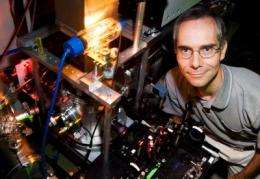
University of Illinois chemistry professor Martin Gruebele led a group that directly observed two-state dynamics in glassy silicon for the first time. Credit: L. Brian Stauffer

Using high-resolution imaging technology, University of Illinois researchers have answered a question that had confounded semiconductor researchers: Is amorphous silicon a glass? The answer? Yes – until hydrogen is added.

Led by chemistry professor Martin Gruebele, the group published its results in the journal Physical Review Letters.

(a-Si) is a popular for many device applications because it is inexpensive and can be created in a flexible thin film, unlike the rigid, brittle crystalline form of silicon. But the material has its own unusual qualities: It seems to have some characteristics of glass, but cannot be made the way other glasses are.

Most glasses are made by rapidly cooling a melted material so that it hardens in a random structure. But cooling liquid silicon simply results in an orderly crystal structure. Several methods exist for producing a-Si from crystalline silicon, including bombarding a crystal surface so that atoms fly off and deposit on another surface in a random position.

This video is not supported by your browser at this time.

A time-lapse video of an amorphous silicon surface. The lumps are clusters of about five atoms of silicon. The "hopping" motion of the lumps shows that a-Si is a glass. Credit: Martin Gruebele

To settle the debate on the nature of a-Si, Gruebele's group, collaborating with electrical and computer engineering professor Joseph Lyding's group at the Beckman Institute for Advanced Science and Technology, used a scanning tunneling microscope to take sub nanometer-resolution images of a-Si surfaces, stringing them together to make a time-lapse video.

The video shows a lumpy, irregular surface; each lump is a cluster about five silicon atoms in diameter. Suddenly, between frames, one bump seems to jump to an adjoining space. Soon, another lump nearby shifts neatly to the right. Although few of the clusters move, the action is obvious.

Such cluster "hopping" between two positions is known as two-state dynamics, a signature property of glass. In a glass, the atoms or molecules are randomly positioned or oriented, much the way they are in a liquid or gas. But while atoms have much more freedom of motion to diffuse through a liquid or gas, in a glass the molecules or atom clusters are stuck most of the time in the solid. Instead, a cluster usually has only two adjoining places that it can ferry between.

"This is the first time that this type of two-state hopping has been imaged in a-Si," Gruebele said. "It's been predicted by theory and people have inferred it indirectly from other measurements, but this is the first time we're been able to visualize it."

The group's observations of two-state dynamics show that pure a-Si is indeed a glass, in spite of its unorthodox manufacturing method. However, a-Si is rarely used in its pure form; hydrogen is added to make it more stable and improve performance.

Researchers have long assumed that hydrogenation has little to no effect on the random structure of a-Si, but the group's observations show that this assumption is not quite correct. In fact, adding hydrogen robs a-Si of its two-state dynamics and its categorization as a glass. Furthermore, the surface is riddled with signs of crystallization: larger clusters, cracks and highly structured patches.

Such micro-crystalline structure has great implications for the properties of a-Si and how they are studied and applied. Since most research has been conducted on hydrogenated a-Si, Gruebele sees a great opportunity to delve into the largely unknown characteristics of the glassy state.

"In some ways, I think we actually know less about the properties of glassy silicon than we think we do, because a lot of what's been investigated of what people call amorphous or glassy silicon isn't really completely amorphous," Gruebele said. "We really need to revisit what the properties of a-Si are. There could yet be surprises in the way it functions and the kind of things that we might be able to do with it."

Next, the group hopes to conduct temperature-depended studies to further establish the activation barriers, or the energy "humps" that the clusters must overcome to move between positions.

More information: Direct Imaging of Two-State Dynamics on the Amorphous Silicon Surface, Phys. Rev. Lett. 106, 235501 (2011) DOI:10.1103/PhysRevLett.106.235501

Abstract
Amorphous silicon is an important material, amidst a debate whether or not it is a glass. We produce amorphous Si surfaces by ion bombardment and vapor growth, and image discrete Si clusters which hop by two-state dynamics at 295 K. Independent of surface preparation, these clusters have an average diameter of ∼5 atoms. Given prior results for metallic glasses, we suggest that this cluster size is a universal feature. The hopping activation free energy of 0.93±0.15  eV is rather small, in agreement with a previously untested surface glass model. Hydrogenation quenches the two-state dynamics, apparently by increasing surface crystallinity.

Provided by University of Illinois at Urbana-Champaign search and more info website

Filter


Move the slider to adjust rank threshold, so that you can hide some of the comments.


Display comments: newest first

jselin
Jun 14, 2011

Rank: not rated yet
I'm confused... what does this tell you that XRD wouldn't? Wouldn't the short range crystallization present after the introduction of hydrogen show up as peaks within an amorphous signature?
MNIce
Jun 15, 2011

Rank: not rated yet
I'm confused... what does this tell you that XRD wouldn't? Wouldn't the short range crystallization present after the introduction of hydrogen show up as peaks within an amorphous signature?


Did anybody look for that, or did everybody just assume XRD analysis would not show anything worth the effort? Perhaps the signal was dismissed as noise - diffraction from a collection of small, randomly oriented crystals in a generally amorphous matrix of the same element probably will not stand out very much unless the crystals make up a substantial fraction of the material.
Rank 5 /5 (1 vote)
Relevant PhysicsForums posts
  • distribution of molecules throughout the atmosphere
    created2 hours ago
  • The Global Positioning System !
    created3 hours ago
  • A Question relating Power
    created4 hours ago
  • Writing a book so im learning about things, i have some general questions please read
    created7 hours ago
  • Question about induced E field.
    created8 hours ago
  • Charging a capacitor in a tesla coil
    created8 hours ago
  • More from Physics Forums - General Physics

More news stories

Is a classical electrodynamics law incompatible with special relativity?

(Phys.org) -- The laws of classical electromagnetism that were developed in the 19th century are the same laws that scientists use today. They include Maxwell’s four equations along with the Lorentz la ...

Physics / General Physics

created May 24, 2012 | popularity 4.7 / 5 (16) | comments 42 | with audio podcast feature

Landmark calculation clears the way to answering how matter is formed

(Phys.org) -- An international collaboration of scientists, including Thomas Blum, associate professor of physics, is reporting in landmark detail the decay process of a subatomic particle called a kaon – ...

Physics / General Physics

created May 25, 2012 | popularity 4.2 / 5 (21) | comments 47 | with audio podcast

Lying in wait for WIMPs: Researchers seek to dramatically increase sensitivity of Large Underground Xenon detector

Although it's invisible, dark matter accounts for at least 80 percent of the matter in the universe. No one knows what it is, but most scientists would bet on weakly interacting massive particles, or WIMPs.

Physics / General Physics

created May 23, 2012 | popularity 4 / 5 (7) | comments 15 | with audio podcast

Hawaii lab turns laser-powered bubbles into microrobots

(Phys.org) -- A team of scientists from the University of Hawaii are working on microrobots created from bubbles of air in a saline solution. The bubbles take on their title of “robots” as a laser ...

Physics / General Physics

created May 23, 2012 | popularity 5 / 5 (4) | comments 2 | with audio podcast weblog

Sound increases the efficiency of boiling

Scientists at the Georgia Institute of Technology achieved a 17-percent increase in boiling efficiency by using an acoustic field to enhance heat transfer. The acoustic field does this by efficiently removing vapor bubbles ...

Physics / Soft Matter

created May 24, 2012 | popularity 5 / 5 (2) | comments 2


Nvidia trumpets Tegra 3 phone design wins for 2012

(Phys.org) -- Nvidia’s competitive war paint has a name, Tegra 3. On the heels of Nvidia announcements about lowering costs of its Tegra 3 processors and Nvidia-enabled tablets running Android Ice Cream ...

Browser wars flare in mobile space

The browser wars are heating up again, but this time the fight is for dominance of the mobile Internet.

Scientist: Evolution debate will soon be history

(AP) -- Richard Leakey predicts skepticism over evolution will soon be history. Not that the avowed atheist has any doubts himself.

Dell tablet leak: 10.1-inch display, two-battery choice

(Phys.org) -- Headline after headline talks about vendors’ tablets in the wings as likely number-one contenders for the iPad. Such claims have justifiably been taken with a grain of salt, considering ...

SpotterRF debuts Radar Backpack Kit (w/ Video)

(Phys.org) -- SpotterRF has announced a special radar backpack kit designed to enhance situational awareness for soldiers on the ground. The company says its special radar is designed for warfighters as part ...

SpaceX capsule has 'new car' smell, astronauts say (Update)

SpaceX's Dragon cargo vessel smells like a new car, said astronauts at the International Space Station after opening the hatches Saturday following the spacecraft's landmark mission to the orbiting lab.