New method for imaging molecules inside cells
June 28, 2011

New method for imaging molecules inside cells

Enlarge

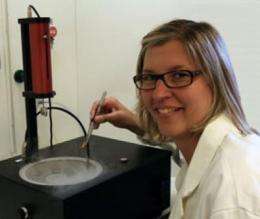
This is Ingela Lanekoff with a cell sample in the new sample holder. Credit: University of Gothenburg

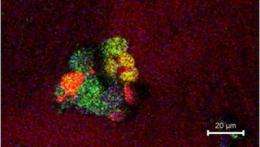
Using a new sample holder, researchers at the University of Gothenburg, Sweden, have further developed a new method for imaging individual cells. This makes it possible to produce snapshots that not only show the outline of the cell's contours but also the various molecules inside or on the surface of the cell, and exactly where they are located, something which is impossible with a normal microscope.

Individual are small, just one or two hundredths of a millimetre in diameter. As such, special is needed to distinguish the various parts inside the cell. Researchers generally use a that magnifies the cell and shows its contours outline, but does not provide any information on the inside the cell and on its surface.

"The new sample holder is filled with holds in solution," says Ingela Lanekoff, one of the researchers who developed the new method at the University of Gothenburg's Department of Chemistry. "We then rapidly freeze the sample down to -196°C, which enables us to get a snapshot of where the various molecules are at the moment of freezing. Using this technique we can produce images that show not only the outline of the cell's contours, but also the molecules that are there, and where they are located."

So why do the researchers want to know which molecules are to be found in a single cell? Because the cell is the smallest living component there is, and the chemical processes that take place here play a major role in how the cell functions in our body. For example, our brain has special cells that can communicate with each other through chemical signals. This vital communication has been shown to be dependent on the molecules in the cell's membrane.
New method for imaging molecules inside cells
Enlarge

This is a cell sample. Credit: University of Gothenburg

Imaging the molecules in the membrane of single individual cells's membrane enables researchers to measure changes. Together with previous results, Lanekoff's findings show that the rate of communication in the studied cells studied is affected by a change of less than one per cent in the quantities abundance of a specific molecule in the membrane. This would suggest that communication between the cells in the brain is heavily dependent on the chemical composition of the membrane of each individual cell,. This could be an important part of the puzzle which could go some way towards explaining the mechanisms behind learning and memory.

Provided by University of Gothenburg search and more info website


Rank 5 /5 (1 vote)
Relevant PhysicsForums posts

More news stories

Scientist: Evolution debate will soon be history

(AP) -- Richard Leakey predicts skepticism over evolution will soon be history. Not that the avowed atheist has any doubts himself.

Biology / Evolution

created 13 hours ago | popularity 3.5 / 5 (11) | comments 30

Thousands of shellfish found dead in Peru

Thousands of crustaceans were found dead off the coast of Lima following the mystery mass death of dolphins and pelicans, the Peruvian Navy said Friday.

Biology / Ecology

created 23 hours ago | popularity 4.8 / 5 (4) | comments 7

More plant species responding to global warming than previously thought

(Phys.org) -- Far more wild plant species may be responding to global warming than previous large-scale estimates have suggested.

Biology / Ecology

created May 22, 2012 | popularity 4.6 / 5 (14) | comments 18 | with audio podcast

For monogamous sparrows, it doesn't pay to stray (but they do it anyway)

It's quite common for a female song sparrow to stray from her breeding partner and mate with the male next door, but a new study shows that sleeping around can be costly.

Biology / Plants & Animals

created May 22, 2012 | popularity 5 / 5 (1) | comments 7 | with audio podcast

Study uncovers secret to speedy burrowing by razor clams

(Phys.org) -- If you look at a razor burrowing clam sitting in a bucket, you’d never guess that it could burrow itself down into the soil, much less do it with any speed. Razor clams look like fat straws, ...

Biology / Plants & Animals

created May 25, 2012 | popularity 1 / 5 (1) | comments 3 | with audio podcast report


Nvidia trumpets Tegra 3 phone design wins for 2012

(Phys.org) -- Nvidia’s competitive war paint has a name, Tegra 3. On the heels of Nvidia announcements about lowering costs of its Tegra 3 processors and Nvidia-enabled tablets running Android Ice Cream ...

Browser wars flare in mobile space

The browser wars are heating up again, but this time the fight is for dominance of the mobile Internet.

Dell tablet leak: 10.1-inch display, two-battery choice

(Phys.org) -- Headline after headline talks about vendors’ tablets in the wings as likely number-one contenders for the iPad. Such claims have justifiably been taken with a grain of salt, considering ...

SpotterRF debuts Radar Backpack Kit (w/ Video)

(Phys.org) -- SpotterRF has announced a special radar backpack kit designed to enhance situational awareness for soldiers on the ground. The company says its special radar is designed for warfighters as part ...

SpaceX capsule has 'new car' smell, astronauts say (Update)

SpaceX's Dragon cargo vessel smells like a new car, said astronauts at the International Space Station after opening the hatches Saturday following the spacecraft's landmark mission to the orbiting lab.

Australia hails surprise super-telescope decision

Australia has hailed a surprise decision giving it a role in a radio telescope project aimed at revolutionising astronomy, vowing to draw on its decades of experience in space science.