First ever single crystal metallic glass created under 25 gigapascals of pressure
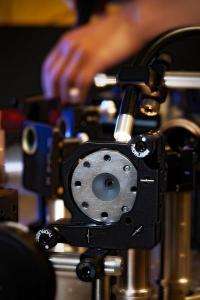
Scientists recently used a diamond anvil like this one to squeeze tiny samples of metallic glass. Under very high pressure, the samples switched from their amorphous, glassy state to form a single crystal -- the first time this behavior has been seen in a glass. The discovery. published in the June 17 issue of Science, could help scientists design better metallic glasses, which are widely used in power transformers, anti-theft tags and other products, and it may help explain why these materials are so tough. Credit: Image courtesy Brad Plummer/SLAC.
Glass, by definition, is amorphous; its atoms lack order and are arranged every which way. But when scientists squeezed tiny samples of a metallic glass under high pressure, they got a surprise: The atoms lined up in a regular pattern to form a single crystal.
It's the first time researchers have glimpsed this hidden property in a glass. The discovery, reported June 17th in Science, offers a new window into the atomic structure and behavior of metallic glasses, which have been used for decades in products such as anti-theft tags and power transformers but are still poorly understood. The more scientists learn about the structure of these commercially important materials, the more effectively they can design new metallic glasses and tinker with old ones to improve their performance.
"Maybe a lot of glasses have this underlying structure, but we just didn't know how to look for it," said paper co-author Wendy Mao, a mineral physicist at the Department of Energy's (DOE) SLAC National Accelerator Laboratory and Stanford University.
Daniel Miracle, a metallurgist at the Air Force Research Laboratory in Ohio who was not involved in the research, called the discovery "a really, really neat, important finding." Not only will it help researchers design better metallic glasses, he said, but it may help explain why these materials can be so tough: If each piece of glass is a single crystal at heart, it doesn't have any of the weak spots at the boundaries between crystals where fractures and corrosion tend to start.
Unlike familiar window glass, metallic glasses are alloys made of metalsin this case cerium and aluminum. They resist wear and corrosion and they have useful magnetic properties. If you took apart the plastic anti-theft tag on a DVD case, you'd find a thin piece of metallic glass that looks like aluminum foil. When you rent or buy a DVD, the checkout clerk rubs it across a pad to demagnetize the metallic glass so it won't trigger an alarm when you leave. By placing the cerium-aluminum glass under 25 gigapascals of pressure -- about 250,000 times normal atmospheric pressure -- the team was able to create a single crystal.
Scientists have been investigating metallic glasses for half a century, and in 1982 turned up the surprising discovery that these glasses do have some atomic structure, forming patterns over distances spanning just a few atoms. But no long-range patterns were apparent.
"The structure of glass is still mysterious. We know little about it, even though we use glass a lot," said Qiaoshi (Charles) Zeng of Zhejiang University in China, who led a research team of scientists from SLAC, Stanford, the Carnegie Institution of Washington, George Mason University and China's Jilin University. "And it's not easy investigating the structure of glass by traditional methods."
Zeng, Mao and their colleagues were not looking for order when they squeezed samples of the metallic glass between the tips of two diamonds at Argonne National Laboratory's Advanced Photon Source, applying 250,000 bars of pressure (250,000 times the pressure of the Earth's atmosphere at sea level). They were simply doing a series of experiments on how materials behave in extreme conditions.
All the samples were taken from a centimeter-long, extremely thin ribbon of the metallic glass. Under intense pressure, all of the samples "devitrified," abruptly switching out of their glassy state to form a face-centered cubic crystalone whose atoms are arranged like ping-pong balls packed into a box.
What's more, all the atoms in the crystallized samples lined up in the same directionan indication, the researchers wrote, that this underlying structure ran throughout the whole ribbon of glass, and was put there when the glass formed.
Zeng, who will be joining Mao's group at Stanford in July, said the high-pressure technique may offer a new approach for making single-crystal materials from glasses. In addition, he said, it provides a unified understanding of the atomic structures of materials by directly linking the two most extreme examples: highly ordered single crystals and highly disorganized glass.
Provided by
SLAC National Accelerator Laboratory
-
From lemons to lemonade: Reaction uses carbon dioxide to make carbon-based semiconductor,
32 comments
-
Thioridazine kills cancer stem cells in human while avoiding toxic side-effects of conventional cancer treatments,
3 comments
-
SpaceX private rocket blasts off for space station (Update),
42 comments
-
Climate scientists say they have solved riddle of rising sea,
31 comments
-
SpaceX capsule has 'new car' smell, astronauts say (Update),
2 comments
-
Transparency of molten substances?
May 25, 2012
-
saturated paramagnetic and ferromagnetic
May 24, 2012
-
How to calculate the bandstructure of Twisted Bilayer Graphene
May 23, 2012
-
vast computational richness from swapping one proton
May 22, 2012
-
Oscillator strength of mixed LH- and HH-excitons
May 22, 2012
-
2D Quantum Well and k-values
May 21, 2012
- More from Physics Forums - Atomic, Solid State, Comp. Physics
More news stories
Is a classical electrodynamics law incompatible with special relativity?
(Phys.org) -- The laws of classical electromagnetism that were developed in the 19th century are the same laws that scientists use today. They include Maxwell’s four equations along with the Lorentz la ...
Landmark calculation clears the way to answering how matter is formed
(Phys.org) -- An international collaboration of scientists, including Thomas Blum, associate professor of physics, is reporting in landmark detail the decay process of a subatomic particle called a kaon ...
May 25, 2012 |
4.2 / 5 (21) |
47
|
Lying in wait for WIMPs: Researchers seek to dramatically increase sensitivity of Large Underground Xenon detector
Although it's invisible, dark matter accounts for at least 80 percent of the matter in the universe. No one knows what it is, but most scientists would bet on weakly interacting massive particles, or WIMPs.
May 23, 2012 |
4 / 5 (7) |
15
|
Hawaii lab turns laser-powered bubbles into microrobots
(Phys.org) -- A team of scientists from the University of Hawaii are working on microrobots created from bubbles of air in a saline solution. The bubbles take on their title of robots as a laser ...
Sound increases the efficiency of boiling
Scientists at the Georgia Institute of Technology achieved a 17-percent increase in boiling efficiency by using an acoustic field to enhance heat transfer. The acoustic field does this by efficiently removing vapor bubbles ...
May 24, 2012 |
5 / 5 (2) |
2
Nvidia trumpets Tegra 3 phone design wins for 2012
(Phys.org) -- Nvidias competitive war paint has a name, Tegra 3. On the heels of Nvidia announcements about lowering costs of its Tegra 3 processors and Nvidia-enabled tablets running Android Ice Cream ...
Browser wars flare in mobile space
The browser wars are heating up again, but this time the fight is for dominance of the mobile Internet.
Scientist: Evolution debate will soon be history
(AP) -- Richard Leakey predicts skepticism over evolution will soon be history. Not that the avowed atheist has any doubts himself.
Dell tablet leak: 10.1-inch display, two-battery choice
(Phys.org) -- Headline after headline talks about vendors tablets in the wings as likely number-one contenders for the iPad. Such claims have justifiably been taken with a grain of salt, considering ...
Keep food safety in mind this memorial day weekend
(HealthDay) -- Picnics, parades and cookouts are as much a part of Memorial Day weekend as tributes to the United States' war veterans.
Social welfare cuts ultimately come with heavy price, researchers say
(Phys.org) -- Slashing government funding for Medicaid, food stamps and other programs that serve the poor while politically popular with some lawmakers and many conservatives may do more harm ...
Jun 16, 2011
Rank: 1.3 / 5 (14)
long -> wide
http://google.com...parisons for the illiterate%22
Jun 16, 2011
Rank: 4 / 5 (4)
Tin foil? Gold leaf?
Jun 16, 2011
Rank: 4.5 / 5 (4)
Jun 16, 2011
Rank: 3 / 5 (4)
You should look up the words you used and see if any of them are synonyms, or what they actually mean. dictionary.com for the illiterate (you) and the ignorant (you again)
Jun 17, 2011
Rank: not rated yet
Jun 17, 2011
Rank: not rated yet
By the tone of the article, it sounds as if there is no significant structural defect. furthermore, you would have to quantify what type or size of defect you are counting before coming up with a number. But either way, the article does not give us enough info to estimate :(.
I know from offhand knowledge that the maximum size it could have using a diamond anvil capable of those pressures is no more than a few millimeters.
Jun 20, 2011
Rank: not rated yet
"The single crystal was preserved after decompressed to the ambient pressure"
Jun 23, 2011
Rank: not rated yet