Swiss solar aircraft makes first international flight (Update 2)
May 13, 2011

Solar Impulse takes off from Payerne airbase

Enlarge

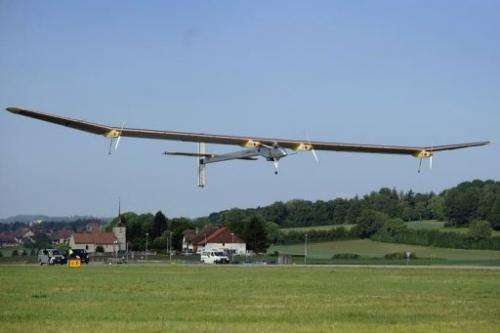
Swiss record-setting solar powered aircraft Solar Impulse takes off from Payerne airbase and is to make its first international flight. Solar Impulse is due to land at Brussels airport this evening.

Pioneering Swiss solar-powered aircraft Solar Impulse ambled over Europe into Belgium on Friday on its first international flight, with the pilot reporting that everything was running smoothly.

"The flight is going really well, I have just flown over Liege, it's a real pleasure to enter Belgian airspace," Andre Borschberg said as the dragonfly-like cruised at 50 kilometres (31 miles) per hour.

UPDATE: Swiss solar-powered aircraft lands in Brussels

"The view I have here is extraordinary," the Swiss pilot added in a live feed over the Internet. "I'm above the clouds, for now I'm taking advantage of the blue sky."

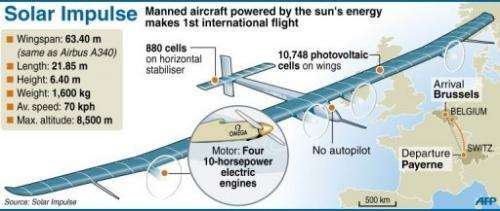
The experimental emissions-free aircraft was scheduled to take just over 12 hours to cover some 480 kilometres (300 miles) from western Switzerland to Brussels airport, after flying over France and Luxembourg at 3,600 metres (11,880 feet), the team said earlier.

The single-seater lifted off gently in clear blue skies from Payerne airbase at 8:40 am (0640 GMT) after being delayed by early morning mist.

Solar Impulse HB-SIA, which has the of a large but weighs no more than a saloon car, made history in July 2010 as the first manned plane to fly around the clock and through the night on the sun's energy.
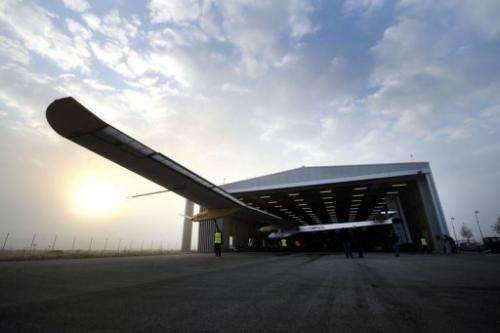
Solar Impulse HB-SIA has the wingspan of a large airliner but weighs no more than a saloon car
Enlarge

Swiss record-setting solar powered aircraft Solar Impulse leaves his hangar in the fog prior to takes off from Payerne airbase. Pioneering Swiss solar-powered aircraft Solar Impulse, which holds a 26-hour record for flight duration, took off from Switzerland on Friday on its first international flight to Belgium.

It holds the endurance and altitude records for a manned solar-powered aeroplane after staying aloft for 26 hours, 10 minutes and 19 seconds above Switzerland, flying at 9,235 metres (30,298 feet).

The high-tech plane has since flown several times, notably between Geneva and Zurich airports, but the journey to a busy airport at Brussels through crowded airspace is regarded as a new test.

"Flying an aircraft like Solar Impulse through European airspace to land at an international airport is an incredible challenge for all of us, and success depends on the support we receive from all the authorities concerned," said Borschberg, who also piloted July's flight.

HB-SIA relies on 12,000 solar cells on its 64-metre wings to charge the batteries that provide the energy for the 10-horsepower electric motors driving four propellors.

Its record-breaking last year demonstrated its capacity to store up enough energy to fly through a summer night.

The showcase for will go on display at Brussels airport until May 29 before flying on to the international air show at Le Bourget in Paris from June 20 to 26.

"This time, we have a real airplane -- flying -- proof that new technologies can reduce our dependence on fossil energy," said Bertrand Piccard, joint founder and president of the Solar Impulse project.
Solar Impulse
Enlarge

Factrfile on the solar-powered Solar Impulse aircraft (130 x 52 mm)

The Solar Impulse team is planning to fly even further, including possible transamerican, transatlantic and round-the-world flights -- in stages -- in 2013 and 2014 using a slightly larger aircraft.

Asked about upping the speed, Borschberg said: "That's not the aim of this plane for now."

Piccard, himself the first man along with Briton Brian Jones to fly non-stop around the world in a balloon, comes from a dynasty of pioneers.

His grandfather Auguste Piccard twice beat the record for reaching the highest altitude in a balloon, in 1931-32.

His late father Jacques Piccard was a deep sea explorer, who holds the record for travelling to the deepest point underwater, 10,916 metres (35,813 feet) below sea level in the Marianas Trench in the Pacific.

(c) 2011 AFP

4.4 /5 (11 votes)  

Filter


Move the slider to adjust rank threshold, so that you can hide some of the comments.


Display comments: newest first

Eikka
May 13, 2011

Rank: not rated yet
A rough estimate on how much solar panels they can fit on the wings and how much power it would produce:

64 m * 1 m * 1 kW * 0.12 Cp * 1.37 HP/kW = 10.52 HP

They're not operating on a very large margin of error.
PaulieMac
May 13, 2011

Rank: not rated yet
A rough estimate on how much solar panels they can fit on the wings and how much power it would produce:

64 m * 1 m * 1 kW * 0.12 Cp * 1.37 HP/kW = 10.52 HP

They're not operating on a very large margin of error.


Ahh, but they'd be taking off with batteries fully charged, so the margin of error would be somewhat wider.

I wonder if it accelerates for takeoff under its own power, or gets towed?
Rank 4.4 /5 (11 votes)
Relevant PhysicsForums posts

More news stories

Browser wars flare in mobile space

The browser wars are heating up again, but this time the fight is for dominance of the mobile Internet.

Technology / Software

created 1 hour ago | popularity not rated yet | comments 0

SpotterRF debuts Radar Backpack Kit (w/ Video)

(Phys.org) -- SpotterRF has announced a special radar backpack kit designed to enhance situational awareness for soldiers on the ground. The company says its special radar is designed for warfighters as part ...

Technology / Hi Tech & Innovation

created 22 hours ago | popularity 5 / 5 (5) | comments 12 | with audio podcast report

Probability of contamination from severe nuclear reactor accidents is higher than expected: study

Catastrophic nuclear accidents such as the core meltdowns in Chernobyl and Fukushima are more likely to happen than previously assumed. Based on the operating hours of all civil nuclear reactors and the number ...

Technology / Energy & Green Tech

created May 22, 2012 | popularity 3.6 / 5 (21) | comments 56 | with audio podcast

HyperSolar shows dirty water no barrier to power world

(Phys.org) -- The Santa Barbara, California, company, HyperSolar, is set to transparently share the ups and downs of its research experiences toward the company’s ultimate vision, successfully producing ...

Technology / Energy & Green Tech

created May 24, 2012 | popularity 4.8 / 5 (15) | comments 17 | with audio podcast report

Tesla to launch electric sedan in US on June 22

Tesla Motors said Tuesday it would begin deliveries of "the world's first premium electric sedan" on June 22, slightly ahead of schedule.

Technology / Energy & Green Tech

created May 22, 2012 | popularity 4.5 / 5 (11) | comments 18


Nvidia trumpets Tegra 3 phone design wins for 2012

(Phys.org) -- Nvidia’s competitive war paint has a name, Tegra 3. On the heels of Nvidia announcements about lowering costs of its Tegra 3 processors and Nvidia-enabled tablets running Android Ice Cream ...

Scientist: Evolution debate will soon be history

(AP) -- Richard Leakey predicts skepticism over evolution will soon be history. Not that the avowed atheist has any doubts himself.

Dell tablet leak: 10.1-inch display, two-battery choice

(Phys.org) -- Headline after headline talks about vendors’ tablets in the wings as likely number-one contenders for the iPad. Such claims have justifiably been taken with a grain of salt, considering ...

SpaceX capsule has 'new car' smell, astronauts say (Update)

SpaceX's Dragon cargo vessel smells like a new car, said astronauts at the International Space Station after opening the hatches Saturday following the spacecraft's landmark mission to the orbiting lab.

Thousands of shellfish found dead in Peru

Thousands of crustaceans were found dead off the coast of Lima following the mystery mass death of dolphins and pelicans, the Peruvian Navy said Friday.

Australia hails surprise super-telescope decision

Australia has hailed a surprise decision giving it a role in a radio telescope project aimed at revolutionising astronomy, vowing to draw on its decades of experience in space science.