California: Aggressive efficiency and electrification needed to cut emissions
May 24, 2011 by Julie Chao

Aggressive efficiency and electrification needed to cut emissions

Enlarge

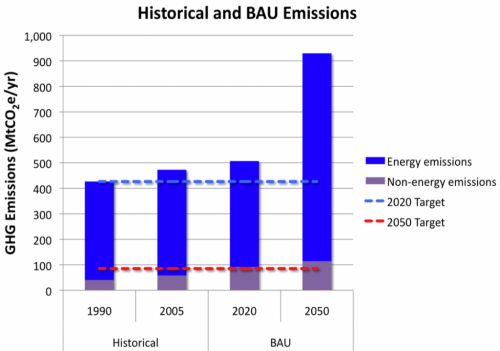
If California continues "business as usual" (BAU), or without any additional energy-savings measures, greenhouse gas emissions in 2050 are expected to nearly double those in 2005, to more than 900 metric tons carbon dioxide equivalent. (Credit: Jeff Greenblatt)

(PhysOrg.com) -- In the next 40 years, California's population is expected to surge from 37 million to 55 million and the demand for energy is expected to double. Given those daunting numbers, can California really reduce its greenhouse gas emissions to 80 percent below 1990 levels by 2050, as required by an executive order? Scientists from Lawrence Berkeley National Laboratory who co-wrote a new report on California's energy future are optimistic that the target can be achieved, though not without bold policy and behavioral changes as well as some scientific innovation.

The report, titled "California's Energy Future -- The View to 2050," draws a series of energy system "portraits" showing how California can meet its ambitious emissions targets using a combination of measures and energy sources that may include , enhanced efficiency, , , grid , and carbon capture and sequestration (CCS).

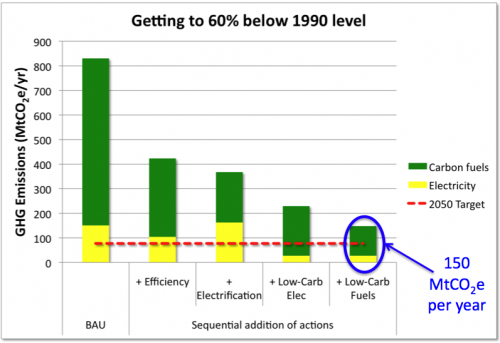
The first 60 percent in emissions reductions can be realized with currently available technology, the report finds. "California can achieve emissions roughly 60 percent below 1990 levels with technology we largely know about today if such technology is rapidly deployed at rates that are aggressive but feasible," the report says.

The remaining 20 percent reduction in emissions will have to come from advancements in several technologies still in development, which may include , , more efficient and sustainable biofuels, , more effective CCS and advanced batteries for both vehicles and grid storage. Berkeley Lab scientists are actively pursuing research in all of these areas.

If no measures are taken, emissions will likely double by 2050 relative to 1990 levels. With efficiency alone—including more efficient buildings, industrial facilities and vehicles—emissions could be held to 20 percent over 1990 levels.

The report was sponsored by the California Council on Science and Technology and funded by the California Energy Commission, the S.D. Bechtel Foundation and the California Air Resources Board. Berkeley Lab researchers Jeff Greenblatt, Jim McMahon and Max Wei were significant contributors and collaborated with analysts from several other institutions including UC Davis, UC Berkeley, Stanford University, Caltech and the Electric Power Research Institute.

One of the report's major findings is that the state will need a very different electricity system that is better able to balance supply and demand while integrating more renewable energy sources such as wind and solar, which are intermittent. "The grid as it currently stands is entirely unsustainable," says Greenblatt. "We're going to see a very different grid in 2050 than we have now."

McMahon, head of the Energy Analysis Department in the Environmental Energy Technologies Division, explains: "We need either more storage on the grid—whether with batteries or compressed air or something else—or a very intelligent system that's able to respond to what's available. For example, since the wind tends to blow more at night, a smarter system would heat your water at night when you have the power and store that water, and not in the morning when everybody wants to take a shower."

Reducing emissions will require efforts on both the supply and demand side of the energy equation. Faster development of California's diverse array of renewable energy resources—wind, solar, biomass, geothermal, hydro and offshore marine —will be needed to ensure an adequate supply of clean electricity, the report says. The scientists calculated that wind power, for example, would have to grow at 7.5 percent annually and solar at 12 percent annually. The report also considered the impact on land use from scaling up such operations; it estimated that 1.3 percent of the state's land area would have to be devoted exclusively to renewables.
Aggressive efficiency and electrification needed to cut emissions
Enlarge

Getting greenhouse gas emissions to 60 percent below the 1990 level will require four types of measures: aggressive energy efficiency, aggressive electrification, decarbonizing electricity (such as by using renewable energy sources) and decarbonizing the remaining fuel supply (such as by using biofuels). (Credit: Jeff Greenblatt)

On the demand side, the report recommends aggressive efficiency measures, such as retrofitting 1.8 percent of all buildings every year starting now. "A lot of things have to start picking up speed this decade so that by 2020 we have significant momentum. We need to do work now for things to start to amplify," Greenblatt says. And McMahon adds: "Cars and appliances last a long time, 15 to 20 years, and power plants and buildings even longer—50 years or more. That's why we can't wait. We don't want to lock in inefficient things."

While bold policy initiatives are likely needed to ensure that homeowners, industry and other players make the necessary changes, McMahon notes a silver lining: "The good news is efficiency has gotten less costly as we've gotten more experience with it."

The report recommends simultaneously electrifying as much as possible by switching from fuels such as natural gas or petroleum to electricity. Uses that can be electrified include space heating, water heating, vehicles, domestic cooking and bus and rail fleets.

Another important component on the demand side is human behavior. Based on previously published studies suggesting changes in behavior can affect emissions by as much as 20 percent, the report assumed a 10 percent impact and listed a variety of possible changes. "It's things like changing your diet, changing transportation to carpool more and use public transit, thermostat setbacks so you're cooling or heating your house a little less, eco-driving—in Europe they've taught people how to drive more efficiently," McMahon says. "If you had 10 percent of people telecommuting, you'd have 10 percent less traffic."

The Berkelely Lab scientists find cause for optimism. Already, for example, Americans are eating less red meat than they did a generation ago, which is beneficial for the environment. "There's portion of the population very interested in green living. I tend to think it's generational—there are a lot of young people trying to figure out how to live more sustainably on the earth," McMahon says. "So over time they may have more and more say over what we do."

More information: Report: http://ccst.us/pub … 11energy.pdf

Provided by Lawrence Berkeley National Laboratory search and more info website

Filter


Move the slider to adjust rank threshold, so that you can hide some of the comments.


Display comments: newest first

spectator
May 24, 2011

Rank: 1 / 5 (1)
The efficiency collumn is complete lunacy.

You think you're going to cut baseline emmissions completely in half through efficiency improvements alone, even as population increases by nearly 50%?

There isn't even mathematical room for thermodynamic efficiency increases of that magnitude at any level of the civilization.

That would require something like 80% efficient power plants, which is thermodynamically impossible by any theory I've ever heard proposed.

If they really are that paranoid, just flat out ban coal and natural gas power plants, and convert to pure hydro, wind, solar and nuclear. Otherwise, you don't even have a chance to make those projections.

You're talking about replacing even industrial power supplies, and you think you're going to magically improve efficiency of combustion generators by about double in 40 years, when it took 150 years to get them where they are now...good luck with that...
spectator
May 24, 2011

Rank: 1 / 5 (1)
The only real way to significantly increase automobile efficiency are as follows:

1) Thermoelectrics,
As seen in other articles, gives about 10% improvement....which is almost insignificant compared to what these lunatics expect...

2) Weight Reduction
But auto makers aren't even going in the right direction with this. In fact, they keep making automobiles larger and larger, especially trucks.

Note that "Hybridization" doesn't count under "efficiency" because that falls under "electrification".

Marginal improvements in the ICE are not going to get you anywhere near a 50% reduction in emissions, even if population remained constant, nevermind with +50% population.

Are you KIDDING ME!?

lol. Ban automobiles and tell everyone to walk, I guess...
ryggesogn2
May 24, 2011

Rank: 1 / 5 (1)
California's population is expected to surge from 37 million to 55 million

Based upon what?
As CA keeps destroying its economy, who will want to live there?
that_guy
May 24, 2011

Rank: not rated yet
I read the first paragraph of this article, and the first thing that came to my mind is "troll bait"

This looks like a difficult task, and it will be interesting to see how it all turns out. Right now, California is paying a lot for all these initiatives, but if things turn out well, it could put them far ahead of the rest of the country when that time comes. We are in a slow burning, low level energy crisis, and if Cali gets ahead of the curve, they could end up in a very good place.
spectator
May 25, 2011

Rank: 3 / 5 (2)
We are in a slow burning, low level energy crisis...


No we aren't.

Who told you that lie?

There is enough natural gas in the U.S. to power the entire country for around 100 years.

There is enough oil to power the country for somewhere between 180 and 300 years.
Justsayin
May 30, 2011

Rank: not rated yet
Point to where the government is known for efficiency and accuracy........please.
unknownorgin
May 31, 2011

Rank: not rated yet
I have the misfortune of living in california. The state government likes to impose green rules that do not require the state to do its part. An example of this is to save constuction costs the state will put stop lights on highways instead of off ramps or overpasses that would cut air pollution from cars and trucks accelerating to highway speed. The drivers of state and city vehicles always floorboard them from a stop and drive at excessive speed. State vehicles idle for hours but trucks not owned by the state will be fined for idling the engine more than five minutes. It is not known if all california state owned vehicles would comply to the same smog standards that privatly owned vehicles are required to.
Rank not rated yet
Relevant PhysicsForums posts

More news stories

SpotterRF debuts Radar Backpack Kit (w/ Video)

(Phys.org) -- SpotterRF has announced a special radar backpack kit designed to enhance situational awareness for soldiers on the ground. The company says its special radar is designed for warfighters as part ...

Technology / Hi Tech & Innovation

created 20 hours ago | popularity 5 / 5 (5) | comments 12 | with audio podcast report

Probability of contamination from severe nuclear reactor accidents is higher than expected: study

Catastrophic nuclear accidents such as the core meltdowns in Chernobyl and Fukushima are more likely to happen than previously assumed. Based on the operating hours of all civil nuclear reactors and the number ...

Technology / Energy & Green Tech

created May 22, 2012 | popularity 3.6 / 5 (21) | comments 56 | with audio podcast

Delphi gasoline-injection engine technique rivals hybrid's edge

(Phys.org) -- Running a diesel like engine on gasoline is something Delphi is doing in notable fashion. They claim they are on to a promising way to enjoy an engine that gives the vehicle owner high efficiency ...

Technology / Energy & Green Tech

created May 21, 2012 | popularity 4.7 / 5 (18) | comments 38 | with audio podcast report

HyperSolar shows dirty water no barrier to power world

(Phys.org) -- The Santa Barbara, California, company, HyperSolar, is set to transparently share the ups and downs of its research experiences toward the company’s ultimate vision, successfully producing ...

Technology / Energy & Green Tech

created May 24, 2012 | popularity 4.8 / 5 (15) | comments 17 | with audio podcast report

Tesla to launch electric sedan in US on June 22

Tesla Motors said Tuesday it would begin deliveries of "the world's first premium electric sedan" on June 22, slightly ahead of schedule.

Technology / Energy & Green Tech

created May 22, 2012 | popularity 4.5 / 5 (11) | comments 18


Scientist: Evolution debate will soon be history

(AP) -- Richard Leakey predicts skepticism over evolution will soon be history. Not that the avowed atheist has any doubts himself.

Dell tablet leak: 10.1-inch display, two-battery choice

(Phys.org) -- Headline after headline talks about vendors’ tablets in the wings as likely number-one contenders for the iPad. Such claims have justifiably been taken with a grain of salt, considering ...

SpaceX capsule has 'new car' smell, astronauts say (Update)

SpaceX's Dragon cargo vessel smells like a new car, said astronauts at the International Space Station after opening the hatches Saturday following the spacecraft's landmark mission to the orbiting lab.

Thousands of shellfish found dead in Peru

Thousands of crustaceans were found dead off the coast of Lima following the mystery mass death of dolphins and pelicans, the Peruvian Navy said Friday.

Astronomers seize last chance in lifetime for Venus Transit

Astronomers are gearing for one the rarest events in the Solar System: an alignment of Earth, Venus and the Sun that will not be seen for another 105 years.

Australia hails surprise super-telescope decision

Australia has hailed a surprise decision giving it a role in a radio telescope project aimed at revolutionising astronomy, vowing to draw on its decades of experience in space science.