Scientists finely control methane combustion to get different products
April 14, 2011

Scientists finely control methane combustion to get different products

Enlarge

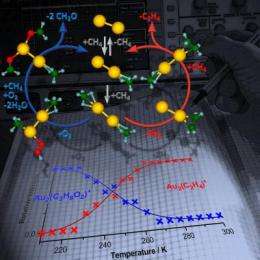
This diagram shows how catalysts of two gold atoms can help convert methane into ethylene at room temperature (shown in red) and into formaldehyde at lower temperatures (shown in blue). Credit: Uzi Landman

Scientists have discovered a method to control the gas-phase selective catalytic combustion of methane, so finely that if done at room temperature the reaction produces ethylene, while at lower temperatures it yields formaldehyde. The process involves using gold dimer cations as catalysts — that is, positively charged diatomic gold clusters. Being able to catalyze these reactions, at or below room temperature, may lead to significant cost savings in the synthesis of plastics, synthetic fuels and other materials. The research was conducted by scientists at the Georgia Institute of Technology and the University of Ulm. It appears in the April 14, 2011, edition of The Journal of Physical Chemistry C.

"The beauty of this process is that it allows us to selectively control the products of this catalytic system, so that if one wishes to create , and potentially methyl alcohol, one burns by tuning its with oxygen to run at lower temperatures, but if it's ethylene one is after, the reaction can be tuned to run at ," said Uzi Landman, Regents' and Institute Professor of Physics and director of the Center for Computational Materials Science at Georgia Tech.

Reporting last year in the journal Angewandte Chemie International Edition, a team that included theorists Landman and Robert Barnett from Georgia Tech and experimentalists Thorsten Bernhardt and Sandra Lang from the University of Ulm, found that by using gold dimer cations as catalysts, they can convert methane into ethylene at room temperature.

This time around, the team has discovered that, by using the same gas-phase gold dimer cation , methane partially combusts to produce formaldehyde at temperatures below 250 Kelvin or -9 degrees Fahrenheit. What's more, in both the room temperature reaction-producing ethylene, and the formaldehyde generation colder reaction, the gold dimer catalyst is freed at the end of the reaction, thus enabling the catalytic cycle to repeat again and again.

The temperature-tuned catalyzed methane partial combustion process involves activating the methane carbon-to-hydrogen bond to react with molecular oxygen. In the first step of the reaction process, methane and oxygen molecules coadsorb on the gold dimer cation at low temperature. Subsequently, water is released and the remaining oxygen atom binds with the methane molecule to form formaldehyde. If done at higher temperatures, the oxygen molecule comes off the gold catalyst, and the adsorbed methane molecules combine to form through the elimination of hydrogen molecules.

In both the current work, as well as in the earlier one, Bernhardt's team at Ulm conducted experiments using a radio-frequency trap, which allows temperature-controlled measurement of the reaction products under conditions that simulate realistic catalytic reactor environment. Landman's team at Georgia Tech performed first-principles quantum mechanical simulations, which predicted the mechanisms of the catalyzed reactions and allowed a consistent interpretation of the experimental observations.

In future work, the two research groups plan to explore the use of multi-functional alloy cluster catalysts in low temperature-controlled catalytic generation of synthetic fuels and selective partial combustion reactions.

Provided by Georgia Institute of Technology search and more info website

4.7 /5 (3 votes)  

Filter


Move the slider to adjust rank threshold, so that you can hide some of the comments.


Display comments: newest first

zevkirsh
Apr 14, 2011

Rank: not rated yet
whoa , this sounds big. as if you could simulate combustion along a whole spectrum of temperature gradients, and possible along pressure gradients as well? and find out that you get a whole array of products. interesting research.
Rank 4.7 /5 (3 votes)
Relevant PhysicsForums posts
  • What's the rule to covalent character
    created1 hour ago
  • Schwartz reagent-- NMR/MS/IR
    created20 hours ago
  • High school chemistry EEI
    createdMay 25, 2012
  • oxidation of I- by KMnO4
    createdMay 25, 2012
  • Inversion temp
    createdMay 25, 2012
  • Hybridization of SnCl3 -
    createdMay 25, 2012
  • More from Physics Forums - Chemistry

More news stories

Researchers demonstrate possible primitive mechanism of chemical info self-replication

(Phys.org) -- When scientists think about the replication of information in chemistry, they usually have in mind something akin to what happens in living organisms when DNA gets copied: a double-stranded molecule ...

Chemistry / Materials Science

created May 25, 2012 | popularity 5 / 5 (4) | comments 2 | with audio podcast

High-speed method to aid search for solar energy storage catalysts

Eons ago, nature solved the problem of converting solar energy to fuels by inventing the process of photosynthesis.

Chemistry / Materials Science

created May 25, 2012 | popularity 5 / 5 (3) | comments 4 | with audio podcast

Building a better solar panel -- one molecule at a time

(Phys.org) -- One of the fundamental building blocks in modern chemistry, an organometallic chemical compound called ferrocene, has never been structurally defined - until now.

Chemistry / Materials Science

created May 25, 2012 | popularity 5 / 5 (3) | comments 0 | with audio podcast

New CO2-removing catalyst can take the heat

(Phys.org) -- The current method of removing the greenhouse gas carbon dioxide (CO2) from the flues of coal-fired power plants uses so much energy that no one bothers to use it. So says Roger Aines, principal ...

Chemistry / Materials Science

created May 24, 2012 | popularity 5 / 5 (7) | comments 7 | with audio podcast

Discarded data may hold the key to a sharper view of molecules

(Phys.org) -- There's nothing like a new pair of eyeglasses to bring fine details into sharp relief. For scientists who study the large molecules of life from proteins to DNA, the equivalent of new lenses have come in the ...

Chemistry / Biochemistry

created May 24, 2012 | popularity 4.7 / 5 (3) | comments 0 | with audio podcast


Nvidia trumpets Tegra 3 phone design wins for 2012

(Phys.org) -- Nvidia’s competitive war paint has a name, Tegra 3. On the heels of Nvidia announcements about lowering costs of its Tegra 3 processors and Nvidia-enabled tablets running Android Ice Cream ...

Browser wars flare in mobile space

The browser wars are heating up again, but this time the fight is for dominance of the mobile Internet.

Dell tablet leak: 10.1-inch display, two-battery choice

(Phys.org) -- Headline after headline talks about vendors’ tablets in the wings as likely number-one contenders for the iPad. Such claims have justifiably been taken with a grain of salt, considering ...

Scientist: Evolution debate will soon be history

(AP) -- Richard Leakey predicts skepticism over evolution will soon be history. Not that the avowed atheist has any doubts himself.

SpaceX capsule has 'new car' smell, astronauts say (Update)

SpaceX's Dragon cargo vessel smells like a new car, said astronauts at the International Space Station after opening the hatches Saturday following the spacecraft's landmark mission to the orbiting lab.

Of mice and mental models: Neuroscientific implications of risk-optimized behavior in the mouse

(Medical Xpress) -- Regardless of an organism’s biological complexity, every encephalized animal continuously makes under-informed behavioral choices that can have serious consequences. Despite its ubiquity, ...