Scotland surges ahead with new 10MW tidal farm
March 18, 2011 by Bob Yirka report

Scotland surges ahead with new 10MW tidal farm

Enlarge

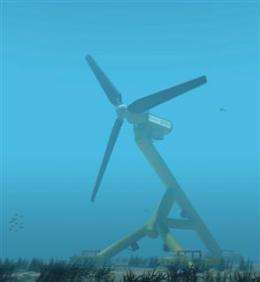
(PhysOrg.com) -- Taking advantage of the steady sea currents that flow through the underwater canyon walls in the sound of Islay, off the southwest coast of Scotland, between the islands of Islay and Jura, the Scottish energy company ScottishPower Renewables (SPR) has been given the go-ahead by the Scottish government to begin installing 10 underwater HS100 tidal turbines (made by Hammerfest Strom, a Norwegian company) on the ocean floor.

As countries all over the world seek to oil and coal, the UK, and Scotland in particular have come to see the value of tidal currents as a renewable resource, and no wonder; according to John Swinney, the Scottish finance secretary, the waterways around Scotland comprise nearly 25% of Europe’s total tidal resources.

The choice of the HS100 follows up experience learned from the installation of a 300kw experimental operation in Kvalsundet, Norway, which has been running for six years. SPR is also currently installing a single unit in Orkney (the small island chain in the north of Scotland) to provide a learning lab for the eventual installation in the Islay Sound.

The new 10MW current farm, similar in appearance to an underwater wind farm, will be the largest such operation ever undertaken, and is expected to more than double the energy capacity now being used on the existing grid to support over 5000 homes and businesses.

This video is not supported by your browser at this time.

Hammerfest Strom Tidal Turbine Technology

The site chosen is ideal due to the continuous 11 kilometers per hour speed of the current (6.7 mph) between the islands and the relative lack of strong storms; also the need for additional power on the two whisky producing islands will provide a means of expansion for the local malt whisky industry. Harnessing underwater currents is seen by many in the environmental arena as an extremely “green” form of energy production, as the turbines are out of sight and don’t produce any pollution, though there is some concern about the effects of noise on dolphins and whales. All signs indicate that the local citizenry are pleased with the announcement of the project due to the expected injection of cash into the surrounding economy and the jobs that will be created.

The installation of the current farm is expected to cost £40 million ($65 million) and will go a long way for Scotland in meeting its stated goal of deriving 80% its needs from renewable resources by 2020. Work is expected to start in 2012, with completion of the project in 2015, according to SPR chief, Keith Anderson.

More information: http://hammerfests … nd-of-islay/

(c) 2010 PhysOrg.com

Filter


Move the slider to adjust rank threshold, so that you can hide some of the comments.


Display comments: newest first

jselin
Mar 18, 2011

Rank: 5 / 5 (2)
Typo: £40 million is 65 million USD not 6.5

3.3 million of these turbines would supply ALL of the power needs of the US (29PWh/yr including fossil fuels per Wikipedia) at an up front cost of 21 trillion. Yikes.

Also, at 10 cents per kWh, the installation in this article would pay for itself and start making profit after 7-8 years.

All "back of the napkin" of course.
holoman
Mar 18, 2011

Rank: 3.7 / 5 (3)
Are the blade speeds sufficient to slice large sea creatures
into pieces ?
that_guy
Mar 18, 2011

Rank: 5 / 5 (1)
@ iselin - Nice calculations. I think the story really needed to show that...uh...this is economical renewable energy, the golden grail. Missed factor - Mainenance costs - water, being dense will create mechanical stress, and salt water - corrosive, will mean higher maintenance costs.

However it sounds like scottland is particularly well situated for it, compared to the US.

Holoman - doubtful. Water is more forceful than air, so the blades can handle a higher torque conversion and move slower (A lot slower than ship propellers). Also, dolphins and whales aren't the dumbest animals in the sea. They see a giant moving blade like that and will probably avoid it anyways, regardless of the actual danger.
MarkyMark
Mar 19, 2011

Rank: 1 / 5 (1)
Are the blade speeds sufficient to slice large sea creatures
into pieces ?

No they are not that fast im told.
ubavontuba
Mar 19, 2011

Rank: not rated yet
I wonder, would shrouding the blades in a venturi increase efficiency?

P.S. @Deesky:

You're my biggest fan!
NotParker
Mar 19, 2011

Rank: 1 / 5 (1)
Wind Farms kill Whales. And Eagles. And Hawks. Evil.

ht_delete_tp://blogs.telegraph.co.uk/news/jamesdelingpole/100080019/wind-farms-kill-whales-blubber-on-the-green-movements-hands/
alec123456789
Mar 20, 2011

Rank: not rated yet

Are the blade speeds sufficient to slice large sea creatures into pieces?


What, like the Loch Ness monster? I can hear the protesters now...
Rank 5 /5 (8 votes)
Relevant PhysicsForums posts

More news stories

SpotterRF debuts Radar Backpack Kit (w/ Video)

(Phys.org) -- SpotterRF has announced a special radar backpack kit designed to enhance situational awareness for soldiers on the ground. The company says its special radar is designed for warfighters as part ...

Technology / Hi Tech & Innovation

created 17 hours ago | popularity 5 / 5 (4) | comments 12 | with audio podcast report

Probability of contamination from severe nuclear reactor accidents is higher than expected: study

Catastrophic nuclear accidents such as the core meltdowns in Chernobyl and Fukushima are more likely to happen than previously assumed. Based on the operating hours of all civil nuclear reactors and the number ...

Technology / Energy & Green Tech

created May 22, 2012 | popularity 3.6 / 5 (21) | comments 54 | with audio podcast

Delphi gasoline-injection engine technique rivals hybrid's edge

(Phys.org) -- Running a diesel like engine on gasoline is something Delphi is doing in notable fashion. They claim they are on to a promising way to enjoy an engine that gives the vehicle owner high efficiency ...

Technology / Energy & Green Tech

created May 21, 2012 | popularity 4.7 / 5 (18) | comments 37 | with audio podcast report

HyperSolar shows dirty water no barrier to power world

(Phys.org) -- The Santa Barbara, California, company, HyperSolar, is set to transparently share the ups and downs of its research experiences toward the company’s ultimate vision, successfully producing ...

Technology / Energy & Green Tech

created May 24, 2012 | popularity 4.8 / 5 (15) | comments 17 | with audio podcast report

Tesla to launch electric sedan in US on June 22

Tesla Motors said Tuesday it would begin deliveries of "the world's first premium electric sedan" on June 22, slightly ahead of schedule.

Technology / Energy & Green Tech

created May 22, 2012 | popularity 4.5 / 5 (11) | comments 18


Scientist: Evolution debate will soon be history

(AP) -- Richard Leakey predicts skepticism over evolution will soon be history. Not that the avowed atheist has any doubts himself.

Dell tablet leak: 10.1-inch display, two-battery choice

(Phys.org) -- Headline after headline talks about vendors’ tablets in the wings as likely number-one contenders for the iPad. Such claims have justifiably been taken with a grain of salt, considering ...

SpaceX capsule has 'new car' smell, astronauts say (Update)

SpaceX's Dragon cargo vessel smells like a new car, said astronauts at the International Space Station after opening the hatches Saturday following the spacecraft's landmark mission to the orbiting lab.

Thousands of shellfish found dead in Peru

Thousands of crustaceans were found dead off the coast of Lima following the mystery mass death of dolphins and pelicans, the Peruvian Navy said Friday.

Keep food safety in mind this memorial day weekend

(HealthDay) -- Picnics, parades and cookouts are as much a part of Memorial Day weekend as tributes to the United States' war veterans.

Astronomers seize last chance in lifetime for Venus Transit

Astronomers are gearing for one the rarest events in the Solar System: an alignment of Earth, Venus and the Sun that will not be seen for another 105 years.