Making liquid power
March 29, 2011 by Katie Gatto
(PhysOrg.com) -- Power is a game of supply and demand. Unfortunately, it is also a very time sensitive game. You not only have to make the right amount of power, but you have to make it at the right time. Power is largely a perishable commodity. It can be stored in a battery, for a limited amount of time, but eventually it will wear out. This can be an issue with human generated power, but when you deal with greener methods of power, like solar and wind, we don't always have control over how much power is generated and when it is generated.
Since this creates a variety of issues with power generation, and potential waste, researchers have been interested in ways to store the power in the longer term. So, how do you keep your power in storage? You make it into a liquid.
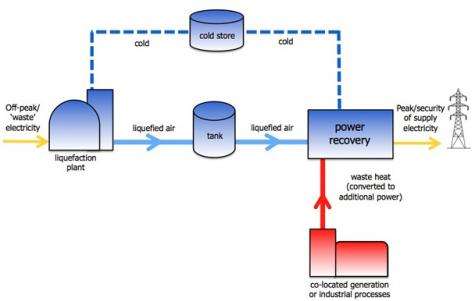
Scientists at Britain's Highview Power Storage have figured out how to convert its excess energy into liquid air. The system that does this, which has been dubbed the CryoEnergy System, is like a very big power cold storage unit. The power uses the excess energy to power large refrigeration units. These units cool the powered air down to a temperature of -196 C, which causes it to liquefy. This air liquid, which is also known as cryogen, can then be stored in an insulated tank, that has an ambient pressure of about 1 bar.
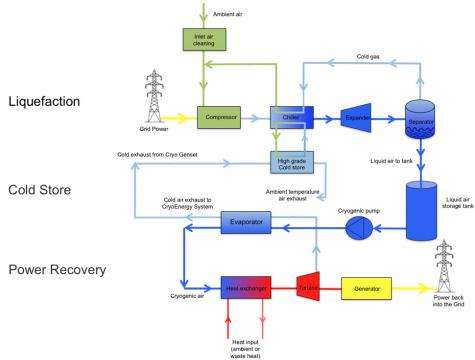
When the power is needed, at high demand times, the air can be released into a sealed space. When the liquid reaches boiling temp, above -196C, the liquid will expand more than 700% and being to spin that staple of power generation, a turbine.
The energy return on the process is about 50%. The CryoEnergy System has been in use at Scotland's Slough Heat & Power plant for the past nine months.
More information: http://www.highvie … s/?page_id=5
© 2010 PhysOrg.com
-
From lemons to lemonade: Reaction uses carbon dioxide to make carbon-based semiconductor,
32 comments
-
Thioridazine kills cancer stem cells in human while avoiding toxic side-effects of conventional cancer treatments,
3 comments
-
SpaceX private rocket blasts off for space station (Update),
42 comments
-
Climate scientists say they have solved riddle of rising sea,
30 comments
-
Research team claims to have found evidence Lake Cheko is impact crater for Tunguska Event,
18 comments
-
Need a rigid insulation material???
3 hours ago
-
magnets or EMF in car bumpers to protect from fender bender
20 hours ago
-
length of wire in a coil of known dimensions?
May 25, 2012
-
India Engineering Powerhouse
May 25, 2012
-
electromagnet core dereference between hard and soft iron
May 25, 2012
-
Measuring water pressure in an open tank
May 24, 2012
- More from Physics Forums - General Engineering
More news stories
SpotterRF debuts Radar Backpack Kit (w/ Video)
(Phys.org) -- SpotterRF has announced a special radar backpack kit designed to enhance situational awareness for soldiers on the ground. The company says its special radar is designed for warfighters as part ...
Probability of contamination from severe nuclear reactor accidents is higher than expected: study
Catastrophic nuclear accidents such as the core meltdowns in Chernobyl and Fukushima are more likely to happen than previously assumed. Based on the operating hours of all civil nuclear reactors and the number ...
Technology / Energy & Green Tech
May 22, 2012 |
3.6 / 5 (21) |
54
|
Delphi gasoline-injection engine technique rivals hybrid's edge
(Phys.org) -- Running a diesel like engine on gasoline is something Delphi is doing in notable fashion. They claim they are on to a promising way to enjoy an engine that gives the vehicle owner high efficiency ...
HyperSolar shows dirty water no barrier to power world
(Phys.org) -- The Santa Barbara, California, company, HyperSolar, is set to transparently share the ups and downs of its research experiences toward the companys ultimate vision, successfully producing ...
Tesla to launch electric sedan in US on June 22
Tesla Motors said Tuesday it would begin deliveries of "the world's first premium electric sedan" on June 22, slightly ahead of schedule.
Technology / Energy & Green Tech
May 22, 2012 |
4.5 / 5 (11) |
18
Scientist: Evolution debate will soon be history
(AP) -- Richard Leakey predicts skepticism over evolution will soon be history. Not that the avowed atheist has any doubts himself.
Dell tablet leak: 10.1-inch display, two-battery choice
(Phys.org) -- Headline after headline talks about vendors tablets in the wings as likely number-one contenders for the iPad. Such claims have justifiably been taken with a grain of salt, considering ...
SpaceX capsule has 'new car' smell, astronauts say (Update)
SpaceX's Dragon cargo vessel smells like a new car, said astronauts at the International Space Station after opening the hatches Saturday following the spacecraft's landmark mission to the orbiting lab.
Thousands of shellfish found dead in Peru
Thousands of crustaceans were found dead off the coast of Lima following the mystery mass death of dolphins and pelicans, the Peruvian Navy said Friday.
Keep food safety in mind this memorial day weekend
(HealthDay) -- Picnics, parades and cookouts are as much a part of Memorial Day weekend as tributes to the United States' war veterans.
Astronomers seize last chance in lifetime for Venus Transit
Astronomers are gearing for one the rarest events in the Solar System: an alignment of Earth, Venus and the Sun that will not be seen for another 105 years.

Mar 29, 2011
Rank: not rated yet
Mar 29, 2011
Rank: 5 / 5 (1)
Mar 29, 2011
Rank: 5 / 5 (4)
The efficiency can be up to 85%, but gets less as you draw more energy out, so the system has to be relatively large to be of benefit. At least liquid air always boils at -196 C so the temperature difference to ambient is constant, and so is the efficiency.
If they'd add a heat reservoir where they could dump the heat made by the liquefaction pump at a high temperature, and then use that instead of ambient air to boil and expand the air, then they'd get a higher return efficiency.
Mar 29, 2011
Rank: not rated yet
The process is almost the same. You squeeze air, it heats up, you let it cool down and store it in a tank. Then you add ambient heat to expand it back to its original volume through a turbine.
Air heats up when compressed and cools down then expanded. This process simply stores the air in the densest possible way, which ultimately gives you the greatest pressure differential across the turbine.
Mar 29, 2011
Rank: 5 / 5 (1)
Blairstown NJ has a storage facility where they pump water to a reservoir on top of a small mountain, then let it flow back down when needed. I believe this method is something like 75-80% efficient and has a huge capacity. I wonder what the load/duration of this compressed air system is? As far as I know, the most efficient system currrently under developement is the liquid salt thermal system (maybe 99%), but final cost/kWh is still up in the air pending more in-the-field experience.
Using liquid refrigerated air is different in one key way from using compressed air, and that is the problem of having to heat up compressed air before you can decompress it. Condensation has to be taken into account in the processes too. In the liquid air system, you should be able to us a sealed dry air source to reduce condensation problems.
Mar 29, 2011
Rank: not rated yet
For any method to be viable, the final coat per unit over the life of the system needs to be cheaper than installing a natural gas turbine system.
Mar 29, 2011
Rank: not rated yet
Surprising.
Mar 29, 2011
Rank: not rated yet
Too costly. Keep in mind that power generation is a for-profit business.
Mar 29, 2011
Rank: not rated yet
Not really. When you put liquid air into a bucket, it boils away until the bucket and the surroundings have cooled down to -196 C and then it stops boiling. It no longer expands into gas.
It has to be heated just the same, which is done by blowing warm ambient air through a heat exchanger, or by waste heat from a nearby power station.
Mar 29, 2011
Rank: not rated yet
Pumped hydro storage usually has a poor energy density. If you can pump a ton of water a kilometer up the side of a mountain, you get about 2 kWh of electricity back assuming 75% efficiency.
For one average household for one day, you would need about 40 tons of water lifted up the mountain. That would be about a small swimming pool's worth.
Now multiply that by 10 000 and you get the point.
Mar 29, 2011
Rank: 5 / 5 (2)
Mar 30, 2011
Rank: not rated yet
the storage tank needs to be too big and it needs to handle very high pressures, and is thus impractical and unsafe and less cost effective.
Mar 30, 2011
Rank: not rated yet
Mar 30, 2011
Rank: not rated yet
Nothing new. You can use electrolysis (near 100% efficient) to store hydrogen and then use a fuel cell (50% efficient) to convert back into electricity, total loss of 50%. Liquefied oxygen firstly would be energy costly for refrigeration...and very explosive should anything explosive be in the vicinity. So really not safer and less efficient than electrolysis method. Cost of hardware is similar to equivalent needed in batteries and inverters etc. The problem
is that 50% loss, whereas batteries although they lose charge overtime are more or less 100% efficient. The problem with batteries is energy density. Best bet is in large capacitors.
Mar 30, 2011
Rank: not rated yet
Mar 30, 2011
Rank: not rated yet
The problem with batteries is cost. They are very expensive per unit of energy stored and they wear out after a relatively few number of charge cycles.
They are mainly used to fill the time between when a main load supply goes down and a backup natural gas or deisel generator can come online.
Mar 30, 2011
Rank: 5 / 5 (1)
Mar 30, 2011
Rank: not rated yet
Mar 31, 2011
Rank: not rated yet
This would permit to smooth out energy production, both from variable wind speeds and different wave activity, and guarantee constant generator rpm. It would be a rather simple matter to associate such caverns with windmills. Heavy equipment (such as turbines and generators) would no longer have to sit high up in the air as they do today. They could be located at ground level or underground...
No need to go into cryogenic storage. Space is not, generally, a big problem.
Apr 03, 2011
Rank: not rated yet
The total round-trip efficiency with water filtering, electrolysis, leakage, pressurization, storage and pumping is about 20% at best, so hydrogen really isn't a viable method for storing energy.
You really have to be hell-bent to seriously use it in any way.
Apr 03, 2011
Rank: not rated yet
The other advantage of electrolysis of water is that you already have access to water at the power plant anyway, even a large solar plant. So what you can do is use some of the energy to electrolysis water, and then after sunset and after stored steam has been used up, you then burn the hydrogen in a generator with a double carnot cycle, the same way natural gas power plants work, or in a fuel cell, to re-capture this power when it's needed.
Apr 03, 2011
Rank: 5 / 5 (1)
The total round-trip efficiency of a cryo-liquid isn't going to be anywhere near the ridiculous 50% listed here either. The carnot limit is 66%, and the best real-world generators are around 41%. You can look this up on the internet. Which means that even a double cycle would only get you to about 65% energy return, even if all the other steps in the process were 100% efficient.
Now that doesn't consider losses due to less-than-ideal insulation, it doesn't consider the cost of refrigerating the air, etc.
So their 50% number in this article is scientifically and fundamentally impossible. They are ignoring and/or under-reporting certain losses and costs in the cycle.