New method for rapidly producing protein-polymers
January 25, 2011

New method for rapidly producing protein-polymers

Enlarge

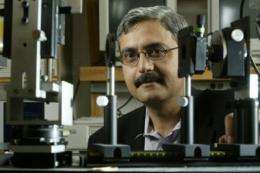
This is Ashutosh Chilkoti of Duke University. Credit: Duke University Photography

Duke University bioengineers have developed a new method for rapidly producing an almost unlimited variety of man-made DNA sequences.

These novel sequences of recombinant DNA are used to produce repetitive proteins to create new types of drugs and bioengineered tissues. Current methods for producing these DNA sequences are slow or not robust, the researchers said, which has hindered the development of these increasingly important new classes of protein-based polymers.

Researchers have already demonstrated that when a large protective macromolecule – known as a polymer – is attached to a , it greatly improves effectiveness and allows the protein to remain active in the bloodstream longer. There are many protein-polymer based medications in use today, such as human growth hormones, drugs to stimulate blood cell formation in cancer patients and anti-viral agents.

"This new technique should be very useful in making a practically unlimited number of these protein building blocks," said Ashutosh Chilkoti, Theo Pilkington Professor of Biomedical Engineering at Duke's Pratt School of Engineering. The results of the Duke team's experiment were published online in the journal . Graduate students Miriam Amiram and Felipe García Quiroz, working in Chilkoti's lab, were co-first authors of this paper.

"Depending on how complicated you want the polymer sequence to be, there are an infinite number of combinations you could make," Chilkoti said. "We haven't even begun to look at all the sequences that can be made or the unique properties they might have."

The researchers call the new process overlap-extension rolling circle amplification, and it is a modification of existing technologies. Because of this, they said that other laboratories would not need major investments in new equipment or materials.

"A very popular method for making tandem copies of involves inserting them iteratively into a bacterial plasmid," Amiram said. "After the vector has grown in size, the copies of the sequence are cut out using enzymes and the process is repeated to generate a larger . It is a very time-consuming process.

"With this new method, you don't get just one product, but many," she said. "This should help us to make large libraries of proteins, which we can use to rapidly screen new combinations. This powerful strategy generates libraries of repetitive genes over a wide range of molecular weights in a 'one-pot' parallel format."

Chilkoti compared it to sausage-making. Instead of stuffing the casings one-by-one individually, the new tool can rapidly stuff and stitch together long strings of sausages.

"This could help remove one of the biggest stumbling blocks we face in producing these drugs," Chilkoti said. "You can't make the proteins without genes, which act as the software directing the protein's production. Instead of building each sequence individually, as is done now, we can literally make hundreds, each with subtle differences."

The researchers used the system to synthesize genes found in two classes of protein-polymers. In the first, they produced protein-polymer combinations for elastin, a ubiquitous protein found in connective tissue. The researchers term them "smart" protein-polymers because they can be controlled by heat.

In the second set of experiments, they rapidly synthesized novel glucagon-like peptide-1 (GLP-1) analogs to show variable pharmokinetic properties. GLP-1 is a hormone that acts to release insulin in the body.

Provided by Duke University search and more info website


Rank 5 /5 (1 vote)
Relevant PhysicsForums posts
  • Schwartz reagent-- NMR/MS/IR
    created7 hours ago
  • Inversion temp
    created11 hours ago
  • High school chemistry EEI
    created18 hours ago
  • oxidation of I- by KMnO4
    createdMay 25, 2012
  • Invesion temp
    createdMay 25, 2012
  • Hybridization of SnCl3 -
    createdMay 25, 2012
  • More from Physics Forums - Chemistry

More news stories

High-speed method to aid search for solar energy storage catalysts

Eons ago, nature solved the problem of converting solar energy to fuels by inventing the process of photosynthesis.

Chemistry / Materials Science

created May 25, 2012 | popularity 5 / 5 (3) | comments 3 | with audio podcast

From lemons to lemonade: Reaction uses carbon dioxide to make carbon-based semiconductor

(Phys.org) -- A materials scientist at Michigan Technological University has discovered a chemical reaction that not only eats up the greenhouse gas carbon dioxide, it also creates something useful. And, by ...

Chemistry / Materials Science

created May 21, 2012 | popularity 4.7 / 5 (88) | comments 28 | with audio podcast

New CO2-removing catalyst can take the heat

(Phys.org) -- The current method of removing the greenhouse gas carbon dioxide (CO2) from the flues of coal-fired power plants uses so much energy that no one bothers to use it. So says Roger Aines, principal ...

Chemistry / Materials Science

created May 24, 2012 | popularity 5 / 5 (7) | comments 7 | with audio podcast

Researchers demonstrate possible primitive mechanism of chemical info self-replication

(Phys.org) -- When scientists think about the replication of information in chemistry, they usually have in mind something akin to what happens in living organisms when DNA gets copied: a double-stranded molecule ...

Chemistry / Materials Science

created May 25, 2012 | popularity 5 / 5 (4) | comments 2 | with audio podcast

Castor oil: Action mechanism of one of the oldest drugs known to man elucidated

Castor oil is known primarily as an effective laxative; however, it was also used in ancient times with pregnant women to induce labour. Only now have scientists at the Max Planck Institute for Heart and Lung ...

Chemistry / Biochemistry

created May 21, 2012 | popularity 3 / 5 (2) | comments 3 | with audio podcast


SpotterRF debuts Radar Backpack Kit (w/ Video)

(Phys.org) -- SpotterRF has announced a special radar backpack kit designed to enhance situational awareness for soldiers on the ground. The company says its special radar is designed for warfighters as part ...

Australia hails surprise super-telescope decision

Australia has hailed a surprise decision giving it a role in a radio telescope project aimed at revolutionising astronomy, vowing to draw on its decades of experience in space science.

Astronomers seize last chance in lifetime for Venus Transit

Astronomers are gearing for one the rarest events in the Solar System: an alignment of Earth, Venus and the Sun that will not be seen for another 105 years.

Thousands of shellfish found dead in Peru

Thousands of crustaceans were found dead off the coast of Lima following the mystery mass death of dolphins and pelicans, the Peruvian Navy said Friday.

SpaceX capsule has 'new car' smell, astronauts say

SpaceX's Dragon cargo vessel smells like a new car, said astronauts at the International Space Station after opening the hatches Saturday following the spacecraft's landmark mission to the orbiting lab.

Family history of Alzheimer's affects functional connectivity

(HealthDay) -- Cognitively normal individuals with a family history of late-onset Alzheimer's disease (AD) may display lower resting state functional connectivity in the default mode network (DMN) of the brain, ...