Research paper on magnetic control makes the top 10
Nov 30, 2010
Research paper on magnetic control makes the top 10
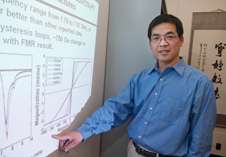
A study of the electric field control of magnetism was named one of the top 10 papers of the past decade by Advanced Functional Materials Photo by Lauren McFalls

A study of the electric field control of magnetism led by a Northeastern engineering professor was named one of the top 10 papers of the past decade by the prestigious journal Advanced Functional Materials.

Professor of electrical and computer engineering Nian Sun and his team reported on their effort to solve the need for greater in controlling magnetic properties, in applications such as motors; generators; disk drives; inductors; and transformers in cars, computers and cell phones.

The conventional approach has been through fields generated by electromagnets, which require large amounts of current, are bulky, and severely limit the applications of magnetic materials. Sun and his colleagues pursued a newer method known as electric field control, which is potentially more space and energy efficient.

As part of this research, Sun began investigating a new group of composite materials, known as multiferroic composites, five years ago. A strong, effective was produced by an electric field in a layered multiferroic composite, which used a negligible amount of energy. In sharp contrast, conventional electromagnets typically need hundreds of watts of power consumption to generate such a magnetic field, Sun said.

"The effective electric field control of magnetism in magnetic layered structures has significant technological implications," said Sun. "The compact and nearly passive electric magnetic control of magnetism could lead to more compact wireless communication systems and radar systems with significantly reduced and longer . It may also lead to new random access memory devices and other novel spintronic devices. The effective electric field control of magnetism may dramatically change our lifestyle."

Explore further: 'Chemical architects' build materials with potential applications in drug delivery and gas storage

More information: Paper online: onlinelibrary.wiley.com/doi/10.1002/adfm.200801907/abstract

add to favorites email to friend print save as pdf

Related Stories

Powerful new way to control magnetism

Aug 23, 2010

A team of scientists at Rutgers University has found a material in which an electric field can control the overall magnetic properties of the material. If the magnetoelectric effect discovered by the Rutgers group can be ...

How space eruptions happen

Apr 07, 2009

(PhysOrg.com) -- Mathematicians at the University of St Andrews have made a discovery which could lead to a better understanding of why huge eruptions occur in space.

Recommended for you

3-D printing artificial bone

Jun 17, 2013

Researchers working to design new materials that are durable, lightweight and environmentally sustainable are increasingly looking to natural composites, such as bone, for inspiration: Bone is strong and ...

Polymer-coated catalyst protects 'artificial leaf'

Jun 17, 2013

Due to the fluctuating availability of solar energy, storage solutions are urgently needed. One option is to use the electrical energy generated inside solar cells to split water by means of electrolysis, ...

User comments : 3

Adjust slider to filter visible comments by rank

Display comments: newest first

lengould100
not rated yet Nov 30, 2010
A strong, effective magnetic field was produced by an electric field in a layered multiferroic composite, which used a negligible amount of energy.


It would be good if the article confirmed that the laws of thermodynamics still hold, eg. a magnetic field rapidly oscillating in polarity still requires approximately the same amount of energy to oscillate. Otherwise people will start dreaming of 100 kw electric motors requiring only 10 kw of electricity to operate...
Simonsez
not rated yet Nov 30, 2010
F*cking magnets, how do they work?!
electrodynamic
not rated yet Jan 13, 2011
Sounds like a possible way of storing power.

More news stories

Long distance calls by sugar molecules

All our cells wear a coat of sugar molecules, so-called glycans. ETH Zurich and Empa researchers have now discovered that glycans rearrange water molecules over long distances. This may have an effect on ...

Counting small RNA in disease-causing organisms

Small molecules of RNA (tens to hundreds of nucleotides in length) play a key regulatory role in bacteria. Due to their small size, directly measuring the number of small RNA (sRNA) present in a single bacterium ...

Study suggests new approach to fight lung cancer

Recent research has shown that cancer cells have a much different – and more complex – metabolism than normal cells. Now, scientists at The University of Texas at Dallas have found that exploiting these differences might ...