Nanogenerators grow strong enough to power small conventional electronics (w/ Video)
November 8, 2010

Nanogenerators grow strong enough to power small conventional electronics

Enlarge

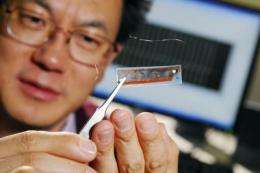
Professor Zhong Lin Wang holds an earlier version of the nanogenerators developed using zinc oxide nanowires. Credit: Credit: Gary Meek

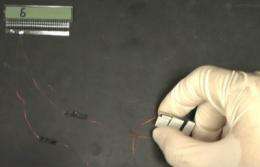
Blinking numbers on a liquid-crystal display (LCD) often indicate that a device's clock needs resetting. But in the laboratory of Zhong Lin Wang at Georgia Tech, the blinking number on a small LCD signals the success of a five-year effort to power conventional electronic devices with nanoscale generators that harvest mechanical energy from the environment using an array of tiny nanowires.

In this case, the comes from compressing a nanogenerator between two fingers, but it could also come from a heartbeat, the pounding of a hiker's shoe on a trail, the rustling of a shirt, or the of a heavy machine. While these nanogenerators will never produce large amounts of for conventional purposes, they could be used to power nanoscale and microscale devices – and even to recharge pacemakers or iPods.

Wang's nanogenerators rely on the piezoelectric effect seen in crystalline materials such as , in which an electric charge potential is created when structures made from the material are flexed or compressed. By capturing and combining the charges from millions of these nanoscale zinc oxide wires, Wang and his research team can produce as much as three volts – and up to 300 nanoamps.

This video is not supported by your browser at this time.

In the laboratory of Zhong Lin Wang at Georgia Tech, a blinking LCD signals the success of a five-year effort to power conventional electronic devices using nanoscale generators that harvest mechanical energy from the environment. Credit: Georgia Tech

"By simplifying our design, making it more robust and integrating the contributions from many more , we have successfully boosted the output of our nanogenerator enough to drive devices such as commercial liquid-crystal displays, light-emitting diodes and laser diodes," said Wang, a Regents' professor in Georgia Tech's School of Materials Science and Engineering. "If we can sustain this rate of improvement, we will reach some true applications in healthcare devices, personal electronics, or environmental monitoring."

Recent improvements in the nanogenerators, including a simpler fabrication technique, were reported online last week in the journal Nano Letters. Earlier papers in the same journal and in Nature Communications reported other advances for the work, which has been supported by the Defense Advanced Research Projects Agency (DARPA), the U.S. Department of Energy, the U.S. Air Force, and the National Science Foundation.

"We are interested in very small devices that can be used in applications such as health care, environmental monitoring and personal electronics," said Wang. "How to power these devices is a critical issue."

The earliest zinc oxide nanogenerators used arrays of nanowires grown on a rigid substrate and topped with a metal electrode. Later versions embedded both ends of the nanowires in polymer and produced power by simple flexing. Regardless of the configuration, the devices required careful growth of the nanowire arrays and painstaking assembly.

In the latest paper, Wang and his group members Youfan Hu, Yan Zhang, Chen Xu, Guang Zhu and Zetang Li reported on much simpler fabrication techniques. First, they grew arrays of a new type of nanowire that has a conical shape. These wires were cut from their growth substrate and placed into an alcohol solution.

The solution containing the nanowires was then dripped onto a thin metal electrode and a sheet of flexible polymer film. After the alcohol was allowed to dry, another layer was created. Multiple nanowire/polymer layers were built up into a kind of composite, using a process that Wang believes could be scaled up to industrial production.

When flexed, these nanowire sandwiches – which are about two centimeters by 1.5 centimeters – generated enough power to drive a commercial display borrowed from a pocket calculator.

Wang says the nanogenerators are now close to producing enough current for a self-powered system that might monitor the environment for a toxic gas, for instance, then broadcast a warning. The system would include capacitors able to store up the small charges until enough power was available to send out a burst of data.
Nanogenerators grow strong enough to power small conventional electronics
Enlarge

Compressing a nanogenerator between two fingers is enough to drive a liquid-crystal display. Credit: Courtesy Zhong Lin Wang

While even the current nanogenerator output remains below the level required for such devices as iPods or cardiac pacemakers, Wang believes those levels will be reached within three to five years. The current nanogenerator, he notes, is nearly 100 times more powerful than what his group had developed just a year ago.

Writing in a separate paper published in October in the journal Nature Communications, group members Sheng Xu, Benjamin J. Hansen and Wang reported on a new technique for fabricating piezoelectric nanowires from lead zirconate titanate – also known as PZT. The material is already used industrially, but is difficult to grow because it requires temperatures of 650 degrees Celsius.

In the paper, Wang's team reported the first chemical epitaxial growth of vertically-aligned single-crystal nanowire arrays of PZT on a variety of conductive and non-conductive substrates. They used a process known as hydrothermal decomposition, which took place at just 230 degrees Celsius.

With a rectifying circuit to convert alternating current to direct current, the researchers used the PZT nanogenerators to power a commercial laser diode, demonstrating an alternative materials system for Wang's nanogenerator family. "This allows us the flexibility of choosing the best material and process for the given need, although the performance of PZT is not as good as zinc oxide for power generation," he explained.

This video is not supported by your browser at this time.

High performance flexible nanogenerator technology using freely bendable piezoelectric ceramic thin films.

And in another paper published in Nano Letters, Wang and group members Guang Zhu, Rusen Yang and Sihong Wang reported on yet another advance boosting nanogenerator output. Their approach, called "scalable sweeping printing," includes a two-step process of (1) transferring vertically-aligned zinc oxide nanowires to a polymer receiving substrate to form horizontal arrays and (2) applying parallel strip electrodes to connect all of the nanowires together.

Using a single layer of this structure, the researchers produced an open-circuit voltage of 2.03 volts and a peak output power density of approximately 11 milliwatts per cubic centimeter.

"From when we got started in 2005 until today, we have dramatically improved the output of our nanogenerators," Wang noted. "We are within the range of what's needed. If we can drive these small components, I believe we will be able to power small systems in the near future. In the next five years, I hope to see this move into application."

More information: http://pubs.acs.or … 21/nl102959k

Provided by Georgia Institute of Technology

Filter


Move the slider to adjust rank threshold, so that you can hide some of the comments.


Display comments: newest first

DamienS
Nov 08, 2010

Rank: 5 / 5 (3)
This is great research, as replacing batteries in portable devices is such a pain. This is why I don't have a wireless keyboard and mouse. Speaking of which, I'm sure they could make the action of a keys press into an energy harvester or the movement of a mouse. You could have a small rechargeable battery constantly being topped up as you use the kbd/mouse, so you would never need to replace the battery. My kinetic watch already works on this principle (with no battery).
Kedas
Nov 09, 2010

Rank: not rated yet
"11 milliwatts per cubic centimeter"
It must be on places where you can't easily change battery otherwise it would be a waste of space.

Assuming light 250 lumens/watt you can get max 2.8 Lumen/cubic centimeter
antialias_physorg
Nov 09, 2010

Rank: 5 / 5 (1)
I had contacted the author last year along with the german national institute for earthquake research (which happens to be 100m down the road from where I used to work) with the idea of using these devices to harvest energy from background seismic activity.

Unfortunately the calculations show that the energy density is too small for this to be economically viable.

But in areas where there is high/constant vibration (e.g. along the shore lines) arrays of buried units of these devices could produce a steady (if small) amount of energy for local use.

The advantage would be that the generators require no service, have no parts that wear out and thus could operate pretty much indefinitely once buried.
M_N
Nov 09, 2010

Rank: not rated yet
"11 milliwatts per cubic centimeter"
It must be on places where you can't easily change battery otherwise it would be a waste of space.

Assuming light 250 lumens/watt you can get max 2.8 Lumen/cubic centimeter

250 lumens / watt is higher than any LED, so I'm not sure where you got that number from. Anyway, the idea of this is for when you only need SMALL amounts of power (eg a SMALL light). Even a couple of lumens is useful in a dark room...
913spiffy
Nov 14, 2010

Rank: not rated yet
Incredible thoughts. Incredible progress. 0=)
Rank 5 /5 (18 votes)
Relevant PhysicsForums posts
  • I need help with understanding of Inertia of a slender rod and plate?
    created45 minutes ago
  • Voltage and current in a series circuit
    created2 hours ago
  • Force on the top hinge of an open door
    created2 hours ago
  • Specular reflection from moving mirrors
    created6 hours ago
  • Setting Up a Nitrogen Laser
    created8 hours ago
  • Can sound fall?
    created9 hours ago
  • More from Physics Forums - General Physics

More news stories

Synthetic nano-waste does not disappear

(Phys.org) -- Tiny particles of cerium oxide do not burn or change in the heat of a waste incineration plant. They remain intact on combustion residues or in the incineration system, as a new study by Swiss ...

Nanotechnology / Bio & Medicine

created 9 hours ago | popularity not rated yet | comments 0 | with audio podcast

Nanotechnology for solar energy conversion systems

EU researchers extensively characterised the self-organisation of nanotubes and developed novel compositions particularly appropriate to solar energy conversion applications.

Nanotechnology / Nanomaterials

created 7 hours ago | popularity not rated yet | comments 0

Nano-structured polymer-based materials from scrap

EU researchers developed polymer blends and processing techniques facilitating recovery of scrap from industrial processes. Advances in this area have the potential to decrease costs and waste while protecting ...

Nanotechnology / Nanomaterials

created 8 hours ago | popularity not rated yet | comments 0

Dopant gives graphene solar cells highest efficiency yet

(Phys.org) -- By taking advantage of graphene’s favorable electrical and optical properties, and then adding an organic dopant, researchers have achieved the highest power conversion efficiency yet for ...

Nanotechnology / Nanophysics

created May 21, 2012 | popularity 5 / 5 (10) | comments 14 | with audio podcast feature

Nanomedicine: Quantum dots appear safe in pioneering study on primates

A pioneering study to gauge the toxicity of quantum dots in primates has found the tiny crystals to be safe over a one-year period, a hopeful outcome for doctors and scientists seeking new ways to battle diseases ...

Nanotechnology / Bio & Medicine

created May 20, 2012 | popularity 4.3 / 5 (3) | comments 8 | with audio podcast


Researchers solve structure of human protein critical for silencing genes

In a study published in the journal Cell on May 24, Cold Spring Harbor Laboratory (CSHL) scientists describe the three-dimensional atomic structure of a human protein bound to a piece of RNA that "guides" the pr ...

High-speed method to aid search for solar energy storage catalysts

Eons ago, nature solved the problem of converting solar energy to fuels by inventing the process of photosynthesis.

It's in the genes: Research pinpoints how plants know when to flower

Scientists believe they've pinpointed the last crucial piece of the 80-year-old puzzle of how plants "know" when to flower.

Yahoo! ditches digital newsstand for iPads

Yahoo! shuttered its fledgling digital newsstand for iPads on Friday in what it said was the start of a product purge intended to make the floundering Internet pioneer more nimble.

Tongue analysis software uses ancient Chinese medicine to warn of disease

For 5,000 years, the Chinese have used a system of medicine based on the flow and balance of positive and negative energies in the body. In this system, the appearance of the tongue is one of the measures used to classify ...

Yahoo kills 'Livestand' just 6 months after debut

(AP) -- Yahoo is killing a tablet magazine called Livestand just six months its debut on the iPad.