Electric cars get charged wirelessly in London (w/ Video)
November 4, 2010 by John Messina report

Electric cars get charged wirelessly in London (w/ Video)

Enlarge

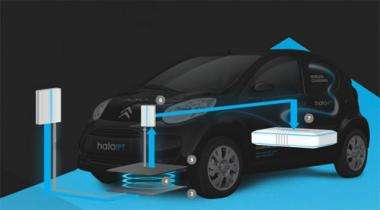
Wireless charging system allows the next generation of electric vehicles to be charged wirelessly. Credit: HaloIPT

(PhysOrg.com) -- HaloIPT has recently demonstrated wireless charging of electric vehicles in London using their inductive power transfer technology. The company fitted Citroen electric cars with receiver pads on the underside of the car, allowing the batteries to be charged wirelessly.

Existing such as the Leaf and i-MiEV requires an electric cable to be connected from a socket on the side of the car to street-side power station or electrical socket at home.

The IPT technology uses inductive charging and the electrical pads in the road are buried under the asphalt making them invisible and protecting them from adverse weather conditions. HaloIPT claims that their charging system provides for greater lateral movement which means that the vehicle’s receiving pad does not have to be directly over the transmitter pad.

This video is not supported by your browser at this time.

IPT system allows the next generation of electric vehicles to be charged wirelessly and even powered up as they drive over electrified roads.

IPT System

The primary power supply is powered from the mains supply and energizes a lumped coil; the current ranges anywhere from 5 to125 amps. Since the coil is inductive, compensation may be required using series or parallel capacitors to reduce the working voltages and currents in the supply circuitry.

The receiver pad coils are magnetically coupled to the primary power coil. Power is transferred by tuning the receiver pad coil to the operating frequency of the primary pad coil with series or parallel capacitors. The power transfer is controllable with a switch-mode controller.

The IPT charging system gives drivers a ‘worry free’ solution about forgetting to recharge their electric vehicle. It also eliminates the need for a driver to make a conscious decision about having to charge their vehicle.

According to HaloIPT a commercial scale demo of their IPT technology is expected in 2012.

More information: HaloIPT

© 2010 PhysOrg.com

4.4 /5 (16 votes)  

Filter


Move the slider to adjust rank threshold, so that you can hide some of the comments.


Display comments: newest first

jwalkeriii
Nov 04, 2010

Rank: 1 / 5 (2)
Same idea and same video from 2009 as far as I can tell (youtube: HaloIPT). Isa warrantless repost.
DamienS
Nov 04, 2010

Rank: 3.3 / 5 (3)
Existing electric cars such as the Nissan Leaf and Mitsubishi i-MiEV requires an electric cable to be connected from a socket on the side of the car to street-side power station or electrical socket at home.

The IPT technology uses inductive charging...

If electric vehicles are about energy efficiency, then surely cable charging is way more efficient. Sure, induction charging may be less of a hassle, but it does waste quite a bit of power in the process. It's interesting they don't mention the associated losses in the article.
fixer
Nov 04, 2010

Rank: 5 / 5 (2)
If they are really smart they will run existing overhead power supplies underground and charge from the inductance from the HV supply that is usually lost.
Added bonus, removal of international eyesores- telegraph posts!
trekgeek1
Nov 04, 2010

Rank: 5 / 5 (1)
If they are really smart they will run existing overhead power supplies underground and charge from the inductance from the HV supply that is usually lost.
Added bonus, removal of international eyesores- telegraph posts!


If you design a system to extract power from magnetic fields, it will do more than just take the lost energy. Since it is depleting that magnetic field, the cable will try to replenish its field thus causing increased losses. So yeah, it could charge the car, but it will suck a lot of juice from the lines and that juice was heading somewhere with a purpose.
Saiful_Nizam
Nov 04, 2010

Rank: 2 / 5 (1)
What about the EMF radiation? i think that's the main problem for this application to be implemented. My two cents..
tkjtkj
Nov 05, 2010

Rank: 3 / 5 (1)
All of the above seems true, but: there really might be room for this technology:
I pro-rated ($/mile/lb.weight) my electric bicycle .. from its 60 lb up to the wgt of a 2500 lb car ..
and surprisingly, the numbers worked out to be a 'gasoline price equivalent' of $1.05 / gallon.
If these numbers are any where near accurate, the wasted energy losses of this system could still make for a relatively economically sound alternative.
but:
"One bicycle, even with an overweight rider,does not a valid computation make"
Planetbob99
Nov 05, 2010

Rank: 4 / 5 (1)
A wireless solution *almost* makes sense for cell phones and the like - when the receiver is actually integrated into the item being charged, and the energy levels involved are small.
Wireless charging of something on the scale of a car:
- breaks any ability to participate in the 'smart' grid: your car would not be able to feed back into the grid (and if you care about green measures, being part of the storage of power is a BIG deal)
- Will use at least 20% more power that a physical connection would in order to get the same charge. At LEAST. Park a little bit off of optimal and it will be closer to 50% more, or even twice as power.
- A dedicated high school student could create a lego MindStorm project that would connect a physical cable to a particular type of electric car. It just is NOT that difficult. A couple of servos, a sensor or two and a few magnets.

tkjtkj
Nov 05, 2010

Rank: 5 / 5 (1)
PlanetBob99 said:
- Will use at least 20% more power that a physical connection would in order to get the same charge. At LEAST. Park a little bit off of optimal and it will be closer to 50% more, or even twice as power.


so, as i suggested, that results still a significant saving over present technology.

My "$1 / gal" becomes "2", still 33% less than gasoline prices here in USA...
Jimbaloid
Nov 05, 2010

Rank: 5 / 5 (2)
It might however also solve some other 'social issues' that might yet be seen; When we reach a certain saturation of electric vehicles and charging points we might see mischievous types unplugging/cutting cables, or hijacking your charge while you are gone. Also perhaps removes a trip hazard?!
jsland
Nov 05, 2010

Rank: 1 / 5 (1)
What does millions of vehicles demanding electrical "fuel" going to do to our grid?????
Buyck
Nov 05, 2010

Rank: 5 / 5 (1)
Very usefull technology! Very practical and a clean solution in stead of cables and so on...
Eikka
Nov 06, 2010

Rank: 1 / 5 (1)

My "$1 / gal" becomes "2", still 33% less than gasoline prices here in USA...


Have you factored in the increase in electricity prices due to increased demand?
Eikka
Nov 06, 2010

Rank: 1 / 5 (1)
Also, if the system is, say 80% efficient, and you got 50 kWh to charge in 8 hours. That would mean you would output 12.5 kWh of stray energy, or the equivalent of using a 1.5 kW space heater for 8 hours.

For one thing, I don't want to be standing next to the device when it's dumping 1.5 kilowatts to its surroundings. That's like standing next to a pile of a thousand cellphones all transmitting at the same time.
Alburton
Nov 07, 2010

Rank: 1 / 5 (2)
Funny thing with the charger having sensors for stopping if the cat walks by.
WitH this things losses cats are just going to love that warm little cozy spot....
wont humankind stop until it is destroyed by the psycho-mutant-cat-army of its creation?
random
Nov 08, 2010

Rank: 1 / 5 (1)
Tesla woz 'ere
Skeptic_Heretic
Nov 08, 2010

Rank: 5 / 5 (1)
For one thing, I don't want to be standing next to the device when it's dumping 1.5 kilowatts to its surroundings. That's like standing next to a pile of a thousand cellphones all transmitting at the same time.
That's more akin to standing in line at a rock concert. The human body produces a lot of juice on it's own.
fixer
Nov 08, 2010

Rank: not rated yet
To get an idea of the losses from overhead power lines, stand under one and hold up a fluorescent light tube!
That power can be put to good use, it is already produced, it just needs harvesting.
Rank 4.4 /5 (16 votes)
Relevant PhysicsForums posts

More news stories

Apple CEO Cook gives up $75M in stock dividends

(AP) -- Apple says CEO Tim Cook is giving up $75 million in dividends on restricted stock.

Technology / Business

created 1 hour ago | popularity not rated yet | comments 0

Beyond oil, can Alaska be tapped as a source for renewable energy?

Alaska has massive hydro, wind, geothermal and other renewable resources, but the state's rural villages are chained to diesel and suffer oppressive energy costs they say threaten their existence. Lawmakers, energy experts ...

Technology / Energy & Green Tech

created 2 hours ago | popularity not rated yet | comments 0

Computers excel at identifying smiles of frustration (w/ Video)

(Phys.org) -- Researchers at the Massachusetts Institute of Technology (MIT) in the US have trained computers to recognize smiles, and they have turned out to be more adept at recognizing smiles of frustration ...

Technology / Computer Sciences

created 9 hours ago | popularity 4 / 5 (2) | comments 1 | with audio podcast report

Researchers successfully test solar desalination system for arid land agriculture

Ben-Gurion University of the Negev (BGU) researchers have created a man-made oasis in the desert with the successful application of a solar-powered desalination system that provides water for irrigation in arid regions. The ...

Technology / Energy & Green Tech

created 4 hours ago | popularity not rated yet | comments 1

HyperSolar shows dirty water no barrier to power world

(Phys.org) -- The Santa Barbara, California, company, HyperSolar, is set to transparently share the ups and downs of its research experiences toward the company’s ultimate vision, successfully producing ...

Technology / Energy & Green Tech

created 21 hours ago | popularity 4.8 / 5 (14) | comments 16 | with audio podcast report


New device allows pacemaker patients to safely undergo MRIs

For many, it's a medical conundrum: The very pacemaker keeping their heart in rhythm prevents them from undergoing an MRI to diagnose other ailments, because interaction between the two devices could prove deadly.

Common therapies for basal cell carcinoma offer similar survival

(HealthDay) -- For patients with superficial basal cell carcinoma (sBCC), treatment with imiquimod or photodynamic therapy (PDT) results in similar long-term tumor-free survival, according to a review published ...

One-fifth of healthy middle-aged men have low-grade murmur

(HealthDay) -- More than one-fifth of healthy middle-aged men have a low-grade systolic heart murmur that confers a nearly five-fold higher risk of future aortic valve replacement (AVR), according to a study ...

Cancer patients share web info with docs for insight, advice

(HealthDay) -- Cancer patients' primary goal in talking with their doctors about information they've found on the Internet is to get more insight and advice on the online information, new research indicates.

Of mice and mental models: Neuroscientific implications of risk-optimized behavior in the mouse

(Medical Xpress) -- Regardless of an organism’s biological complexity, every encephalized animal continuously makes under-informed behavioral choices that can have serious consequences. Despite its ubiquity, ...

Dragon arrives at space station in historic 1st (Update 2)

The privately bankrolled Dragon capsule arrived at the International Space Station for a historic docking Friday, captured by astronauts wielding a giant robot arm.