5 reasons to like the Nissan Leaf
Oct 11, 2010 By Jim Motavalli

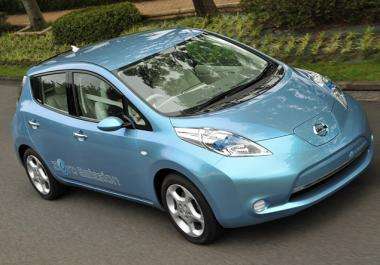
Surprise, the Nissan Leaf is great fun to drive. Well, it's not all that much of a surprise: I'd driven two other cars with the Leaf technology under the hood, but this was my first go-round (through Central Park, of all places) in the actual production Leaf, one of just 17 in the U.S. right now.

We're on a countdown to delivery -- the first Leafs, costing $25,280 after a $7,500 federal tax incentive, will be delivered in December. Those owners are in for a treat, because the Leaf is a delight on nearly every level:

• It's really fun to drive. The is almost preternaturally quiet -- you can't even hear the gentle motor sound it makes to warn pedestrians at speeds of 20 mph or less. And yet it surges ahead like, well, Lance Armstrong at the start of a bike race, on or off steroids. (Armstrong, the official spokesman for the Leaf, is the only American to actually have one right now.) The Leaf offers faster acceleration than you'd expect from 107 horsepower, a factor of its relatively light weight and aerodynamic design. There's very little regenerative braking effect unless you engage "Eco" mode, but there is a bit of comforting "creep" when you release the brakes at a stoplight. The handling is quite sharp, and the ride is nicely balanced -- even New York's potholes didn't upset it.

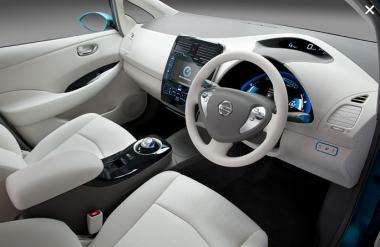
• The graphics and interface are cool. If you like cutting-edge video games, you'll be right at home. My favorite screen showed a map with a circle that encompassed your driving range -- your performance at the wheel helps determine how far you'll get. There's a nicely designed app for the iPhone (or any computer) that allows the driver to remotely stop or start a charge, as well as pre-heat or cool the car's cabin. A screen-based timer can be set to start charging late at night when rates or low, but you can override it with a touch of a button to start charging immediately. Does it have USB iPod access? Of course -- did you have to ask?
• The incentives are in place. Some Leaf owners will be luckier than others. Luckiest are in California, where a $5,000 cash rebate gets the price down to around $20,000. California is also doing more than any other state to put in a charging network. But other states are also getting involved: EV purchase subsidies of one form or another are also in place in Tennessee (where the Leaf will be built starting in model year 2013), Hawaii, Georgia and Colorado. Anyone can get the federal $7,500 tax incentive, and also an up-to-$2,000 tax credit to install a 240-volt charger. But that one expires Dec. 31 unless the dithering Congress manages to renew it. It's too bad we're not Chinese, because over there you can get $8,800 for buying an EV.

• The economics make sense. According to Paul Hawsom, Nissan's product planning manager for sports cars and EVs, a 25-mpg car running on $3 a gallon gas will cost 12 cents per mile to operate, or $1,800 over 15,000 miles. The Leaf or comparable EV operating on electricity at the national average of 11 cents per kilowatt-hour will cost 2.6 cents per mile. That means $396 over 15,000 miles. "The advantage exists even if gasoline drops below $1.10 per gallon," Hawsom said. And since there's no real purchase penalty to a subsidized Leaf, the savings start immediately.

• There are charging options. The Leaf will come with a 110 charger for any wall outlet, but that's a 16-hour slog. Nissan, with partner AeroVironment, will equip your garage for 240-volt charging that can be subsidized by that disappearing federal credit. Luckily, 240-volt charging (seven hours from when the warning light comes on) is standardized with the gun-shaped J1772 plug. Less sure is 480-volt fast charging, which takes just 30 minutes. Leafs in selected markets will be equipped for the Japan-developed CHAdeMO fast-charging standard, but the U.S. is still debating whether to go with that or not.

The Leaf and its ilk aren't for everyone. "If you do a lot of camping, it's probably not the vehicle for you," Hawsom said. Likewise if you tow a boat or need seven-passenger seating (though it seats five comfortably, with OK but not great rear legroom). And you'll need to live with the limited, 100-mile range, which could be less in weather extremes (when the heater or air conditioner are cranking, and the batteries are performing less than optimally). A lot of highway driving will affect range, too.

Nissan has 20,000 $99 reservations in the U.S. In the first year, global production in Japan is set at 50,000, which could mean that the allocation and the reservations line up neatly. Production capacity should ramp up quickly, because Nissan is planning to add both battery and car plants in Europe and the U.S. Battery capacity in conjunction with NEC will far exceed car capacity, because the companies are planning to supply battery packs to other carmakers. All in all, it sounds like a workable plan.

Explore further: Solar and lithium ion car race winners announced

3.5 /5 (17 votes)
add to favorites email to friend print save as pdf

Related Stories

Electric cars rolling out

Dec 16, 2009

(PhysOrg.com) -- Electric vehicles are far from new, but we are still a long way from electric cars being the norm. Now two new electric cars may bring that goal a step closer.

Nissan to make electric cars in Britain from 2013

Mar 18, 2010

Nissan Motor on Thursday said it would start building its zero-emission Leaf electric car at a plant in Britain from 2013, saving more than 2,000 jobs in one of England's most deprived regions.

Nissan's 'Leaf' to challenge Toyota's Prius (Update)

Aug 06, 2009

Nissan's upcoming all-electric car could outsell hybrids like Toyota's Prius even though it can't drive more than about 100 miles (160 kilometers) without stopping to recharge, a senior executive said.

Seattle Charges Up for Electric Cars

Dec 15, 2009

(AP) -- Over the next two years, 2,500 charging stations for electric vehicles will be built in the Seattle area as part of a partnership between Nissan North America and the Electric Transportation Engineering ...

Recommended for you

Green conversion of heat to electricity

10 hours ago

Soon, it will be possible to produce electricity from heat over 30 degrees emitted from a waste incinerator, refinery, or data processor. The start-up Osmoblue has just confirmed the feasibility of this new ...

Space drives e-mobility

11 hours ago

An ESA business incubation start-up company is helping major car manufacturers to develop electric vehicle concepts and improve safety systems by turning ideas quickly into virtual prototypes.

User comments : 28

Adjust slider to filter visible comments by rank

Display comments: newest first

caeman
1 / 5 (3) Oct 11, 2010
All that and 15 years to recoup the additional cost of this EV, when compared to a gas-powered auto! What a bargain!
Milou
3 / 5 (2) Oct 11, 2010
I deliver pizza. The circle range will not do any good in that situation. Back and forth, stop and go, speed up/slow down for 4 hrs solid. I would love to go electric but I drive about 80 + mile in one day, not counting to/from work. And I need 240V maybe 480V in the garage??? I better keep delivering for the next century!
david_42
4.8 / 5 (4) Oct 11, 2010
Orly? I think your calculator is damaged. In 18 years, the difference between gas and electricity will pay for the car completely, without considering any of the tax kickbacks.

Since I rarely drive less than 130 miles on the days I drive, this won't help me. But my wife has a 6 mile commute and would only have to charge it once a week.
Eikka
3 / 5 (2) Oct 11, 2010
In 18 years sure, too bad the battery will last only 5.

And the range reduction in "weather extremes" is not a slight problem. Mitsubishi admits that its car may drop 50% off the range in "difficult conditions". In reality you need near-optimal conditions just to reach the nominal range, and real driving tests confirm.

The MiEV has 20 kWh in the battery, and the Leaf has 24 kWh. Both are rated for 100 miles, yet the MiEV will only do about 60 in the real world, and extrapolating from that the Leaf will do about 75.

I wish these companies would stop trying to cheat and measure the range and performance using some proper standards - not "up to".
Eikka
1.5 / 5 (2) Oct 11, 2010
Also, even the Tesla Roadster needs 250 Wh/mi according to Tesla, and it is a streamlined sportscar that is designed for low energy consumption.

Using that figure, the Leaf can never achieve 100 miles. It just doesn't add up.
Shootist
5 / 5 (3) Oct 11, 2010
Physorg editors now allowing advertisements to pass as science?
Eikka
1 / 5 (1) Oct 11, 2010
Doing a bit more research, it seems that the battery in the car is estimated to cost $9000 in mass production, and Nissan will give it an 8 year or 100,000 mile warranty. (to what capacity? 80% or 65%?)

That's 9 cents per mile. Add the 2.6 calculated for electricity, and you got 11.6 cents per mile, which practically the same as for the gasoline, especially when you know that the Leaf won't consume as little electricity as advertised.

Without rebates and tax incentives, this car couldn't compete.
Newbeak
3 / 5 (1) Oct 11, 2010
I'll hold out for a series hybrid car like the Volt.It is the best of both worlds-commute less than 40 miles a day,and you only use electricity.For a weekend camping trip,the back up engine kicks in after 40 miles.
John_balls
5 / 5 (3) Oct 11, 2010
Doing a bit more research, it seems that the battery in the car is estimated to cost $9000 in mass production, and Nissan will give it an 8 year or 100,000 mile warranty. (to what capacity? 80% or 65%?)

That's 9 cents per mile. Add the 2.6 calculated for electricity, and you got 11.6 cents per mile, which practically the same as for the gasoline, especially when you know that the Leaf won't consume as little electricity as advertised.

Without rebates and tax incentives, this car couldn't compete.

What are u a lobbyst for big oil. Just say thank you , this is just beginning.
DamienS
5 / 5 (4) Oct 11, 2010
Is this meant to be a review or a puff piece? Shocking article on a science news site!

The car is almost preternaturally quiet

Preternaturally - seriously?!
Parsec
5 / 5 (2) Oct 12, 2010
All that and 15 years to recoup the additional cost of this EV, when compared to a gas-powered auto! What a bargain!

Hmmm... 20K isn't a big (if any) of a price premium over gas cars of the same size class. Since the Leaf costs a lot less to operate, it looks like a 0 year payback over a conventional car.

I think your math is quite off. It looks like you took the entire price of the car, and divided it by the yearly upkeep to come up with 15 years.
Roj
5 / 5 (4) Oct 12, 2010
As will all electronic things, market demand for version one, finances R&D for advances in version 2.
Roj
4.5 / 5 (8) Oct 12, 2010
Anyone who has worked on their own vehicles will appreciate not worrying about smog checks during registration, or leaky fluids on driveways, much less regular fluid & filter changes.

I look forward to never changing another thermostat, water-pump, belt, hose, radiator, starter, alternator, or dead lead-acid battery again.
plasticpower
5 / 5 (4) Oct 12, 2010
Anyone who has worked on their own vehicles will appreciate not worrying about smog checks during registration, or leaky fluids on driveways, much less regular fluid & filter changes.

I look forward to never changing another thermostat, water-pump, belt, hose, radiator, starter, alternator, or dead lead-acid battery again.


Agreed. Oil changes alone can add up over time and an ICE can wear out pretty quickly. Electric motors on the other hand require nearly zero maintenance and are very easy to repair if something goes wrong. The only worry I have about this car is battery life (as in, how long until capacity is severely degraded)
jimbo92107
5 / 5 (2) Oct 12, 2010
Ditto on maintenance. How nice never again to change the oil, replace spark plugs, filters, or be required to fork up hundreds of dollars to have an engine or tranny gasket replaced. An electric car is dead simple compared to the crazy complexity of an internal combustion vehicle. And now (surprise!), it turns out GM was lying about the mpg of the Volt.
KillerKopy
3.5 / 5 (2) Oct 12, 2010
"It's too bad we're not Chinese, because over there you can get $8,800 for buying an EV."

Wow... who writes this crap the Chinese create more pollution than anyone on earth. But thats besides the point if we were Chinese we would be restricted from reading this webpage because it clearly has a bias and also a comment blog. And why is our government paying people to buy new cars, we have a bit of a debt problem last time I checked don't we. Thanks for all the debt grampa!!
Eikka
2 / 5 (2) Oct 12, 2010

What are u a lobbyst for big oil. Just say thank you , this is just beginning.


I like electric cars. I don't like being lied to.

If I'm going to buy one, I want to make sure that I don't get these "up to" and "may be" deals or subsidized c*ap that I have to pay for anyways in the form of tax hikes later on, and I'm generally against governments giving private companies money to hide the economic unsustainability of the thing that they're selling.

I mean, what exactly are they trying to accomplish? Nissan is barely making a profit on these things anyways.

Electric cars aren't going to have any significant impact on the environment until they're ready to be adopted by pretty much everyone, and we're not there yet, so it's pointless to throw good money and resources into making them, instead of putting the same money to work in research and developement.
Eikka
2 / 5 (1) Oct 12, 2010

I look forward to never changing another thermostat, water-pump, belt, hose, radiator, starter, alternator, or dead lead-acid battery again.


Then look again, because electric cars will have thermostats, water pumps, hoses, liquids, radiators and belts. How else do you figure you'd have a A/C system, vacuum assisted brakes, battery thermal management etc.?

About the only thing you'll miss is the oil change. The rest of the parts that need regular maintenance are still there, and who knows what problems you will have with the new electronic bits, like the DC/DC converter that runs the separate 12 volt battery that acts as the backup for the drive system. (That's right, even an EV needs a starter battery)
winthrom
2 / 5 (1) Oct 12, 2010
The only way electric cars are going to replace ICE is when there is an induction track (Alternating Current third rail ala Nikola Tesla)is buried in all major traffic highways and roads. The 50-100 mile range gets you on/off the highway from/to your home where you recharge. Long trips are via induction power (probably run by the state as tolls). Batteries are for driving non-third rail streets.
krundoloss
2 / 5 (1) Oct 12, 2010
What will make electric cars viable. A decent electricity storing medium. Batteries suck, they wear out, and they are too heavy. We need supercapacitors or some other means of energy storage, the batteries wearing out is a MAJOR problem. I will not buy an electric vehicle if the batteries are just going to wear out, its rediculous. All batteries are just sorry, our world desperately needs something better.
JeffJohnson17
not rated yet Oct 12, 2010
I would rather buy an Envision Motor Company Vehicle.
200 plus miles per charge. 3 year 70000 mile warranty.
Nickel Sodium Chloride batteries sound promising.
Wonder why this site doesn't do a story on them?
You can buy one today!
It will be nice not having an exhaust system that needs costly repairs. Also I won't miss replacing the air filter either.
Sonhouse
not rated yet Oct 16, 2010
I would rather buy an Envision Motor Company Vehicle.
200 plus miles per charge. 3 year 70000 mile warranty.
Nickel Sodium Chloride batteries sound promising.
Wonder why this site doesn't do a story on them?
You can buy one today!
It will be nice not having an exhaust system that needs costly repairs. Also I won't miss replacing the air filter either.

Doesn't sound like that good a deal to me. For instance, what about in a crash, 500 F liquid squirting inside the car? What about the 18% per DAY self-discharge rate? The power density is less than lithium ion batteries and if they cool off it takes a couple of DAYS to heat them up to operating temperature and if discharged, won't be ready for prime time for four days. Not exactly a winner as far as I can see. Back to the drawing board.
luggite
not rated yet Oct 16, 2010
I remember seeing a movie trailer where a certain actor named Vince Vaughn said that "Electric cars are gay." The trailer was pulled from theaters, but the fact is that many electric cars don't have the range or power of traditional cars. Please correct me if I'm wrong, but why should we not outfit the world's fleets with clean diesel vehicles until battery technology improves?
Eikka
not rated yet Oct 16, 2010
Please correct me if I'm wrong, but why should we not outfit the world's fleets with clean diesel vehicles until battery technology improves?


Diesel particulate and NOx emissions, and the fact that to get rid of them reduces the efficiency of the engine to that of gasoline engines or lower.

Arguably, modern particle filters and catalytic converters don't actually work for diesel. They burn off most of the big particles, but end up breaking the rest into many more smaller particles of soot that are more dangerous to health because at their size they can enter your bloodstream from the lungs.

I advocate methane as fuel. It's clean burning, enough of it can be stored on-board a vehicle to get acceptable range, it's fast to refuel, doesn't require many changes to the infrastructure, and it's easy to make from organic waste.
Skeptic_Heretic
1 / 5 (1) Oct 17, 2010
They need to get the round trip mileage in inclement weather conditions up to about 250 miles, then this will be a car that jsut about everyone can use without issue.

Either that or get the charging down to 30 minutes without a 480 volt connection. With a 100 Amp breaker box, which is about standard for most houses, that'd be almost a quarter of your incomming line feed. It's inconvenient to say the least to limit the amount of circuits that the rest of your house can use so that you can charge your car.
ereneon
1 / 5 (1) Oct 17, 2010
Though electric cars are a nice idea, until the batteries (or fuel cell, etc.) are good enough to drive a reasonable distance (like the same you get from a tank of gas), in real world conditions, with low enough charging time, and without needing to be replaced for the life of the car, I don't think I'll be getting one. Lithium ion batteries are unstable, toxic, explosive, heavy, expensive, and highly damaging to the environment to produce (not to mention easily breakable and highly temperature sensitive). How about a battery where you have liquid cathodes and anodes, and you pull up the the "gas station" and just pump out the used fluids and pump in more? Way better than plugging the car in.
chrisp
not rated yet Oct 17, 2010
..so it's pointless to throw good money and resources into making them, instead of putting the same money to work in research and developement.


It will not have significant impact but some, and that's enough. The EV furvor isn't going to wait. Forget about waiting for a better version to come out with more R&D. The R&D's been done, it continues and improves, and now it's time for car companies put out their latest creations. Would everyone wait to buy an iPhone4 until they were assured it would get great reception? Heck no. They're selling like gangbusters even though they aren't perfect! Or would have people waited to buy the first cars when they didn't have to use that stupid hand crank? When people start making more and more decisions that benefit the environment, they're going to feel better, whether it's someone planting a yard with low-water plants, putting in modular solar panels, or someone buying a spiffy new Leaf.
Skeptic_Heretic
3 / 5 (2) Oct 18, 2010
Lithium ion batteries are unstable, toxic, explosive, heavy, expensive, and highly damaging to the environment to produce (not to mention easily breakable and highly temperature sensitive).
Compared to the lead acid battery in every production vehicle on the road now? Plus the perfectly stable and not at all explosive tank of liquid petroleum you're sitting on top of?

Lithium Ion batteries are safe enough to be in your cell phone, which you stick next to your head and your laptop which some people put on top of their legs and reproductive organs. Citing lithium ion batteries as dangerous and explosive is about the worst objection I've ever heard to electric vehicles.

The best way to get this tech into the mainstream in America is make the batteries easily removable and fairly standard so that people can get a battery swap at the gas station and the gas station can charge them, similar to how propane tanks with gas grills are handled.

More news stories

Amazon plans greenhouse-style headquarters

US online giant Amazon has unveiled plans for a futuristic greenhouse style headquarters "where employees can work and socialize in a more natural, park-like setting."

Game system castAR debuts at Maker Faire

(Phys.org) —Two tech talents, formerly employees at video game publisher Valve, have been working on their own vision in the form of game-ready glasses. Their company, Technical Illusions, will seek to ...

If you can remember it, you can remember it wrong

(Medical Xpress)—Native peoples in regions where cameras are uncommon sometimes react with caution when their picture is taken. The fear that something must have been stolen from them to create the photo ...

Reducing caloric intake delays nerve cell loss

Activating an enzyme known to play a role in the anti-aging benefits of calorie restriction delays the loss of brain cells and preserves cognitive function in mice, according to a study published in the May ...

B vitamins could delay dementia

(Medical Xpress)—Despite spending billions of dollars on research and development, drug companies have been unable to come up with effective treatments for dementia and Alzheimer's Disease (AD). Now, A. ...

New method for producing clean hydrogen

Duke University engineers have developed a novel method for producing clean hydrogen, which could prove essential to weaning society off of fossil fuels and their environmental implications.