Imec reports large-area silicon solar cells with high efficiency
Sep 06, 2010
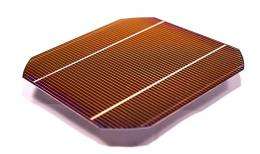
Imec’s Cu-plated large-area silicon solar cell with 19.4% efficiency.

At the 25th European Photovoltaic Solar Energy Conference (Valencia, Spain), Imec presents several large-area silicon solar cells with a conversion efficiency above 19%.

Two types of cells were realized namely with Ag-screenprinted contacts and plated Cu-contacts. Efficiencies of cells with screenprinted contacts were up to 19.1% whereas 19.4% was obtained with Cu-plated contacts. These high efficiencies were obtained thanks to several factors amongst which a combination of improved texturization and optimized firing conditions. The results were achieved on large-area cells (148cm2) with 170µm thickness, proving the industrial viability of the process.

’s record efficiency feature rear-side passivation, and, local aluminum back-side field and screenprinted contacts or Cu-plated contacts on advanced emitter schemes. “The fact that such efficiencies can be obtained by metallization schemes based on screenprinted Ag contacts enables compatibility with present industrial metallization practice in the solar cell industry. The Cu-based front-side metallization is a step towards higher sustainability and lower cost, substituting Ag with Cu in future industrial production of crystalline silicon solar cells,” said Dr. Joachim John, team manager industrial solar cells at Imec.

“High efficiency, low cost, and sustainability are the main drivers in Imec’s research on solar cells, eventually targeting cells that are only 40µm thick with efficiencies above 20. We expect further improvements towards efficiencies of up to 20% for large-area silicon solar cells. This achievement is a major step forward towards industrial manufacturing of sustainable, low-cost, thin silicon solar cells with high efficiency,” said Dr. Jef Poortmans, director Imec energy/solar program.

The results were achieved within Imec's silicon solar cell industrial affiliation program (IIAP), a multi-partner R&D program that explores and develops advanced process technologies aiming a sharp reduction in silicon use, whilst increasing cell efficiency and hence further lowering substantially the cost per Watt peak.

Explore further: Radiation leak at Japan lab; small impact expected

add to favorites email to friend print save as pdf

Related Stories

Recommended for you

Radiation leak at Japan lab; small impact expected

19 hours ago

An atomic research lab in northern Japan has reported a radiation leak that may have affected about 50 people, though none were hospitalized and no impact was expected outside the facility, the lab's operator ...

The long road to the 2000-watt society

May 24, 2013

The vision of a society in which each inhabitant of the earth manages to consume only 2000 watts (48 kilowatt-hours per day) has already been around for 15 years. During this time, there has been a steady incr ...

Germany must spread cost of energy shift fairly: IEA

May 24, 2013

The International Energy Agency said Friday that Germany must shield its consumers from paying too much of the cost of its ambitious switch from nuclear power and fossil fuels toward renewable energy.

Solar Kettle allows for boiling water off the grid

May 23, 2013

(Phys.org) —A company called Contemporary Energy has unveiled a new device it calls the Solar Kettle. It looks very much like a normal coffee thermos, but has flaps on one side that open to allow for collecting ...

User comments : 4

Adjust slider to filter visible comments by rank

Display comments: newest first

deatopmg
1 / 5 (1) Sep 06, 2010
Cost per Watt installed is the only important factor. All this other stuff is interesting only IF it leads to lower installed cost/Watt.
mosahlah
1 / 5 (1) Sep 06, 2010
How about the stuff about Nancy Pelosi and her party killing the desert solar plants. That's kinda important also.
sender
not rated yet Sep 07, 2010
waiting on carbon nanocoil rectifyers actuating radiosonic polymers to couple to these thinfilms
mrlewish
not rated yet Sep 07, 2010
I have yet to understand why they just don't put the solar plants/panels over the super highways in southern California and Arizona. No extra land use to complain about.

More news stories

Yahoo, pay-TV operators among Hulu bidders

Online video site Hulu is again up for sale, with Yahoo and pay TV operators DirecTV and Time Warner Cable among the seven bidders, according to a person with direct knowledge of the matter.

Radiation leak at Japan lab; small impact expected

An atomic research lab in northern Japan has reported a radiation leak that may have affected about 50 people, though none were hospitalized and no impact was expected outside the facility, the lab's operator ...