Electric vehicles aim for 'longest and greenest' world tour
Aug 16, 2010
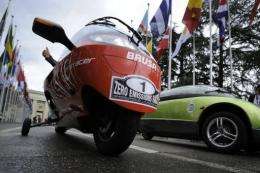
Switzerland's Team Zerotracer (left) and Australia's Team Trev electric vehicles prepare to leave the United Nations (UN) offices in Geneva. Electric vehicles from Australia, Germany and Switzerland set off on the "longest and greenest" round-the-world drive to promote emissions free transport and November's world climate conference.

Electric vehicles from Australia, Germany and Switzerland set off Monday on the "longest and greenest" round-the-world drive to promote emissions free transport and November's world climate conference.

The UN-backed "Zero Race" is organised by Swiss schoolteacher Louis Palmer, who made headlines with his 18-month pioneering world tour in a solar-powered "taxi" two years ago, picking up celebrities on the way.

"With this race we want to show that seven billion people on this planet need renewable energy and clean mobility," said Palmer.

"Petrol is running out and the climate crisis is coming, and we are all running against time."

A South Korean vehicle failed to reach the start line at the United Nations in Geneva in time after it broke down with "a minor battery problem" some 60 kilometres (37.3 miles) up the road, Palmer said.

It was due to join the other three teams later in the day.

The Zero Race is planning to stop off at the World Climate Conference in Cancun, Mexico, after touring through Europe, Russia, China, Canada and the United States before heading back to Geneva in January 2011.

Each plug-in electric vehicle can travel at least 250 kilometres on a single charge, with 80 days of driving time ahead of them.

They are obliged to consume no more electricity than each team has generated or purchased from sources such as wind, solar and .

Australian team TREV, run by Jason Jones and his 24-year-old son Nick, an electrical engineer from Adelaide, told AFP the trip through 16 countries would cost them about 400 Australian dollars (360 US dollars) in fuel.

"We've already bought the power and put it back in the grid," 57-year-old Jones senior explained, standing next to their plastic-bodied two-seat three wheeler.

"We thought it just a great way to show what this car is capable of. The future of automotive transport is not a one-and-a-half tonne gas guzzler."

The vehicles, which also include the Vectrix scooter from Germany and a Swiss Zerotracer two wheeler claiming a top speed of 240 kilometres per hour (150 mph), will be followed by Palmer in a repair van with a trailer.

Palmer said emissions from the the van as well as ship crossings across the Pacific and Atlantic oceans would be carbon offset.

Explore further: Radiation leak at Japan lab; small impact expected

add to favorites email to friend print save as pdf

Related Stories

Japanese solar car leads race Down Under

Oct 26, 2009

Japan's Tokai Challenger was on Monday leading a solar car race across the harsh Australian Outback, having covered about half of the 3,000 kilometre (1,860 mile) desert course, officials said.

Obama puts up $2.4 bln for electric vehicles

Mar 19, 2009

President Barack Obama Thursday unveiled a 2.4 billion dollar boost for electric vehicle development, vowing to compete with foreign nations in the race to be world leader on renewable energy.

Chicago EV Charging Station Powered by Wind

Feb 17, 2010

(PhysOrg.com) -- The "Windy City" is about to make use of that natural source of power, thanks to the addition of an electric vehicle (EV) charging station. Last year, Chicago offered the first solar powered charging station, in an effort to cre ...

Green machine drives for ultra fuel savings

Apr 19, 2005

This is what cars of the future or at least a family’s second car should look like, according to University of Queensland students. It's called the UltraCommuter - a clean, light, solar-electric concept car ...

Recommended for you

Radiation leak at Japan lab; small impact expected

20 hours ago

An atomic research lab in northern Japan has reported a radiation leak that may have affected about 50 people, though none were hospitalized and no impact was expected outside the facility, the lab's operator ...

The long road to the 2000-watt society

May 24, 2013

The vision of a society in which each inhabitant of the earth manages to consume only 2000 watts (48 kilowatt-hours per day) has already been around for 15 years. During this time, there has been a steady incr ...

Germany must spread cost of energy shift fairly: IEA

May 24, 2013

The International Energy Agency said Friday that Germany must shield its consumers from paying too much of the cost of its ambitious switch from nuclear power and fossil fuels toward renewable energy.

Solar Kettle allows for boiling water off the grid

May 23, 2013

(Phys.org) —A company called Contemporary Energy has unveiled a new device it calls the Solar Kettle. It looks very much like a normal coffee thermos, but has flaps on one side that open to allow for collecting ...

User comments : 0

More news stories

Yahoo, pay-TV operators among Hulu bidders

Online video site Hulu is again up for sale, with Yahoo and pay TV operators DirecTV and Time Warner Cable among the seven bidders, according to a person with direct knowledge of the matter.

Radiation leak at Japan lab; small impact expected

An atomic research lab in northern Japan has reported a radiation leak that may have affected about 50 people, though none were hospitalized and no impact was expected outside the facility, the lab's operator ...