Solar-powered Swiss plane gets its day in the sun (Update 2)
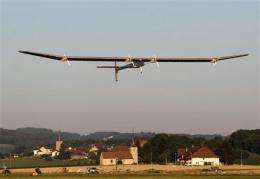
(AP) -- An experimental solar-powered plane whose Swiss makers hope someday to fly around the globe soared into uncharted territory Wednesday - the cold, dark night.
The team of adventurers and engineers behind the Solar Impulse project are already celebrating an aviation milestone for the longest solar flight after keeping the single-seat prototype aloft for almost 15 hours.
But with the goal of 24 hours of nonstop flight, the team set its sights on keeping the sleek aircraft with a 207-foot (63-meter) wingspan in the air until Thursday morning.
Pilot Andre Borschberg "will stay up there as long as possible," said Bertrand Piccard, the project's co-founder.
"Hopefully he will still be in the air at sunrise tomorrow. That is the challenge."
Borschberg took off from Payerne airfield into the clear blue sky shortly before 7 a.m. Wednesday, allowing the plane to soak up plenty of sunshine and fly in gentle loops over the Jura mountains west of the Swiss Alps.
As the sun set, technicians hoped the Solar Impulse's batteries - charged from the 12,000 solar cells fixed to the wings and body - would keep the four-engine plane engines airborne through the night. The batteries would begin charging again at dawn.
Earlier in the afternoon, Piccard told The Associated Press the flight was going "extremely well."
A record-breaking balloonist whose father and grandfather also accomplished pioneering airborne and submarine feats, Piccard has become the figurehead for the project and will be one of two pilots when it eventually takes off for its round-the-world attempt in 2013, with a scheduled five stops along the way.
Piccard said the night flight was a key step toward achieving that ultimate feat.
"The goal of the project is to have a solar-powered plane flying day and night without fuel," he said. "This flight is crucial for the credibility of the project."
At 9:30 p.m., Piccard told reporters that strong winds had pushed the plane off course, cutting the safety margin by one hour.
"If there is one hour missing tomorrow morning, it will be that hour," he said.
Should Borschberg or the team decide that it looks like the Solar Impulse won't make it through the night, the pilot will have the difficult task of landing the fragile aircraft before the batteries run out.
Borschberg was circling in Swiss airspace, first at 28,000 feet (8,535 meters) and then gently easing down through the night - always within gliding range of Payerne airport, so he can land if the plane runs out of energy, Piccard said. Still, the 57-year-old former Swiss fighter pilot is wearing a parachute - just in case.
Engineers in Payerne are closely monitoring every aspect of the aircraft, which has a thin fuselage and a wingspan of a Boeing 777 passenger jet. Its top speed is only 75 mph (120 kph) and it has no room for passengers or baggage, so it is as light and efficient as possible.
Piccard said the test flight - the third major step after its first "flea hop" and an extended flight earlier this year - will demonstrate whether the round-the-world trip is feasible.
The team had hoped to make its 24-hour test flight last week, when days in the northern hemisphere were even longer. But a problem with a key piece of communications equipment forced them to ground the plane while modifications were made.
Piccard, who achieved the first nonstop circumnavigation of the globe in a balloon, the Breitling Orbiter III, in 1999, said the next major step will be a solar Atlantic crossing. That will be done in a second, lighter prototype, because it will involve new challenges and dangers, he said.
Although the goal is to show that emissions-free air travel is possible, the team said it doesn't see solar technology replacing conventional jet propulsion any time soon. Instead, the project is designed to test and promote new energy-efficient technologies.
"Solar Impulse is a message as much as an airplane," he said.
More information:
Solar Impulse night flight page: http://www.solarimpulse.com/nightFlights/
Solar Impulse Twitter page: http://twitter.com/solarimpulse
©2010 The Associated Press. All rights reserved. This material may not be published, broadcast, rewritten or redistributed.


