Future looks sunny for Bangkok's tuk-tuks
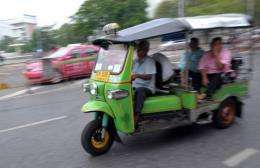
Prapai Hemsuwan gunned the engine of his emerald green three-wheeler, sending it into a fit of rasping coughs and causing clouds of black smoke to belch into the air.
"Life would be meaningless without the tuk-tuk," he said.
His beloved cart is one of nearly 8,000 auto rickshaws in Bangkok and their spluttering paroxysms -- the "tuk-tuk" name came from the sound made by an early model -- have become a key feature of city life.
But the brightly coloured buggies, most of which run on gasoline or natural gas, are facing increasing competition from more modern and greener modes of transport, raising questions over their future.
A sort of motorbike crossed with a tricycle and a tin can, the open-sided buggy exposes its passengers to blasts of exhaust fumes during a white-knuckle ride down sweltering, traffic-choked streets.
Set against air-conditioned and often cheaper taxis, as well as Bangkok's elevated sky train, the humble tuk-tuk looks like something of a relic.
But the creation of a new solar-powered model could see the three-wheelers accelerate into the 21st century.
The prototype cart is the brainchild of Air Marshal Morakot Charnsomruad, who hopes that his buggy could herald a cleaner, greener era on Bangkok's congestion-choked streets.
"It will help clean up our country -- everyone will want to drive it," he told AFP.
Morakot, a former armament and science chief for the Thai Air Force, is already selling electric versions across the world through his Clean Fuel Energy Enterprise.
The new tuk-tuk has a battery, but uses the sun's rays to supplement the power supply.
It is silent, emission-free and can run for 80 kilometres (50 miles) on a three hour battery charge costing 10 baht, compared with up to 60 kilometres for conventional models before they need refuelling.
Thrill-seekers will also be pleased to note that the solar version can reach speeds of about 60 kilometres per hour, even outstripping its gasoline-powered rival in a test sprint.
And, in a nod to the fact that many of those willing to expose themselves to the heady aroma of Bangkok's roads are Western tourists, the new cart has been designed with more leg room and a higher ceiling.
But while Thailand's climate means there is enough sunlight to keep the tuk-tuks on the road year-round, they have yet to make their commercial debut on Bangkok's streets.
City authorities stopped issuing new tuk-tuk licences in 2008, meaning manufacturers have focused on spare parts and exports.
Meanwhile, Thailand's Department of Pollution Control is set to produce new draft standards on three-wheeler emissions in three or four years' time, which will dictate what type of vehicles are acceptable on the road.
Although the authorities want electric models to replace traditional carts -- they can already be seen out and about -- the solar-powered version has not yet received the green light for commercial use.
And the authorities want to balance concerns over the contents of tuk-tuks' tanks -- some even run on cooking oil -- with sensitivity about drivers' needs.
"They have low incomes and if we are too strict on them they will have hard lives," an official said.
The solar machines would have a price tag of about 320,000 baht -- almost 10,000 dollars -- against 180,000 baht for a regular tuk-tuk, but Morakot hopes that eventually government subsidies would make them more affordable.
Greenpeace environmental campaigner Tara Buakamsri said while normal tuk-tuks contribute to pollution, electric and solar vehicles could play their part in "revolutionising Bangkok's way of life".
"Tuk-tuks can lead the way for a better and healthier transport system in Bangkok and the rest of the country," he said.
The tuk-tuk has been a feature of Bangkok's streets for decades.
The first arrivals were imported from Japan in the late 1950s, but Thailand soon began to produce its own cheaper version that quickly replaced pedal-driven three-wheeled bikes known as "samlors".
Despite an attempted ban in the 1960s, they have grown to become something of an unofficial symbol for Thailand.
Fugitive former premier Thaksin Shinawatra even presented a tuk-tuk to Zimbabwean leader Robert Mugabe while in office.
The solar tuk-tuk has already attracted its own political patronage, with current Prime Minister Abhisit Vejjajiva taking a recent sun-powered spin.
At the tuk-tuk rank near Bangkok's flower market, drivers were enthusiastic about the prototype.
Prapai, who has been driving a tuk-tuk for 20 years, was impressed with the look of the solar model and said he would be keen to use one -- as long as it could cope with the heavy loads he carries every day.
The 46-year-old delivers large bundles of vegetables, earning up to 1,500 baht a day after 100 baht spent on fuel.
Fellow driver Korakot Jansupi, 44, believes the tuk-tuk will adapt to remain a feature of Bangkok in the years to come.
"It's a unique symbol of Thailand," he said.
(c) 2010 AFP


