Berlin wants to cut solar power subsidies: lawmaker
Feb 23, 2010
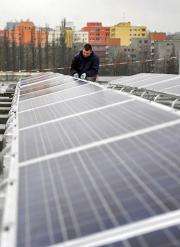
A worker adjusts the solar panels on the roof of the Max-Schmeling-Halle in Berlin in 2009. The German government wants to slash its support to the solar energy industry to prevent the market from overheating, a member of Chancellor Angela Merkel's CDU party said Tuesday.

The German government wants to slash its support to the solar energy industry to prevent the market from overheating, a member of Chancellor Angela Merkel's CDU party said Tuesday.

Germany guarantees good prices for solar panel owners who sell electricity, but the subsidies diminish progressively over 20 years and would be cut more sharply and eliminated altogether in certain cases under a new law, said Peter Altmaier, a CDU member that follows the sector.

is the world's leading market for , but the aid led to farmers installing them on arable fields and boosted the global market, which has in turn helped Chinese producers that have begun to hurt German rivals.

Under a draft law to be considered by Merkel's cabinet on March 3, state guaranteed prices would be cut by 15-16 percent for panels installed on the ground and on roofs.

Support would be eliminated altogether for those planted in fields that could also be used to grow crops.

In late January, Environment Minister Norbert Roettgen, also a CDU member, raised the idea of a 25 percent decrease in subsidies for panels on arable land, but in the end, policymakers decided to cut them completely.

"There must be no more panels installed on arable land," Altmaier said following a meeting of government coalition partners, the CDU and the liberal FDP party.

Experts say the subsidy fails to spur competition in the industry, which represents less than one percent of all in Germany, Europe's top economy.

would still be encouraged in industrial zones and along motorways and railways however.

Producing electricity with solar energy has become a lucrative business in Germany, with the guaranteed prices underwritten by fees shared by all consumers.

That costs consumers a billion euros (1.36 billion dollars) per month according to Hans-Peter Friedrich, a leader of the CDU's Bavarian sister party, the CSU.

And German manufacturers are seeing less and less benefit from the policy.

On Tuesday, the German group Q-Cells posted a 2009 net loss of 1.36 billion euros, on sales that fell by 35 percent to 801 million euros owing to plunging prices and increased competition.

The German group and rivals had enjoyed strong growth until now, with Q-Cells posting sales of just 17.3 million euros in 2002, a figure that topped one billion in 2008.

Last year it was forced to cut 500 jobs from a total workforce of 2,600 and move some production to Malaysia.

Explore further: Green conversion of heat to electricity

add to favorites email to friend print save as pdf

Related Stories

Asian competitors shadow German solar industry

Aug 18, 2009

Germany's solar power industry, until recently the world leader in the technology, is facing an unprecedented crisis, analysts say, outshone by cheaper competitors from Asia, most notably Chinese firms.

German high-tech sector holds up: trade group

Mar 02, 2009

Germany's high-tech industry expects to buck the economic crisis this year with sales stagnating but not sinking, its chief lobby group said on Monday on the eve of the giant CeBIT trade fair.

Greece's Largest Solar Roof in Athens Installed for Olympic Games

Aug 13, 2004

In time for the Olympic Games RWE SCHOTT Solar has begun operation of the country’s largest rooftop solar-energy unit in Athens. Supported by its Greek and German partners, this will help the company to further strengthen its market position in Greece. ...

Recommended for you

Green conversion of heat to electricity

5 hours ago

Soon, it will be possible to produce electricity from heat over 30 degrees emitted from a waste incinerator, refinery, or data processor. The start-up Osmoblue has just confirmed the feasibility of this new ...

Space drives e-mobility

6 hours ago

An ESA business incubation start-up company is helping major car manufacturers to develop electric vehicle concepts and improve safety systems by turning ideas quickly into virtual prototypes.

Philippines approves three new wind farms

May 20, 2013

The Philippines has approved three wind farm projects that will generate 208 megawatts, enough to power more than 40,000 middle-class homes, an energy official said on Monday.

User comments : 0

More news stories

Internet cable from Cuba to Jamaica comes online

A new branch of the Venezuela-to-Cuba undersea fiber-optic cable has reportedly come online, linking the island to nearby Jamaica, increasing Cuba's potential international communications bandwidth and providing a backup ...

Game system castAR debuts at Maker Faire

(Phys.org) —Two tech talents, formerly employees at video game publisher Valve, have been working on their own vision in the form of game-ready glasses. Their company, Technical Illusions, will seek to ...

Poll: Teens migrating to Twitter

A new poll finds that teens are sharing more about themselves on social media. They're also moving increasingly to Twitter to avoid their parents and the "oversharing" that they see on Facebook.