Smart Coating Opens Door To Safer Hip, Knee and Dental Implants
Feb 03, 2010
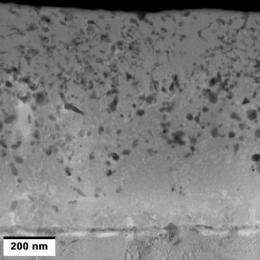
Cross-sectional transmission electron microscope image of the functionally graded smart coating with nano-silver particles distributed throughout the entire thickness of the coating. The crystalline nano-grains can be seen near the interface with the titanium implant and mostly amorphous layer on the top portion of the coating. Credit: Dr. Afsaneh Rabiei, North Carolina State University

(PhysOrg.com) -- Researchers at North Carolina State University have developed a "smart coating" that helps surgical implants bond more closely with bone and ward off infection.

When patients have hip, knee or dental replacement surgery, they run the risk of having their bodies reject the implant. But the smart coating developed at NC State mitigates that risk by fostering growth into the implant. The coating creates a crystalline layer next to the implant, and a mostly amorphous outer layer that touches the surrounding bone. The amorphous layer dissolves over time, releasing calcium and phosphate, which encourages bone growth.

"The bone grows into the coating as the amorphous layer dissolves, resulting in improved bonding, or osseointegration," says Dr. Afsaneh Rabiei, an NC State associate professor of mechanical and aerospace engineering, associate faculty member of biomedical engineering and co-author of a paper describing the research. This bonding also makes the implant more functional, because the bonding helps ensure that the bone and the implant do a better job of sharing the load.

"We call it a smart coating because we can tailor the rate at which the amorphous layer dissolves to match the bone growth rate of each patient," Rabiei says. This is important because people have very different rates of . For example, young people's bones tend to grow far faster than the bones of .

The researchers have also incorporated silver nanoparticles throughout the coating to ward off infections. Currently, implant patients are subjected to an intense regimen of antibiotics to prevent infection immediately following surgery. However, the site of the implant will always remain vulnerable to infection. But by incorporating silver into the coating, the silver particles will act as antimicrobial agents as the amorphous layer dissolves, Rabiei says. This will not only limit the amount of patients will need following surgery, but will provide protection from infection at the implant site for the life of the implant. Moreover, the silver is released more quickly right after surgery, when there is more risk of infection, due to the faster dissolution of the amorphous layer of the coating. Silver release will slow down while the patient is healing. "That is another reason why we call it smart coating," Rabiei says.

Explore further: Unique method creates correct mirror image of molecule

More information: The research, "Functionally graded hydroxyapatite coatings doped with antibacterial components," is published online by Acta BioMaterialia.

Related Stories

DNA layer reduces risk of reserve parts being rejected

Mar 20, 2007

Dutch researchers Jeroen van den Beucken and John Jansen have given body implants a DNA layer. This layer ensures a better attachment, more rapid recovery of the surrounding tissue and less immune responses. ...

Recommended for you

Unique method creates correct mirror image of molecule

22 hours ago

Many molecules have a right and a left form, just like shoes. In pharmaceuticals, it is important that the correct form of the molecule is used. Researchers at the University of Gothenburg, Sweden, have been ...

New method for producing clean hydrogen

May 21, 2013

Duke University engineers have developed a novel method for producing clean hydrogen, which could prove essential to weaning society off of fossil fuels and their environmental implications.

Non-wetting fabric drains sweat

May 20, 2013

(Phys.org) —Waterproof fabrics that whisk away sweat could be the latest application of microfluidic technology developed by bioengineers at the University of California, Davis.

Beautiful 'flowers' self-assemble in a beaker

May 16, 2013

By simply manipulating chemical gradients in a beaker of fluid, materials scientists at Harvard have found that they can control the growth behavior of crystals to create precisely tailored structures—such ...

User comments : 0

More news stories

DNA damage: The dark side of respiration

(Phys.org) —Adventitious changes in cellular DNA can endanger the whole organism, as they may lead to life-threatening illnesses like cancer. Researchers at LMU now report how byproducts of respiration cause mispairing ...

Unlocking secrets of cell reproduction

Research published in Open Biology today identifies, for the first time, nearly all the genes required for reproduction of a cell in a living organism.

Very Large Telescope celebrates 15 years of success

(Phys.org) —With this new view of a spectacular stellar nursery ESO is celebrating 15 years of the Very Large Telescope—the world's most advanced optical instrument. This picture reveals thick clumps ...

US House sends message on Keystone pipeline

US lawmakers agreed to a bill that would speed construction of a Canada-US oil pipeline and circumvent the need for President Barack Obama's approval for the $5 billion project.

Be prepared for weather extremes

Unsettled weather is an Iowa mainstay, and so is Inside's annual reminder of the university's severe weather safety and preparedness guidelines—for storms, extreme heat, flooding and more.