Japanese car wins World Solar Challenge in Australia (w/ Video)
Oct 28, 2009
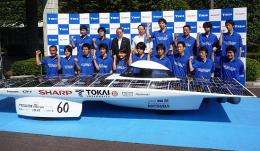
Tokai Challenger

A Japanese sun-powered car won the World Solar Challenge on Wednesday after averaging speeds of more than 100 kilometres (62 miles) per hour in a four-day race through Australia's desert Outback.

Organisers said the Tokai Challenger crossed the finish line in Adelaide, South Australia, at 3:39 pm local time, after 29 hours and 49 minutes' racing following Sunday's departure from the northern city of Darwin.

The futuristic Tokai put in a near-flawless run with only one flat tyre on the 3,000 kilometre race. Its nearest rivals were more than two hours behind and were due to battle it out for second place on Thursday.

This video is not supported by your browser at this time.

The team, from Tokai University, averaged 100.54 kilometres per hour to snap a four-race winning streak by the Netherlands' Nuon outfit. It is the first Japanese victory since Dream II in 1993.

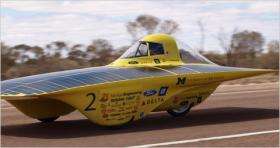
The Infinium, from the University of Michigan, is in third place in Australia.

The World Solar Challenge, aimed at promoting environmentally friendly , started in 1987 and runs every two years.

More information: globalgreenchallenge.com.au/

(c) 2009 AFP

Explore further: Juiced roads: Volvo explores electric power for trucks, buses

add to favorites email to friend print save as pdf

Related Stories

Japanese solar car leads race Down Under

Oct 26, 2009

Japan's Tokai Challenger was on Monday leading a solar car race across the harsh Australian Outback, having covered about half of the 3,000 kilometre (1,860 mile) desert course, officials said.

Mirror technology propels 2007 U-M Solar Car team

Oct 15, 2007

Mirrors hold the hopes of the 2007 University of Michigan Solar Car Team. The storied student organization with more than 100 members has a potentially game-changing car design for the upcoming Panasonic World Solar Challenge, ...

Ladies and Gentlemen, Start Your Solar Cars!

Jul 11, 2005

High school students from across the country and Mexico are on a 1,600-mile race in hand-built, solar-powered cars. The 10th annual Dell-Winston School Solar Car Challenge started today in Round Rock, Texas, ...

Solar car aims to put rivals in the shade

Apr 06, 2009

(PhysOrg.com) -- Plans for a solar-powered racing car which will cruise at 60mph using the same power as a hairdryer have been unveiled by students at Cambridge University.

Recommended for you

Japan formally OKs new nuke safety requirements

59 minutes ago

Japan's nuclear watchdog formally approved a set of new safety requirements for atomic power plants Wednesday, paving the way for the reopening of facilities shut down since the Fukushima disaster.

Cape Wind gets $200M investment from Danish fund

4 hours ago

The Cape Wind offshore wind project has secured a $200 million investment from a Danish pension fund in what the wind farm's president said Tuesday is a milestone for the long-delayed project.

Toxic radiation in groundwater at Fukushima: operator

7 hours ago

Cancer-causing radioactive substances have been found in groundwater at the crippled Fukushima nuclear plant, its Japanese operator said on Wednesday, as it pledged to prevent it getting into the sea.

Poland may delay launch of nuclear plants

17 hours ago

Poland could delay building its first nuclear power plants as natural gas, including shale gas, becomes less costly, the prime minister of the central European heavyweight said Tuesday.

User comments : 2

Adjust slider to filter visible comments by rank

Display comments: newest first

VOR
5 / 5 (1) Oct 28, 2009
I think we should call them solar-powered tricycles. (given thier ultra-light weight etc)
david_42
not rated yet Oct 28, 2009
Terminology hardly matters, as these vehicles are showcases for technology. It's nice to have them around as references for people who are unable to understand the limitations of solar.

Pity the source website is so badly design it's nearly impossible to find any of the details on the cars.

A little research shows that the winner had the highest efficiency cells available, which makes sense.

More news stories

Japan formally OKs new nuke safety requirements

Japan's nuclear watchdog formally approved a set of new safety requirements for atomic power plants Wednesday, paving the way for the reopening of facilities shut down since the Fukushima disaster.

Multiview 3-D photography made simple

Computational photography is the use of clever light-gathering tricks and sophisticated algorithms to extract more information from the visual environment than traditional cameras can.

Sound waves precisely position nanowires

(Phys.org) —The smaller components become, the more difficult it is to create patterns in an economical and reproducible way, according to an interdisciplinary team of Penn State researchers who, using ...