Cambridge University Eco Racing solar car drive across Britain
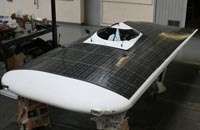
This year Cambridge University Eco Racing (CUER) have designed and built the UK's first road legal solar car.
CUER was formed in January 2007 and now consists of over forty Cambridge University students including Engineers, Judge Business School MBAs, Economists and Natural Scientists. The student team is supported by Professor Peter Guthrie, the Project Ambassador, and final year project supervisors from the Department.
On 8 June 2008 CUER embarked on the first solar-powered journey from Land's End to John O'Groats: the 'End to End trip'. The 934 mile route is being undertaken in the CUER prototype vehicle Affinity, which is thought to have a top speed of around 50-60mph.
During the week long journey the team aims to engage and educate the public in the area of sustainable transportation by displaying the car at schools and public attractions. Scheduled stops include the city centres of Edinburgh and York, as well as the Eden Project in Cornwall.
Team captain Martin McBrien said, "Designing and building the car has been an exhilarating experience for all involved, with the many ups and downs, late nights, and breakthrough moments making the whole project worthwhile. Underpinning everything is the knowledge that the technologies being applied - batteries, electric motors, advanced materials and photovoltaics - will become more and more relevant. Sustainable transportation is no longer an issue for the future, but for today. With oil at $135 a barrel, proving that travelling on free energy from the sun is possible brings real hope."
Jia-Yan Gu, CUER Outreach Officer, said, "We're really excited about the opportunity to engage with school children and the public along the End to End route. We want to spread our enthusiasm about applying technology to help solve environmental issues."
In January 2009 CUER will face another challenge: Zero Rally Africa, a carbon-neutral rally crossing Zambia, Namibia and South Africa. Affinity will be put to the test travelling roughly 2,500 miles from Victoria Falls to Cape Town in this 10 day endurance challenge. CUER will then develop a second vehicle to compete in the World Solar Challenge in Australia in October 2009.
The challenge is to design and build a Solar Electric Vehicle to complete a gruelling 1,850 mile race across the Australian outback using solar energy as the only fuel. Through taking part in these high profile and demanding challenges CUER aims to inspire and inform the public.
For the latest news from the CUER team on their End-to-End journey, see their online blog.
Source: Cambridge University


