The future of solar-powered houses is clear
Apr 10, 2008
The future of solar-powered houses is clear
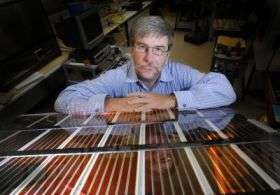
Professor John Bell with a pane of the solar cell glass. Credit: QUT/Erika Fish

The future of solar-powered houses is clear. People could live in glass houses and look at the world through rose-tinted windows while reducing their carbon emissions by 50 percent thanks to QUT Institute of Sustainable Resources research.

Professor John Bell said QUT had worked with a Canberra-based company Dyesol, which is developing transparent solar cells that act as both windows and energy generators in houses or commercial buildings.

He said the solar cell glass would make a significant difference to home and building owners’ energy costs and could in fact generate excess energy that could be stored on onsold.

Professor Bell said the glass was one of a number of practical technologies that would help combat global warming which was a focus of research at the ISR.

“The transparent solar cells have a faint reddish hue but are completely see-through,” Professor Bell said.

“The solar cells contain titanium dioxide coated in a dye that increases light absorption.

“The glass captures solar energy which can be used to power the house but can also reduce overheating of the house, reducing the need for cooling.”

Professor Bell said it would be possible to build houses made entirely of the transparent solar cells.

“As long as a house is designed throughout for energy efficiency, with low-energy appliances it is conceivable it could be self-sustaining in its power requirements using the solar-cell glass,” he said.

“Australian housing design tends to encourage high energy use because electricity is so cheap.

“But it is easy to build a house that doesn’t need powered cooling or heating in Queensland.”

Professor Bell said the solar cell glass was the subject of two Australian Research Council Linkage grants to QUT researchers to investigate ways to increase its energy absorption and to reduce the effects of “shadowing”, where overcast skies and shadwos from trees or other buildings can cause loss of collected power.

He said the glass would be on the market a few years.

Source: Queensland University of Technology

Explore further: US official: Solar plane to help ground energy use (Update)

add to favorites email to friend print save as pdf

Related Stories

Organic polymers show sunny potential

May 29, 2013

(Phys.org) —A new version of solar cells created by laboratories at Rice and Pennsylvania State universities could open the door to research on a new class of solar energy devices.

A solar booster shot for natural gas power plants

Apr 12, 2013

Natural gas power plants can use about 20 percent less fuel when the sun is shining by injecting solar energy into natural gas with a new system being developed by the Department of Energy's Pacific Northwest ...

Chaos proves superior to order

May 07, 2013

An international team of physicists, including researchers from the Universities of York and St. Andrews, has demonstrated that chaos can beat order - at least as far as light storage is concerned.

A liquid crystal force to reckon with

May 02, 2013

A need for fast, solution-based processing of organic electronic devices has sparked increased interest in 'discotic' or disc-shaped liquid crystals. These molecules, which contain a flat aromatic core surrounded ...

Collaboration aims to harness the energy of 2,000 suns

Apr 22, 2013

Today on Earth Day, scientists have announced a collaboration to develop an affordable photovoltaic system capable of concentrating, on average, the power of 2,000 suns, with an efficiency that can collect ...

Recommended for you

Solar-powered plane lands near Washington (Update)

Jun 16, 2013

A solar-powered plane nearing the close of a cross-continental journey landed at Dulles International Airport outside the nation's capital early Sunday, only one short leg to New York remaining on a voyage ...

For solar pilot, human endurance is the sky's limit

Jun 14, 2013

Pilot Andre Borschberg oversaw the construction of a solar plane that can fly through the night, but these days the entrepreneur is more concerned with the limits of man than of technology.

Recycling Europe's three million tonnes of tyre waste

Jun 14, 2013

With up to 70 percent of used tyres ending up in landfills, there is an opportunity to find other ways of recycling this material, and in turn reduce the environmental damage. The EU-funded TyGRE project ...

User comments : 2

Adjust slider to filter visible comments by rank

Display comments: newest first

Zig158
not rated yet Apr 12, 2008
This is just stupid. Does he have any idea how much all that glass would cost? What about thunderstorm or high winds.
Cyril
not rated yet Jul 09, 2008
When manufactured well, glass can be made very durable. I have a large glass wall on the east side of the building. Passive solar energy in the morning, heats up the house nicely. No windows on the south so it doesn't get too hot by noon. High thermal mass keeps the house comfortable. And glass is very cheap actually, compared ot other building materials. Bricks are cheap but you need a lot of them to build a wall, and it takes a lot of labor. Windows are cheaper than brick walls in most cases (supportive walls are a different story)

More news stories

New language discovery reveals linguistic insights

A new language has been discovered in a remote Indigenous community in northern Australia that is generated from a unique combination of elements from other languages. Light Warlpiri has been documented by University of Michigan ...