Using 3-D printing to turn computer models into reality (w/ video)
Mar 19, 2013 by Steve Koppes
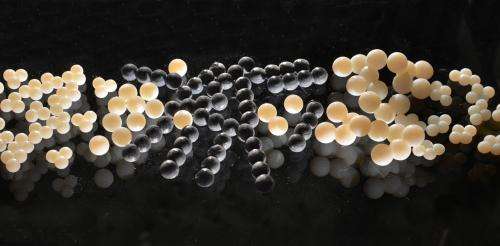
Graduate student Marc Miskin manufactured granular materials of various shapes in a 3D printer to test their aggregate properties when jammed into a confined space. Credit: Robert Kozloff/University of Chicago

Prof. Heinrich Jaeger's research group examines materials and phenomena that appear simple at the surface, but which reveal tremendous complexity upon close examination. One such phenomenon is jamming, in which aggregates of randomly placed particles, including spheres or more complicated shapes, or even molecules, transition from fluid-like to solid-like behavior.

Jamming lends itself to soft robotics, in addition to other applications as explored in a workshop at the University of Chicago last October. In recent and experiments, Jaeger, the William J. Friedman & Alicia Townsend Professor in Physics, and graduate student Marc Miskin investigate another aspect of jamming. They analyzed how the properties of a jammed material can be tuned by changing the shape of the constituent particles. Their results on "Adapting granular materials through artificial evolution" appeared Jan. 20 as an Advance Online Publication in Nature Materials.

This video is not supported by your browser at this time.

Miskin and Jaeger addressed a daunting question in their research: Given a design goal for the jammed aggregate, for example to have it as stiff or as soft as possible in response to an applied force, what particle shape will best produce the desired outcome? For this complex optimization problem, they faced an infinite variety of shapes to choose from. So Miskin employed a computer algorithm—referred to as an "evolutionary optimization" in the accompanying video—to answer this question.

The computer designed particles by starting from a random shape, and then iteratively altered its configuration, at each stage performing a series of simulations that tested how close the performance approximated the stated goal. Once an optimal shape was identified, Miskin then manufactured a large number of copies with the lab's 3D printer for testing in a viselike squeezing apparatus to verify his algorithm's predictions.

Explore further: Scientists discover that shape matters in DNA nanoparticle therapy

More information: www.nature.com/nmat/journal/vaop/ncurrent/full/nmat3543.html

Related Stories

Images capture split personality of dense suspensions

Mar 30, 2012

Stir lots of small particles into water, and the resulting thick mixture appears highly viscous. When this dense suspension slips through a nozzle and forms a droplet, however, its behavior momentarily reveals ...

Recommended for you

Sensitive bomb detector to rove in search of danger

6 hours ago

European researchers have developed and tested a light-weight device capable of detecting extremely minute quantities of explosives from up to 20 metres away, providing an invaluable law-enforcement tool ...

How soon could car seats enter the 3-D comfort zone?

May 23, 2013

New 3D textiles made of recyclable polyester fibres could contribute help cars be easier to recycle. But recycling technology has yet to progress in separating seat material from other car components.

NASA: Austin, calling Austin. 3-D pizzas to go

May 22, 2013

(Phys.org) —The idea of living with 3-D printed food is neither unthinkable nor new; designers and futurists have been looking to 3-D printing as food's next frontier. In 2012, there was news that the Thiel ...

User comments : 0

More news stories

Drones may violate international law

(Phys.org) —As President Obama gives a speech on national security—including defending U.S. use of drones to combat terrorism—Leila Sadat, JD, international law expert and professor of law at Washington University in ...

The long road to the 2000-watt society

The vision of a society in which each inhabitant of the earth manages to consume only 2000 watts has already been around for 15 years. During this time, there has been a steady increase in environmental awareness ...

Dark, massive asteroid to fly by Earth on May 31

It's 1.7 miles long. Its surface is covered in a sticky black substance similar to the gunk at the bottom of a barbecue. If it impacted Earth it would probably result in global extinction. Good thing it is ...

ACOG: Hormone therapy not recommended to prevent CHD

(HealthDay)—Menopausal hormone therapy should not be used for prevention of coronary heart disease, according to a Committee Opinion from the American College of Obstetricians and Gynecologists (ACOG) published ...

Storm chasers: born to be wild?

(HealthDay)—We've all seen them: the surfers who race to the beach when a hurricane hits, the guy who decides to ride out the storm in his overmatched boat, the tornado chasers who fearlessly steer their ...